

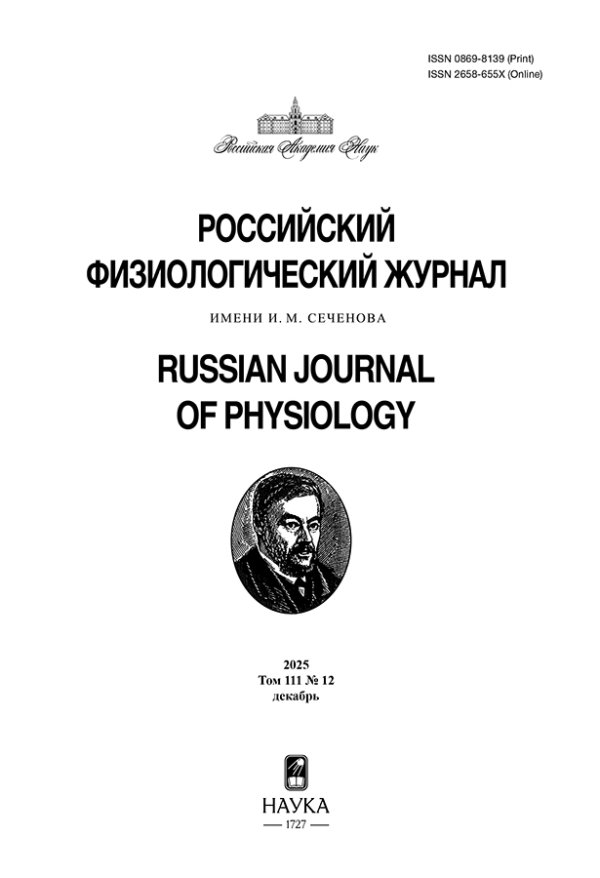
Russian Journal of Physiology

Russian Journal of Physiology (p-ISSN 0869-8139, e-ISSN 2658-655X) is issued monthly and publishes the works in all fields of physiology and physiological aspects of related sciences — zoology, anatomy, histology, embryology, molecular biology, biochemistry.

The journal is peer-reviewed and is included in the VAK list of journals for publishing the works of degree candidates. Currently, the papers are indexed in the VINITI, RISC (elibrary.ru), EBSCO, Google Scholar, and RSCI (on the Web of Science platform) databases. The papers are submitted in electronic form.

Articles are translated and published in the Journal of Evolutionary Biochemistry and Physiology (indexed in WoS, impact factor (2022) - 0.6).

The chief editor is a member of the RAS L.G. Magazanik

Media registration certificate: ПИ № ФС 77 – 67154 от 16.09.2016

最新一期

开放存取 开放存取  受限制的访问 ##reader.subscriptionAccessGranted##  受限制的访问 订阅存取

卷 111, 编号 12 (2025)

封面

完整期次

开放存取 开放存取
受限制的访问 ##reader.subscriptionAccessGranted##
受限制的访问 订阅存取

REVIEW

Relationship between Obesity Phenotype and Hormonal Disorders
Babenko A.
摘要
In studies in recent years, changes underlying metabolically unhealthy visceral obesity and leading to the development of cardiometabolic risk factors are defined as a state of uncontrolled secretion of adipokines and cytokines by increased visceral adipose tissue. Meanwhile, deviations in the production of a number of hormones can cause an increase in the amount of fat in the body and contribute to the formation of different phenotypes of obesity with different options for the distribution of adipose tissue. This review summarizes current information on key hormones whose level changes may contribute to obesity and affect body composition. It also summarizes hormonal changes resulting from the development of obesity (ghrelin, leptin, adiponectin, estrogens, androgens and others). A feature of this review is a comparative analysis of sex differences in the role and contribution of hormones to energy metabolism, the pathogenesis of obesity and the formation of different phenotypes. Identifying hormonal profiles that characterize different obesity phenotypes will improve diagnostics, prognosis, and personalized treatment of this pandemic.
Russian Journal of Physiology. 2025;111(12):1880-1906
pages 1880-1906 views
Allosteric Regulators of the Thyroid-Stimulating Hormone Receptor – New Horizons in the Pharmacology of Thyroid Pathology
Shpakov A., Derkach K.
摘要
The thyroid stimulating hormone receptor (TSHR) expressed in the thyroid gland is a key component of the TSH-regulated signaling system responsible for the synthesis of thyroid hormones and the growth and proliferation of thyroid cells. The TSH receptor is also present in some non-thyroid tissues (bone tissue, orbital fibroblasts, etc.), controlling their physiological functions. It has a large ectodomain containing a high-affinity orthosteric site that binds TSH and autoantibodies to TSHR, as well as a transmembrane domain containing a significant number of allosteric sites with different localizations. Activation of TSHR by the hormone leads to the launch of a large number of signaling cascades mediated through various types of G proteins and β-arrestins. The selectivity and efficiency of activation of these cascades are largely determined by allosteric mechanisms, which include the formation of TSHR complexes, the effect on TSH signaling of the “internal” agonist localized at the C-terminus of the hinge loop of the TSHR ectodomain, and the N-glycosylation status of TSH. Changes in TSHR activity are the causes of a large number of thyroid diseases and other pathologies, but at present TSHR regulators are practically not used in medicine. Other therapy is not directly targeted at TSHR, which is associated with many of their side effects. Since the use of ligands of the TSHR orthosteric site carries significant risks, the attention of researchers is attracted by ligands of its allosteric sites, including those localized in the transmembrane channel. They have a wide profile of pharmacological activity, including regulators with their own activity (direct and inverse agonists, and neutral antagonists), modulators of TSH effects (PAM, NAM, SAM, and BAM) and regulators with combined activity (ago-PAM, ago-NAM). Allosteric ligands are endowed with moderate activity, without causing hyperactivation or complete blockade of TSHR, in many cases demonstrate selectivity for certain signaling cascades, and retain activity when administered orally. Thus, they can be used to treat various thyroid diseases, including Graves' disease, Hashimoto's thyroiditis, primary hypothyroidism, adenomas and thyroid cancer, as well as Graves' ophthalmopathy and diseases of the musculoskeletal system. The review systematizes and analyzes data on low-molecular allosteric regulators of TSHR developed by us and other authors, and assesses the prospects for their use in the clinic.
Russian Journal of Physiology. 2025;111(12):1907–1932
pages 1907–1932 views

EXPERIMENTAL ARTICLES

Hormonal Profile of the Offspring of Prenatally Stressed Male Rats with Modeling of Post-traumatic Stress Disorder during Spermatogenesis
Pivina S., Akulova V., Kholova G., Ordyan N.
摘要
Currently, there is an increasing number of studies demonstrating the transgenerational effects of maternal and paternal stress on various functions of offspring. The effects of maternal (prenatal) stress can be transmitted to the next generations of the offspring through the male line. Various psychopathologies in men, such as posttraumatic stress disorder (PTSD), manifest themselves in their children as various disorders after birth. In this regard, the aim of the present study was to investigate the consequences of PTSD modeling (the “stress-restress” paradigm) in prenatally stressed (PS) male rats before mating with intact females on the activity of the hypothalamic-pituitary-adrenocortical axis (HPA) and the blood content of sex hormones in the offspring of both sexes. The study was performed not only on the offspring of PS males and the offspring of PS males with PTSD modeling before conception, but also on similar groups of the offspring obtained from control males. It is shown that already on the 5th day of life, a change in the HPA axis activity is observed in the offspring of stressed males, mainly in the offspring of males. In sexually mature offspring, regardless of gender and the group of stressed fathers, a decrease in the basal and stress activity of the HPA axis and its accelerated inhibition after stress activation were found. A decrease in the testosterone level was found in the offspring of control and PS males with PTSD modeling, and a decrease in the estradiol level in females – the offspring of PS males with PTSD modeling. It is concluded that the effects of PTSD modeling in male rats during spermatogenesis on the HPA axis activity of their sexually mature offspring are similar and do not depend on the sex of the offspring or whether the males were stressed prenatally. A similar effect of the PTSD-like state of male fathers has on the testosterone level of their offspring, which can reduce their reproductive abilities in unfavorable environmental conditions.
Russian Journal of Physiology. 2025;111(12):1933-1946
pages 1933-1946 views
Effect of Granulocyte Colony-Stimulating Factor Liposomal Form on the Expression of Genes Associated with Chronic Endometritis
Ryzhov J., Obedkova K., Khalenko V., Gzgzyan A., Tapilskaya N.
摘要
The classic function of granulocyte colony-stimulating factor (G-CSF) is the regulation of neutrophil growth and differentiation, but G-CSF is one of the cytokines which plays important roles in folliculo- and embryogenesis, embryo implantation and trophoblast invasion. G-CSF administration may have beneficial effect on outcomes after assisted reproductive technology (ART). The intervention of administration G-CSF into the uterine cavity in patients with chronic endometritis or/and repeated implantation failures increases the pregnancy rate, but mechanisms of action G-CSF on endometrial receptivity are not clear. The study involved 22 patients with infertility, unsuccessful ART attempts and thin endometrium who received intrauterine administrations of liposomal G-CSF twice a week for 6 months as chronic endometritis therapy. Real-time PCR was used to determine the expression of TVP23A, IL10, TGF-β1 genes in endometrial biopsies before and after 6 months of treatment with liposomal G-CSF. Intrauterine liposomal G-CSF administration significantly reduced the expression of the TVP23A gene (p < 0.001), and increased the expression of the IL10 (p < 0.001) and TGF-β1 (p < 0.001) genes in the endometrium. A significant (p < 0.001) increase in endometrial thickness (M-echo) from 5.6 ± 0.6 to 6.8 ± 0.8 mm was observed. The obtained data demonstrate that therapy of chronic endometritis with intrauterine administration of liposomal form of G-CSF during 6 months normalizes the expression of a number of genes associated with chronic inflammation of the endometrium.
Russian Journal of Physiology. 2025;111(12):1947-1959
pages 1947-1959 views
Role of the Oxytocinergic System in Correcting Neurogenic Impairments Induced by Early Life Stress: an in vitro Study
Khilazheva E., Lukyanchuk A., Panina Y., Lopatina O., Malinovskaya N., Blagova A., Salmina A., Komleva Y.
摘要
Early life stress (ELS) induces long-term changes in neuroplasticity which are associated with dysfunction of the oxytocinergic system. However, the molecular mechanisms of such impairments as well as the possibilities of their correction remain poorly understood. In this study, we investigated the effects of ELS, exogenous oxytocin (OXT), and an oxytocin receptor antagonist (atosiban) on cellular processes associated with homeostasis and neurogenesis in neurospheres in vitro. Neurospheres were isolated from the subventricular zone and pyriform cortex of CD1 mice (age P60) in the control and ELS groups, followed by exposure to oxytocin (OXT, 1 μM) or atosiban (1 μM). The level of apoptosis, the DNA damage (H2AX) and the expression of neurogenesis associated genes PSA-NCAM, Dcx, Tbr1, Gad67 and Vglut1 (qRT-PCR) were then quantitatively assessed. The data obtained showed that ELS increased the number of apoptotic cells and decreased the expression of PSA-NCAM, Dcx and Gad67 genes, while OXT improved apoptotic indices, but had no effect on the expression of the studied genes, with the exception of a decrease in Tbr1. In control group, OXT increased the expression of PSA-NCAM and Tbr1, while simultaneously decreasing the level of Gad67, which may reflect its regulatory effect on the balance of excitatory and inhibitory transmission in the developing neuronal network. Atosiban stimulation, however, resulted in increased apoptosis in control samples, highlighting the role of oxytocinergic activity in maintaining neuronal viability even in the absence of stress. These data indicate that ELS causes long-term impairments of neurogenesis and cellular homeostasis, and the modulating effect of OXT depends on the initial state of the cells. These results highlight the potential role of the oxytocinergic system in correcting the consequences of early life stress.
Russian Journal of Physiology. 2025;111(12):1960–1973
pages 1960–1973 views
A Comparative Study of Dehydroepiandrosterone-Induced Polycystic Ovary Syndrome Models in Immature and Prepubertal Female Rats
Pechalnova A., Derkach K., Morina I., Zorina I., Bayunova L., Romanova I., Chernenko E., Shpakov A.
摘要
Polycystic ovary syndrome (PCOS), one of the most common endocrine disorders in women, leads to reduced reproductive potential and infertility. Rodent models, including those induced by dehydroepiandrosterone (DHEA), are used to study PCOS. However, they have not been sufficiently studied, including in terms of ovulation stimulation in PCOS rats by luteinizing hormone (LH) agonists, and this complicates their use in developing approaches for the treatment of PCOS. The aim of the work was to comparatively study and characterize the morphological and biochemical parameters in animals with two most commonly used models of PCOS, induced by six-week treatment of immature (23–25 days) and three-week treatment of prepubertal (45–47 days) female rats with DHEA, and to evaluate the effectiveness of ovulation stimulation in PCOS rats using TP03, a low-molecular-weight LH receptor agonist developed by us. Six-week treatment of immature female rats with DHEA resulted in the development of polycystic ovary morphology, decreased blood progesterone levels, and decreased expression of ovarian genes encoding key steroidogenic proteins (CYP11A1, CYP17A1) and the metalloproteinase ADAMTS-1, a marker of ovulation. Treatment with TP03 increased progesterone levels, enhanced expression of the Cyp11a1, Cyp17a1, and Adamts-1 genes, and led to the formation of corpora lutea (CL), but a significant proportion of these were luteinized unruptured follicles. Three-week treatment of prepubertal female rats with DHEA also resulted in the characteristic features of PCOS, but had a lesser effect on Adamts-1 gene expression and did not induce the formation of defective CL upon stimulation with TP03. In this case, two subgroups were identified among PCOS rats – those with relatively low and those with high progesterone levels. They differed significantly in Cyp17a1 gene expression and in the efficiency of new cycle adipose tissue formation after TP03 treatment. Thus, the longer-term DHEA-induced PCOS model in immature female rats is well suited for studying functional impairments in severe forms of PCOS, while the PCOS model generated in prepubertal rats by three-week DHEA treatment is more suitable for studying moderate forms of PCOS and optimizing the choice of ovulation stimulants effective in this disease.
Russian Journal of Physiology. 2025;111(12):1974-1990
pages 1974-1990 views

FROM THE SPECIAL ISSUE EDITOR

ENDOCRINE REGULATION: PROGRESSIVE TRANSFORMATION OF IDEAS AND APPROACHES
Shpakov A.
摘要
В специальный выпуск «Функционирование эндокринной системы в норме и при патологии» вошли статьи, отражающие трансформацию устоявшихся представлений в области эндокринологии. Современная эндокринология, обогащенная методами геномики, протеомики и биоинформатики, стала одной из самых динамично развивающихся областей физиологии и медицины.
Russian Journal of Physiology. 2025;111(12):1877-1879
pages 1877-1879 views

Согласие на обработку персональных данных с помощью сервиса «Яндекс.Метрика»

1. Я (далее – «Пользователь» или «Субъект персональных данных»), осуществляя использование сайта https://journals.rcsi.science/ (далее – «Сайт»), подтверждая свою полную дееспособность даю согласие на обработку персональных данных с использованием средств автоматизации Оператору - федеральному государственному бюджетному учреждению «Российский центр научной информации» (РЦНИ), далее – «Оператор», расположенному по адресу: 119991, г. Москва, Ленинский просп., д.32А, со следующими условиями.

2. Категории обрабатываемых данных: файлы «cookies» (куки-файлы). Файлы «cookie» – это небольшой текстовый файл, который веб-сервер может хранить в браузере Пользователя. Данные файлы веб-сервер загружает на устройство Пользователя при посещении им Сайта. При каждом следующем посещении Пользователем Сайта «cookie» файлы отправляются на Сайт Оператора. Данные файлы позволяют Сайту распознавать устройство Пользователя. Содержимое такого файла может как относиться, так и не относиться к персональным данным, в зависимости от того, содержит ли такой файл персональные данные или содержит обезличенные технические данные.

3. Цель обработки персональных данных: анализ пользовательской активности с помощью сервиса «Яндекс.Метрика».

4. Категории субъектов персональных данных: все Пользователи Сайта, которые дали согласие на обработку файлов «cookie».

5. Способы обработки: сбор, запись, систематизация, накопление, хранение, уточнение (обновление, изменение), извлечение, использование, передача (доступ, предоставление), блокирование, удаление, уничтожение персональных данных.

6. Срок обработки и хранения: до получения от Субъекта персональных данных требования о прекращении обработки/отзыва согласия.

7. Способ отзыва: заявление об отзыве в письменном виде путём его направления на адрес электронной почты Оператора: info@rcsi.science или путем письменного обращения по юридическому адресу: 119991, г. Москва, Ленинский просп., д.32А

8. Субъект персональных данных вправе запретить своему оборудованию прием этих данных или ограничить прием этих данных. При отказе от получения таких данных или при ограничении приема данных некоторые функции Сайта могут работать некорректно. Субъект персональных данных обязуется сам настроить свое оборудование таким способом, чтобы оно обеспечивало адекватный его желаниям режим работы и уровень защиты данных файлов «cookie», Оператор не предоставляет технологических и правовых консультаций на темы подобного характера.

9. Порядок уничтожения персональных данных при достижении цели их обработки или при наступлении иных законных оснований определяется Оператором в соответствии с законодательством Российской Федерации.

10. Я согласен/согласна квалифицировать в качестве своей простой электронной подписи под настоящим Согласием и под Политикой обработки персональных данных выполнение мною следующего действия на сайте: https://journals.rcsi.science/ нажатие мною на интерфейсе с текстом: «Сайт использует сервис «Яндекс.Метрика» (который использует файлы «cookie») на элемент с текстом «Принять и продолжить».