
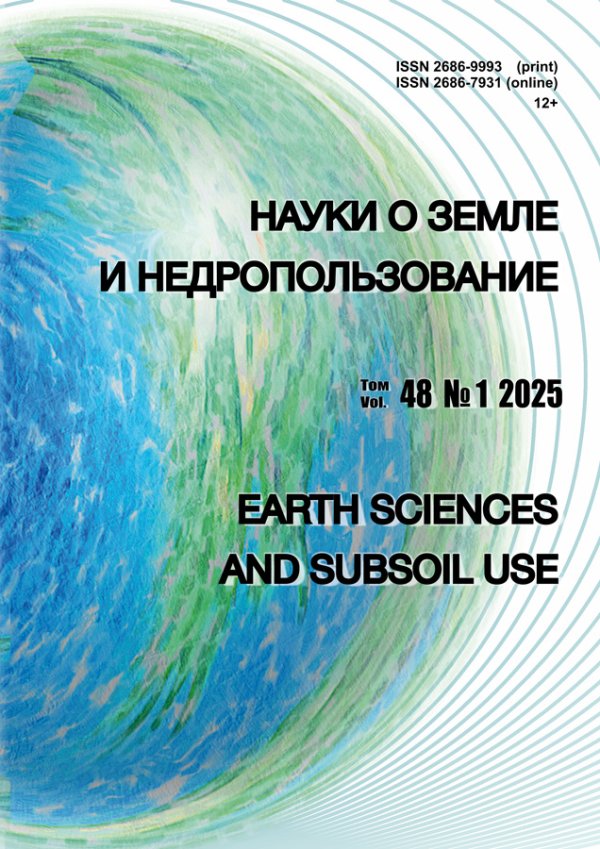
Earth sciences and subsoil use

The Earth sciences and subsoil use journal is established on the basis of the Interuniversity collected papers "Geology, prospecting and exploration of ore mineral deposits" that has been published by IPU (later, ISTU, and then, INRTU) since 1973. In 2004–2017, the journal had the title "Proceedings of the Siberian Department of the Section of Earth Sciences of the Russian Academy of Natural Sciences. Geology, Prospecting and Exploration of Ore Deposits", and in 2017-2019, "Proceedings of the Siberian Department of the Section of Earth Sciences of the Russian Academy of Natural Sciences. Geology, Exploration and Development of Mineral Deposits". Finally, in 2019, due to the involvement of a wide range of researchers dealing with extraction and processing of minerals, the journal took the title "Earth sciences and subsoil use".
The journal periodicity is 4 times a year.

Founder: Federal State Budget Educational Institution of Higher Education "Irkutsk National Research Technical University".

Publisher: Federal State Budget Educational Institution of Higher Education "Irkutsk National Research Technical University". The Publisher is the member of the Association of Scientific Editors and Publishers (ASEP).

Printing house: Federal State Budget Educational Institution of Higher Education "Irkutsk National Research Technical University".

Editor-in-Chief: Alexander Parshin, Cand. Sci. (Geol. & Mineral.), Prefessor.
Deputy Editor-in-Chief: Larisa Auzina, Cand. Sci. (Geol. & Mineral.), Associate Professor.


The Earth sciences and subsoil use journal:

  • is registered by the Federal Communications, Information Technologies and Mass Media Regulatory Authority (Roskomnadzor), Registration No.: PI no. FS77-76110 of June 24, 2019 (extract from the State media register of 28.06.2019);
  • is included in the GeoRef database;
  • is on the List of leading scientific journals and publications on the main results of candidate's and doctoral theses;
  • is included in the Scientific Electronic Library (eLibrary.ru);
  • is included in the electronic library CyberLeninka, in the electronic library system Lan;
  • is included in Ulrich's Periodicals Directory;
  • is included in the EBSCO reference database;
  • is included in the OAJI open access scientific journals database;
  • is distributed to the Russian Book Chamber, All-Russian Institute for Scientific and Technical Information of the Russian Academy of Sciences, leading higher educational institutions, and through the catalog of JSC "Economic Newspaper" Publishing House "The united catalog. Russian press. Newspapers and journals".

Edição corrente

Volume 48, Nº 1 (2025)

Capa

Edição completa

Geoecology

On study results of atmospheric air quality in Irkutsk-2 microdistrict and Bokovo settlement (Irkutsk, Southwestern Baikal Region) using snow geochemical survey
Kachor O., Parshin A., Ikramov Z., Trusova V., Kurina A.
Resumo
The study of snow cover is an informative method for the comprehensive assessment of atmospheric air pollution from various man-made sources applicable to a vast area of the northern territories featuring long winter. At the same time, improving the methodology of snow geochemical surveying helps optimize the solution of such urgent tasks of developing and preserving geosystems in northern regions as assessing the background state of the environment before starting new infrastructure or mining projects, monitoring the impact of explored objects on natural and anthropogenic complexes. The purpose of the study is to assess the ecological state of the air in the Irkutsk-2 microdistrict and in Bokovo settlement (Irkutsk, Southwestern Baikal Region, Eastern Siberia) adjacent to it. The relevance of the study is related to the currently increased frequency of organoleptic and instrument detection of atmospheric pollution, which causes the residents’ dis content. A detailed snow and geochemical survey was carried out to identify and map the areas and the impact degree of the main known economic facilities, as well as identify potential new sources. The research involved taking seasonal snow samples, study of the chemical composition of the solid phase of the snow cover in the area under investigation, as well as mapping the distribution of various pollutants, and interpretation of the data obtained. The article presents the main results of the study in a cartographic form. An expanded set of interactive materials  allowing to compare the identified pollution areas with the locations of interest is presented on the public geoportal of the Institute “Siberian School of Geosciences” of Irkutsk National Research Technical University (geo.istu.edu). The data obtained are characterized by high information content. They are confidently mapped, which makes it possible to consider the express approach based on non-destructive X-ray fluorescence analysis to be quite an effective variant of snow geochemical surveying.
Earth sciences and subsoil use. 2025;48(1):6-23
pages 6-23 views

Geophysics

Petrophysical studies of igneous and metamorphic complexes of the Olkhon geodynamic polygon
Konstantinov K., Sklyarov E., Kosareva L., Lavrenchuk A., Pushkarev E., Konstantinov G., Vorobyeva P., Dugarova A., Perova V., Pilipenko N., Siselyatin E., Tulesonova E.
Resumo
The purpose of the study of igneous and metamorphic complexes of the Olkhon region is to develop a petro physical legend for a new generation aerospace geological map as a basis for interpreting geophysical survey materials, geodynamic reconstructions, etc. Using modern methods and equipment, field work was carried out to select oriented sam ples, conduct laboratory petrophysical and analytical studies. Scalar and vector physical parameters (density, magnetic susceptibility, vectors of remanent and total magnetisation, Königsberger coefficient) characterising modern and ancient (paleomagnetic) state of the objects under investigation were obtained. Statistical processing of the primary measurements showed that the studied complexes are conditionally divided into two petromagnetic complexes: weakly and strongly mag netic. Since the basites (dolerites, gabbros and beerbachites) of the second petromagnetic complex may prove to be prom ising objects for geodynamic reconstructions, they were subjected to reconnaissance geochemical, magnetomineralogical and paleomagnetic surveys. Unaltered magnetite (Fe > 90 %) with a Curie point of about 580 °C is found to be the main mineral-carrier of natural remanent magnetization vectors in the studied formations. In the course of laboratory demagne tisations by alternating magnetic field and temperature, the considered geological formations retained the vectors of char acteristic natural remanent magnetization, which can be used for paleogeodynamic reconstructions of the Olkhon terrane.
Earth sciences and subsoil use. 2025;48(1):24-49
pages 24-49 views
Field trial geophysical and drilling works to study geometry, state and properties of hidden foundations
Lazurchenko A., Dmitriev A., Miromanov A., Gubanov A.
Resumo
Today, most Russian enterprises operate in the plants built in the Soviet era. Therefore, there is a need to assess the condition of workshops with the aim of their further reconstruction. The purpose of the present study is to assess the condition of the load-bearing structures of the chemical plant building including underground foundations. Conducted test pits of some underground reinforced concrete structures of the load-bearing part of the building under study revealed a discrepancy between the actual geometric parameters of the structures and their design characteristics (according to the design documents). Not to stop the production while studying the condition of the supporting structure in the form of hidden foundations, geophysical methods were used in combination with drilling with a small-sized rig and subsequent core sam pling of foundation. High density of above-ground technological equipment, the presence of electrical cable channels, drain collectors and other underground utilities were the main challenges of the work.The following geophysical methods were used in experimental and methodological works: gradiometering, frequency electromagnetic sounding, electrical resistivity tomography, seismic acoustics and ground penetrating radar sounding. Drilling with a 96 mm diameter diamond core bit with a removable core receiver ensures almost 100 % core recovery with minimal deformation of the supporting structure. As a result of the work performed, the geometric parameters of the underground supports were determined using ground penetrating radar and electrical resistivity tomography data, foundation samples were collected and their physical and mechanical properties were determined, which allowed to identify the concrete grade.
Earth sciences and subsoil use. 2025;48(1):50-64
pages 50-64 views

Geology, prospecting and exploration of solid minerals, minerageny

Analysis of natural water resources formation and distribution conditions in Central Ethiopia
Yoshe A., Auzina L.
Resumo
Water is the most important natural resource that ensures Earth’s ecological system operation. The variability of the resource potential of the hydrosphere has a significant, if not decisive, impact on the socio-economic development of the world including Ethiopia in general and its central regions in particular where surface water is the main source of water supply. Growing urbanization, industrialization and agricultural development have increased the demand for multipurpose water supply in the agricultural, industrial and energy sectors of Ethiopia. Due to the increased water demand during the dry seasons of the year the country faces severe water shortages, while the amount of surface water  during the rainy sea sons quite accommodates modern demands. The purpose of this study is to analyze the natural formation and distribution conditions of surface and groundwater resource potential in Central Ethiopia as well as to identify the most promising sites for groundwater prospecting and exploration. Having processed and analyzed the materials using Google Earth Engine cloud technologies and a number of software packages, it was determined that the structural and tectonic development of the territory caused by the region’s confinement to the East African Rift Zone, plays a decisive role in the formation of natural conditions both in Ethiopia as a whole and in its central part in the distribution of natural water resources. The relief, climatic features, and main geomorphological and geological structures are the result of past and ongoing tectonic pro cesses. Understanding of surface and groundwater formation and distribution conditions in the region, significant volume of source material, and the use of modern processing means create the basis for a quantitative assessment of surface water resources and the delineation of the most water-abundant areas of the subsoil.
Earth sciences and subsoil use. 2025;48(1):65-76
pages 65-76 views

Applied mining and petroleum field geology, geophysics, mine surveying and subsoil geometry

Features and assessment of landslide hazard in Moscow
Krakhina E., Ekzarian V.
Resumo
An analysis of domestic classifications of landslide processes is carried out including the study of various as pects of this phenomenon. Special attention is paid to such parameters as the mechanism of landslide manifestation, landslide morphological characteristics, prevailing slope factors, degree of rock stability loss, as well as landslide location, structure and shape in the plan. The manifestation conditions of deep and surface landslides on the territory of the city of Moscow are studied. The results of an expert survey, on the basis of which taxonomic features have been identified, are presented. The classification of factors according to the activity degree of landslide sites in Moscow has been compiled. The purpose of the study is to generalize and systematize the main taxonomic units of landslide processes developed on the territory of Moscow as well as to identify uniform regular features and taxa of the studied process. The article discusses analytical methods for identifying taxonomic units of domestic landslide classifications and their application potential for Moscow region landslide processes. The object of the study is Moscow landslides. The subject is the study of factors and conditions influencing the activity of landslide processes. Conducted expert assessment made it possible to distribute the factors and conditions according to their impact degree on landslide site activity in the territory of Moscow. As a result, 25 factors (“type” taxon) affecting the condition of the slope and distributed by classes of conditions (the total number is 9) have been identified. Several classes have been combined into a taxon with a higher rank (group). The compiled classifi cation features 3 groups distinguished according to the duration of the factor’s impact on the landslide slope.
Earth sciences and subsoil use. 2025;48(1):77-87
pages 77-87 views
Identification of Côte d’Ivoire basin turbidite reservoirs and their characteristics prediction based on 3D seismic survey
Onamoun D., Dmitriev A.
Resumo
The Gulf of Guinea, and in particular the sedimentary basin of Côte d’Ivoire, has recently been the subject of intensive geological exploration and major discoveries of hydrocarbon deposits. The basin is located in the northern part of the Gulf of Guinea, with the water depth of over 3,000 m. The basin has ideal conditions for hydrocarbon system forma tion. The study deals with the RUS-CIV block with the area of 2,600 km2, whereas 1,545 km2 of which has been subjected to 3D seismic surveying. The purpose of the work is qualitative assessment of turbidite reservoir properties in the Upper Cretaceous strata. The available seismic dataset is presented as a three-dimensional seismic cube with prestack time migration data and reprocessed prestack deep migration data covering the main research area. The study uses Kingdom SMT software and attribute maps that best match the channel detection (relative acoustic impedance and the second derivative of its envelope). The shale indicator attribute map enabled estimation of the clay content in the channels. The work demonstrates the efficiency of seismic attribute analysis to optimize prediction and description of hydrocarbon deposit characteristics. The interpretation of geological events at this stage is qualitative. As a result, it is recommended to pay attention to the areas identified through the scatter plot analysis and to deepen the preliminary stage of analysis by conducting a quantitative study.
Earth sciences and subsoil use. 2025;48(1):88-100
pages 88-100 views
PrePatom trough oil and gas potential and fluid dynamic system
Rapatskaya L.
Resumo
The purpose of the conducted research was to assess the oil and gas potential of the PrePatom trough and the leading role of geofluid dynamic processes in the formation of hydrocarbon generation centers. The study used the data of drilling and geophysical works, as well as research materials published in the open press. Many researches recognise the Riphean pericratonic troughs of the Siberian Platform as the main oil and gas generating structures within which the process of hydrocarbon generation had taken place, and probably is still going on with subsequent migration of hydrocarbons into favorable tectonic structures of the platform. The dynamic system generating and concentrating hydrocarbons is a function of geological space and time. The Riphean sediment strata characterized by great thickness, wide distribution over the platform area and diversity of lithological composition are the most ancient oil and gas generating sediments on the planet. The giant Kuyumba-Yurubchen-Tokhom oil and gas accumulation area is confined to the Riphean sediments. It is a unique object not only for the Siberian platform but also for the entire planet. The fluid dynamic system of the Riphean-Vendian-Lower Cambrian strata of the PrePatom trough ensures the formation of hydrocarbon generation centers and formation mechanism of  hydrocarbon deposits, which is controlled by a combination of factors of geological development of the trough, its tectonic structure features, lithological composition, as well as large thicknesses of sedimentary cover deposits.
Earth sciences and subsoil use. 2025;48(1):101-111
pages 101-111 views
Unusually high sample determination based on modal analysis
Ruposov V.
Resumo
The analysis of unusually high samples requires special accuracy, since possible errors in calculating re serves can lead to unjustified underestimation or overestimation of reserves at the ore field site and significantly distort the true picture of the economic viability of the solid mineral deposit. The most commonly used methods for determining unusually high samples are based on statistical analysis, which makes it possible to justify mathematically the identifi cation of outstanding samples. Nevertheless, in some cases, modified histogram construction methods should be used for deposits of the third and fourth complexity groups to identify unusually high samples. The purpose of this study is to demonstrate the possibility of using modal analysis enabling identification of  low-frequency values on a histogram. To make the calculation of the number of classes more convenient a formula and a graphical method for determining this value are proposed. In addition to the frequency analysis, the spatial component of the useful component distribution at the deposit is analyzed, as well as the location of unusually high samples on the plan or section. This method allows to determine the spatial clustering of samples and not to classify this case as unusually high samples. The article demon strates the testing of this method based on a placer gold deposit. The number of classes is calculated according to the proposed methodology, modal values are calculated, and a spatial analysis is carried out using the inverse distance weighted method.
Earth sciences and subsoil use. 2025;48(1):112-121
pages 112-121 views

Согласие на обработку персональных данных с помощью сервиса «Яндекс.Метрика»

1. Я (далее – «Пользователь» или «Субъект персональных данных»), осуществляя использование сайта https://journals.rcsi.science/ (далее – «Сайт»), подтверждая свою полную дееспособность даю согласие на обработку персональных данных с использованием средств автоматизации Оператору - федеральному государственному бюджетному учреждению «Российский центр научной информации» (РЦНИ), далее – «Оператор», расположенному по адресу: 119991, г. Москва, Ленинский просп., д.32А, со следующими условиями.

2. Категории обрабатываемых данных: файлы «cookies» (куки-файлы). Файлы «cookie» – это небольшой текстовый файл, который веб-сервер может хранить в браузере Пользователя. Данные файлы веб-сервер загружает на устройство Пользователя при посещении им Сайта. При каждом следующем посещении Пользователем Сайта «cookie» файлы отправляются на Сайт Оператора. Данные файлы позволяют Сайту распознавать устройство Пользователя. Содержимое такого файла может как относиться, так и не относиться к персональным данным, в зависимости от того, содержит ли такой файл персональные данные или содержит обезличенные технические данные.

3. Цель обработки персональных данных: анализ пользовательской активности с помощью сервиса «Яндекс.Метрика».

4. Категории субъектов персональных данных: все Пользователи Сайта, которые дали согласие на обработку файлов «cookie».

5. Способы обработки: сбор, запись, систематизация, накопление, хранение, уточнение (обновление, изменение), извлечение, использование, передача (доступ, предоставление), блокирование, удаление, уничтожение персональных данных.

6. Срок обработки и хранения: до получения от Субъекта персональных данных требования о прекращении обработки/отзыва согласия.

7. Способ отзыва: заявление об отзыве в письменном виде путём его направления на адрес электронной почты Оператора: info@rcsi.science или путем письменного обращения по юридическому адресу: 119991, г. Москва, Ленинский просп., д.32А

8. Субъект персональных данных вправе запретить своему оборудованию прием этих данных или ограничить прием этих данных. При отказе от получения таких данных или при ограничении приема данных некоторые функции Сайта могут работать некорректно. Субъект персональных данных обязуется сам настроить свое оборудование таким способом, чтобы оно обеспечивало адекватный его желаниям режим работы и уровень защиты данных файлов «cookie», Оператор не предоставляет технологических и правовых консультаций на темы подобного характера.

9. Порядок уничтожения персональных данных при достижении цели их обработки или при наступлении иных законных оснований определяется Оператором в соответствии с законодательством Российской Федерации.

10. Я согласен/согласна квалифицировать в качестве своей простой электронной подписи под настоящим Согласием и под Политикой обработки персональных данных выполнение мною следующего действия на сайте: https://journals.rcsi.science/ нажатие мною на интерфейсе с текстом: «Сайт использует сервис «Яндекс.Метрика» (который использует файлы «cookie») на элемент с текстом «Принять и продолжить».