



The first identification of Orthohantavirus dobravaense, Kurkino virus (Hantaviridae: Orthohantavirus) in the Volga Federal District
- Authors: Nasyrov T.R.1, Elboeva P.I.1, Martynova E.V.1, Okhlopkova O.V.2, Tyurin Y.A.3, Kabwe E.1, Davidyuk Y.N.1
-
Affiliations:
- Institute of Fundamental Medicine and Biology Federal State Autonomous Educational Institution of Higher Education «Kazan (Volga Region) Federal University»
- Research Institute of Virology, Federal Research Center for Fundamental and Translational Medicine
- Kazan State Medical University of the Ministry of Health of the Russian Federation
- Issue: Vol 70, No 6 (2025)
- Pages: 570-580
- Section: ORIGINAL RESEARCHES
- URL: https://journal-vniispk.ru/0507-4088/article/view/375506
- DOI: https://doi.org/10.36233/0507-4088-350
- EDN: https://elibrary.ru/vwfdos
- ID: 375506
Cite item

Abstract
Introduction. The Kurkino and Sochi viruses of species Orthohantavirus dobravaense (ODOB) are among the pathogens that cause hemorrhagic fever with renal syndrome in the European part of Russia. However, the current literature provides limited data on the distribution of genetic variants of the ODOB in Russia.
The aim is to identify ODOB in several regions of Volga, Central and Ural Federal districts of the Russian Federation and analyze their genome.
Materials and methods. Total RNA was isolated from lung tissue samples of striped field mouse (Apodemus agrarius) and yellow-necked mouse (A. flavicollis) captured in a number of areas of the Volga Federal District and neighboring regions in 2015–2023. Orthohantavirus RNA was detected by RT-PCR using specific primers to ODOB. The PCR amplification products were separated in agarose gel, purified, and subjected to Sanger sequencing. Comparative and phylogenetic analyses were performed for the sequenced genome fragments.
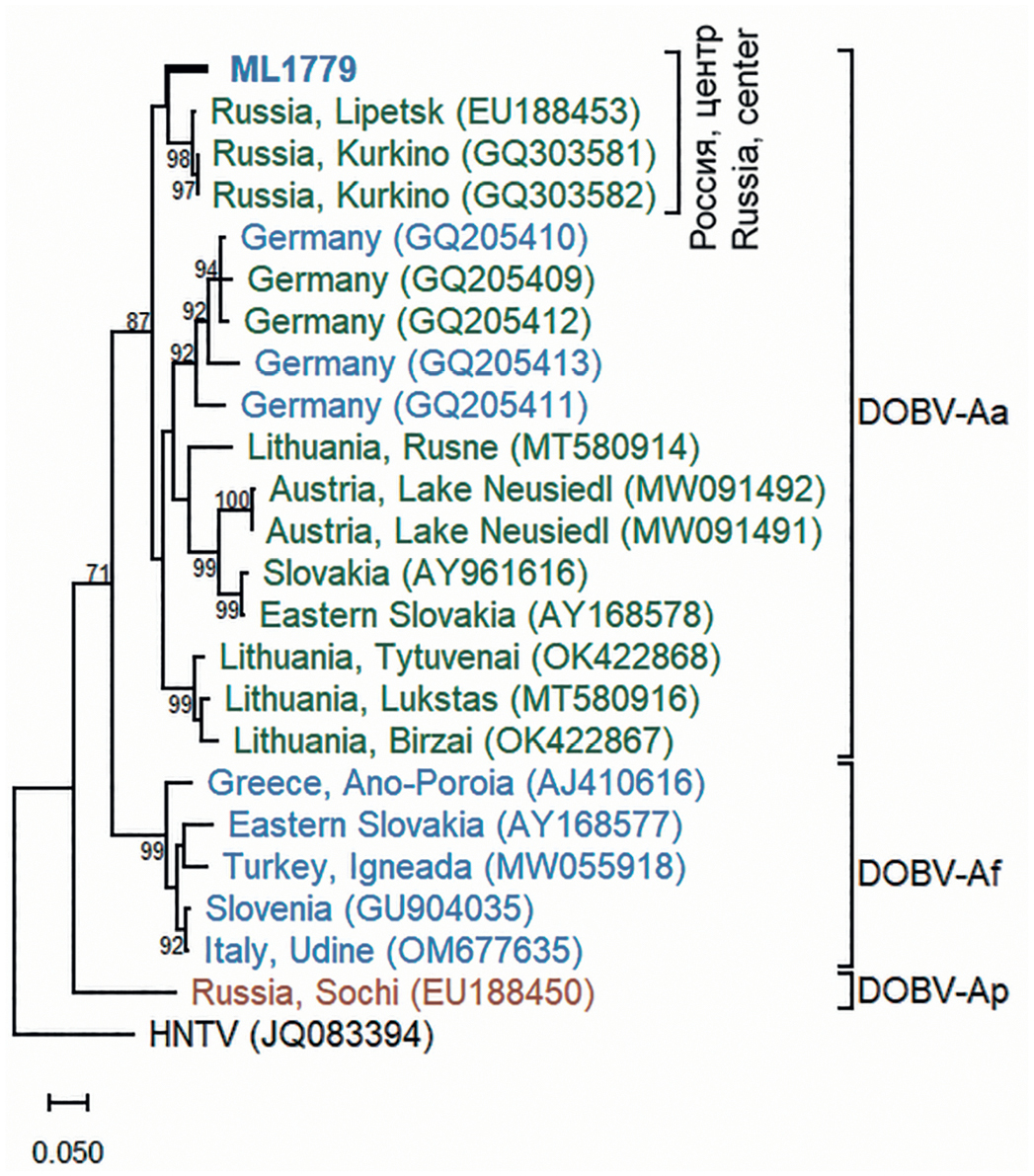
Results. Orthohantavirus RNA was detected in one sample of A. flavicollis from the Ulyanovsk region. Based on the analysis of the nucleotide sequences of the sequenced PCR products, it was found that the highest values of similarity were obtained when comparing the identified strain with the reference Kurkino virus from the Tula region. The data from the phylogenetic analysis of the sequenced fragment of the S and M segments allowed us to establish that the identified isolate is closely related to the Kurkino virus found earlier in A. agrarius in the Tula region. Thus, the detected isolate was identified as variant of Kurkino virus, which is also widespread in the central regions of Russia, Wetern Siberia and close related to genome variants that are distributed in Central Europian countries.
Conclusions. It is proved for the first time that: 1) the range of Orthohantavirus dobravaense (Kurkino virus) extends to a part of the territory of the Volga Federal District; 2) Orthohantavirus dobravaense (Kurkino virus) and Orthohantavirus puumalaense (Puumala virus) are co-circulating in the Ulyanovsk region.
About the authors
Timur R. Nasyrov
Institute of Fundamental Medicine and Biology Federal State Autonomous Educational Institution of Higher Education «Kazan (Volga Region) Federal University»
Email: nasyrovtimur1@mail.ru
ORCID iD: 0009-0000-4116-0471
laborant researcher, OpenLab ‘Gene and Cell Technologies’
Russian Federation, 420008, KazanPolina I. Elboeva
Institute of Fundamental Medicine and Biology Federal State Autonomous Educational Institution of Higher Education «Kazan (Volga Region) Federal University»
Email: polinaelboeva@mail.ru
ORCID iD: 0009-0001-2949-3289
junior researcher, OpenLab ‘Gene and Cell Technologies’
Russian Federation, 420008, KazanEkaterina V. Martynova
Institute of Fundamental Medicine and Biology Federal State Autonomous Educational Institution of Higher Education «Kazan (Volga Region) Federal University»
Email: ignietferro.venivedivici@gmail.com
ORCID iD: 0000-0003-1537-3099
Cand. Sci. (Med.), leading researcher, OpenLab ‘Gene and Cell Technologies’
Russian Federation, 420008, KazanOlesia V. Okhlopkova
Research Institute of Virology, Federal Research Center for Fundamental and Translational Medicine
Author for correspondence.
Email: ohlopkova.lesia@yandex.ru
ORCID iD: 0000-0002-8214-7828
Cand. Sci. (Biol.), senior researcher, Research Institute of Virology
Russian Federation, 630060, NovosibirskYuriy A. Tyurin
Kazan State Medical University of the Ministry of Health of the Russian Federation
Email: tyurin.yurii@yandex.ru
ORCID iD: 0000-0002-2536-3604
D. Sci. (Med.), assistant professor, assistant professor of Department of Biochemistry and Clinical Laboratory Diagnostics
Russian Federation, 420012, KazanEmmanuel Kabwe
Institute of Fundamental Medicine and Biology Federal State Autonomous Educational Institution of Higher Education «Kazan (Volga Region) Federal University»
Email: emmanuelkabwe@ymail.com
ORCID iD: 0000-0003-4328-8190
Cand. Sci. (Biol.), senior researcher, OpenLab ‘Gene and Cell Technologies’
Russian Federation, 420008, KazanYuriy N. Davidyuk
Institute of Fundamental Medicine and Biology Federal State Autonomous Educational Institution of Higher Education «Kazan (Volga Region) Federal University»
Email: davi.djuk@mail.ru
ORCID iD: 0000-0002-4409-2942
Cand. Sci. (Biol.), assistant professor, senior researcher, OpenLab ‘Gene and Cell Technologies’
Russian Federation, 420008, KazanReferences
- Savitskaya T.A., Ivanova A.V., Zubova A.A., Reshetnikova I.D., Isaeva G.Sh., Trifonov V.A., et al. Hantavirus infections: review of the epidemiological situation around the world. Analysis of the epidemiological situation on hemorrhagic fever with renal syndrome in the Russian Federation in 2023 and forecast of its development for 2024. Problemy osobo opasnykh infektsii. 2024; (1): 113–24. https://doi.org/10.21055/0370-1069-2024-1-113-124 https://elibrary.ru/wvtews (in Russian)
- Tkachenko E., Dzagurova T., Galieva G., Ivanis V., Kurashova S., Tkachenko P., et al. Clinical manifestations of hemorrhagic fever with renal syndrome, various nosologic forms and issues of hantavirus infections terminology. Viruses. 2025; 17(4): 578. https://doi.org/10.3390/v17040578
- Morozov V.G., Ishmukhametov A.A., Dzagurova T.K., Tkachenko E.A. Clinical manifestations of hemorrhagic fever with renal syndrome in Russia. Meditsinskii sovet. 2017; (5): 156–61. https://doi.org/10.21518/2079-701X-2017-5-156-161 https://elibrary.ru/yorunb (in Russian)
- Plyusnin A., Vapalahti O., Vaheri A. Hantaviruses: genome structure, expression and evolution. J. Gen. Virol. 1996; 77 (Pt. 11): 2677–87. https://doi.org/10.1099/0022-1317-77-11-2677
- Papa A. Dobrava-Belgrade virus: phylogeny, epidemiology, disease. Antiviral. Res. 2012; 95(2): 104–17. https://doi.org/10.1016/j.antiviral.2012.05.011
- Schlegel M., Klempa B., Auste B., Bemmann M., Schmidt-Chanasit J., Büchner T., et al. Dobrava-Belgrade virus spillover infections, Germany. Emerg. Infect. Dis. 2009; 15(12): 2017–20. https://doi.org/10.3201/eid1512.090923
- Papa A., Nemirov K., Henttonen H., Niemimaa J., Antoniadis A., Vaheri A., et al. Isolation of Dobrava virus from Apodemus flavicollis in Greece. J. Clin. Microbiol. 2001; 39(6): 2291–3. https://doi.org/10.1128/JCM.39.6.2291-2293.2001
- Kolodziej M., Melgies A., Joniec-Wiechetek J., Michalski A., Nowakowska A., Pitucha G., et al. First molecular characterization of Dobrava-Belgrade virus found in Apodemus flavicollis in Poland. Ann. Agric. Environ. Med. 2018; 25(2): 368–73. https://doi.org/10.26444/aaem/90535
- Semizhon P.A., Scheslenok E.P., Dubkov N.A., Sukhotskaya E.A., Stolbunova K.A., Popov I.V., et al. Identification of orthohantaviruses detected for the first time in the Republic of Belarus. Voprosy virusologii. 2025; 70(1): 87–98. https://doi.org/10.36233/0507-4088-292 https://elibrary.ru/rzopww (in Russian)
- Klempa B., Stanko M., Labuda M., Ulrich R., Meisel H., Krüger D.H. Central European Dobrava hantavirus isolate from a striped field mouse (Apodemus agrarius). J. Clin. Microbiol. 2005; 43(6): 2756–63. https://doi.org/10.1128/JCM.43.6.2756-2763.2005
- Klempa B., Tkachenko E.A., Dzagurova T.K., Yunicheva Y.V., Morozov V.G., Okulova N.M., et al. Hemorrhagic fever with renal syndrome caused by 2 lineages of Dobrava hantavirus, Russia. Emerg. Infect. Dis. 2008; 14(4): 617–25. https://doi.org/10.3201/eid1404.071310
- Klempa B., Radosa L., Kruger D.H. The broad spectrum of hantaviruses and their hosts in Central Europe. Acta Virol. 2013; 57(2): 130–7. https://doi.org/10.4149/av_2013_02_130
- Garanina S.B., Platonov A.E., Zhuravlev V.I., Murashkina A.N., Yakimenko V.V., Korneev A.G., et al. Genetic diversity and geographic distribution of hantaviruses in Russia. Zoonoses Public Health. 2009; 56(6-7): 297–309. https://doi.org/10.1111/j.1863-2378.2008.01210.x
- Klempa B., Avsic-Zupanc T., Clement J., Dzagurova T.K., Henttonen H., Heyman P., et al. Complex evolution and epidemiology of Dobrava-Belgrade hantavirus: definition of genotypes and their characteristics. Arch. Virol. 2013; 158(3): 521–9. https://doi.org/10.1007/s00705-012-1514-5
- Dzagurova T.K., Klempa B., Tkachenko E.A., Slyusareva G.P., Morozov V.G, Auste B., et al. Molecular diagnostics of hemorrhagic fever with renal syndrome during a Dobrava virus infection outbreak in the European part of Russia. J. Clin. Microbiol. 2009; 47(12): 4029–36. https://doi.org/10.1128/JCM.01225-09
- Tamura K., Stecher G., Kumar S. MEGA11: Molecular Evolutionary Genetics Analysis version 11. Mol. Biol. Evol. 2021; 38(7): 3022–7. https://doi.org/10.1093/molbev/msab120
- Tamura K., Nei M. Estimation of the number of nucleotide substitutions in the control region of mitochondrial DNA in humans and chimpanzees. Mol. Biol. Evol. 1993; 10(3): 512–26. https://doi.org/10.1093/oxfordjournals.molbev.a040023
- Tkachenko E., Kurashova S., Balkina A., Ivanov A., Egorova M., Leonovich O., et al. Cases of hemorrhagic fever with renal syndrome in Russia during 2000–2022. Viruses. 2023; 15(7): 1537. https://doi.org/10.3390/v15071537
- Avsic-Zupanc T., Xiao S.Y., Stojanovic R., Gligic A., van der Groen G., LeDuc J.W. Characterization of Dobrava virus: a Hantavirus from Slovenia, Yugoslavia. J. Med. Virol. 1992; 38(2): 132–7. https://doi.org/10.1002/jmv.1890380211
- Kabwe E., Al Sheikh W., Shamsutdinov A.F., Ismagilova R.K., Martynova E.V., Okhlopkova O.V., et al. Analysis of Puumala orthohantavirus genome variants identified in the territories of Volga Federal District. Trop. Med. Infect. Dis. 2022; 7(3): 46. https://doi.org/10.3390/tropicalmed7030046
- Mochalkin P.A., Akimkin V.G., Ugleva S.V., Morozkin E.S., Blinova E.A., Sycheva K.A., et al. Combined circulation of Puumala, Tula, Seewis hantaviruses in the territory of the republic of Bashkortostan. Problemy osobo opasnykh infektsii. 2024; (2): 140–7. https://doi.org/10.21055/0370-1069-2024-2-140-147 https://elibrary.ru/iukfus (in Russian)
Supplementary files

