





 Email this article
 Photo gallery: connective tissue diseases
- Authors: Teplyuk N.P.1, Kolesova Y.V.1, Gurianova T.A.1
-
Affiliations:
- The First Sechenov Moscow State Medical University
- Issue: Vol 28, No 6 (2025)
- Pages: 741-752
- Section: PHOTO GALLERY
- URL: https://journal-vniispk.ru/1560-9588/article/view/367131
- DOI: https://doi.org/10.17816/dv694245
- EDN: https://elibrary.ru/LIOWLG
- ID: 367131
Cite item
 Open Access
 Access granted
 Subscription Access

Abstract
Connective tissue forms the basis of skin, bone, cartilage, blood, and vascular walls. Connective tissue diseases are a diverse group of autoimmune disorders that often manifest as skin lesions. Diseases are classified as localized (affecting a single type of tissue) or systemic (affecting multiple organs and target tissues). Their development may be caused by genetic predisposition, external factors (such as infectious agents, ultraviolet radiation, smoking, certain medications, stress, etc.), and changes in hormonal balance. The most common diseases associated with rashes include various variants of lupus erythematosus and dermatomyositis. Additionally, there are several features associated with the clinical presentation and location of a lesion. For example, discoid lupus erythematosus is characterized by erythematous lesions with scaling, atrophy, and scarring. These lesions are primarily found on exposed areas of the skin and scalp. Dermatomyositis is characterized by skin involvement of the trunk and limbs, periorbital lilac-coloured edema (heliotrope eruption), and Gottron papules on the hands. In systemic lupus erythematosus, skin manifestations, such as spots and papules, are often accompanied by internal organ involvement.
A comprehensive approach is required for the diagnosis of connective tissue diseases, incorporating laboratory and imaging tests. In addition to pharmacological therapy, treatment includes physical therapy, exercise, and massage to suppress disease activity and prevent complications. If conservative treatment is ineffective, surgery is required.
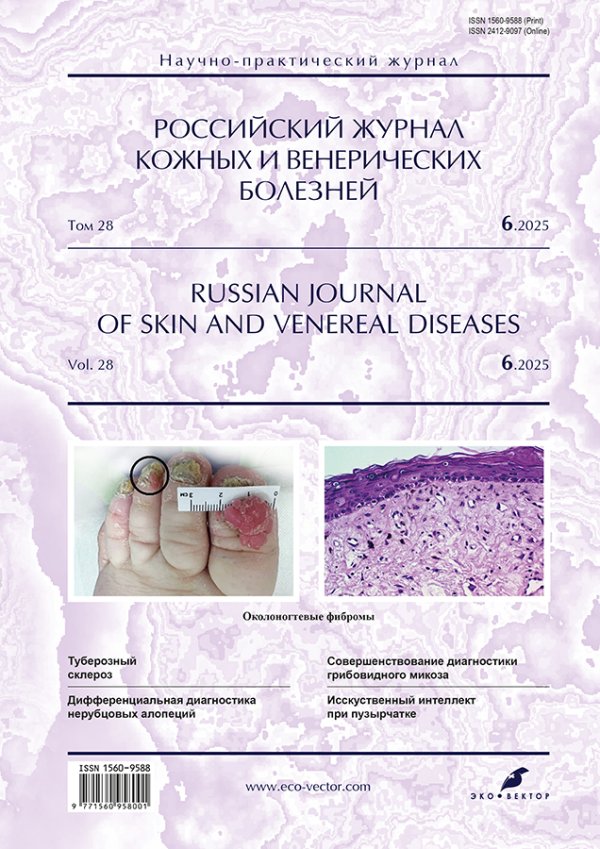
This photo gallery shows different types of skin lesions that are associated with connective tissue diseases.
About the authors
Natalia P. Teplyuk
The First Sechenov Moscow State Medical University
Email: Teplyukn@gmail.com
ORCID iD: 0000-0002-5800-4800
SPIN-code: 8013-3256
MD, Dr. Sci. (Medicine), Professor
Russian Federation, MoscowYuliya V. Kolesova
The First Sechenov Moscow State Medical University
Author for correspondence.
Email: kolesovamsmu@gmail.com
ORCID iD: 0000-0002-3617-2555
SPIN-code: 1441-8730
MD, Cand. Sci. (Medicine)
Russian Federation, MoscowTaisiia A. Gurianova
The First Sechenov Moscow State Medical University
Email: gurianova.123.ta@gmail.com
ORCID iD: 0009-0001-3447-3776
Russian Federation, Moscow
References
Supplementary files
