





 Email this article
 NEUROVEGETATIVE SYSTEM CONDITIONS DURING WINTER MARATHON IN MEN
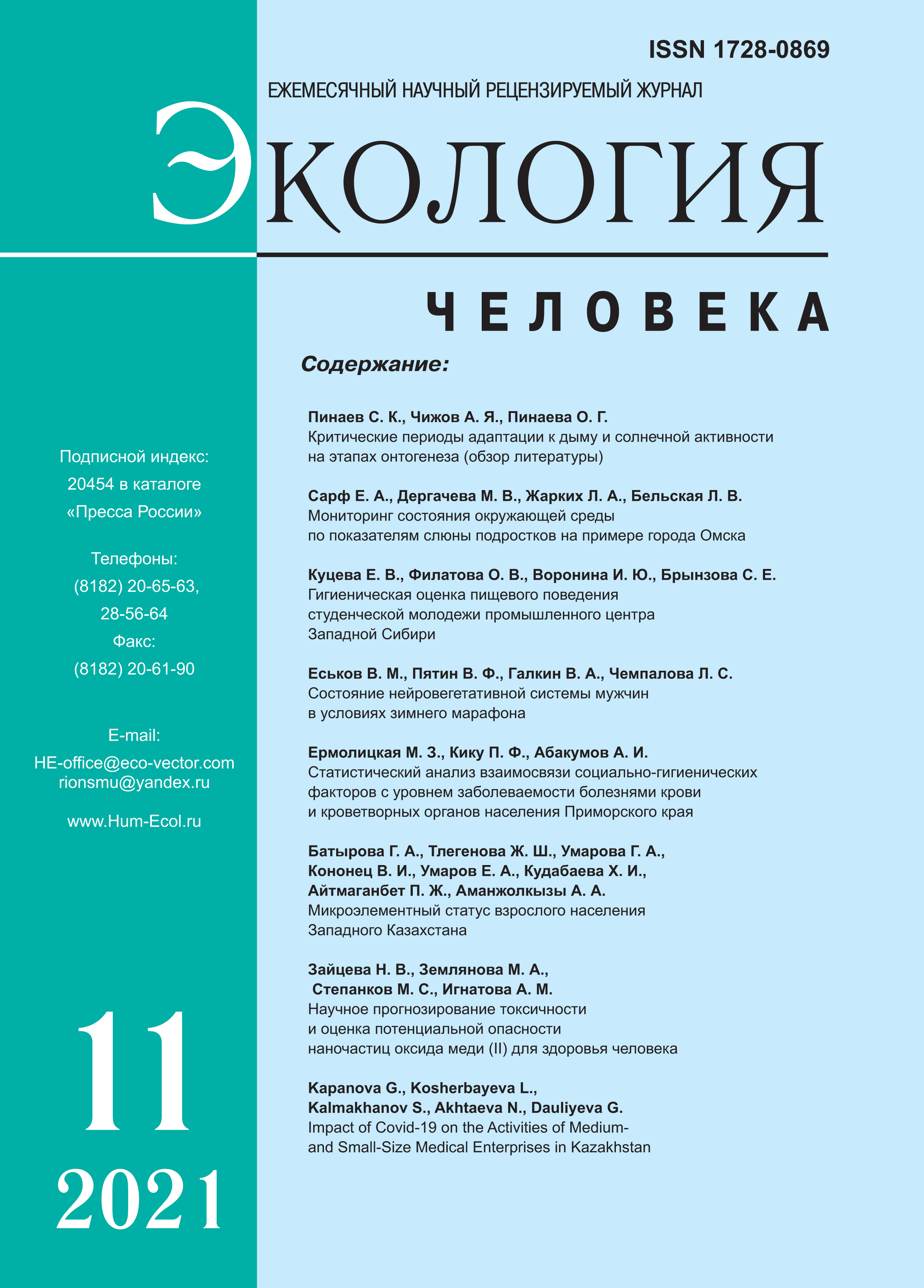
- Authors: Eskov V.M.1, Pyatin V.F.2, Galkin V.A.1, Chempalova L.S.3
-
Affiliations:
- Federal Science Center Scientific-research Institute for System Studies of the Russian Academy of Sciences
- Samara State Medical University
- Samara State Technical University
- Issue: Vol 28, No 11 (2021)
- Pages: 28-32
- Section: Articles
- URL: https://journal-vniispk.ru/1728-0869/article/view/89914
- DOI: https://doi.org/10.33396/1728-0869-2021-11-28-32
- ID: 89914
Cite item
Full Text

Abstract
Introduction: Long-duration physical activity in winter is associated with significant demands for neurovegetative system. Aim: To explore the changes in the parameters of sympathetic and parasympathetic neurovegetative systems in men during a winter marathon. Methods: Parameters of the sympathetic and parasympathetic nervous systems of the group were estimated in 15 men after the winter marathon (50 km) using an automated computer-based system. Pairwise comparisons matrices of the parameter of the sympathetic and parasympathetic systems before and after the marathon were performed. There were found the k numbers of pair samples that had a common general population. Results: Four matrices of pairwise comparisons were constructed and shown the increasing of the proportion of stochastic from k1 = 11 to k2= 13 for the sympathetic autonomic nervous system. Conclusions: An equidirectional dynamic of stochastic's proportion changes before and after the marathon is observed. For the sympathetic and parasympathetic systems, the drop of chaos is observed, but we still can make a conclusion on the statistical instability of the samples.
Full Text
##article.viewOnOriginalSite##About the authors
V. M. Eskov
Federal Science Center Scientific-research Institute for System Studies of the Russian Academy of Sciences
Email: filatovmik@yandex.ru
заслуженный деятель науки Российской Федерации, доктор физико-математических наук, доктор биологических наук, профессор, главный научный сотрудник, зав. отделом биофизики и нейрокибернетики
V. F. Pyatin
Samara State Medical University
V. A. Galkin
Federal Science Center Scientific-research Institute for System Studies of the Russian Academy of Sciences
L. S. Chempalova
Samara State Technical University
References
- Еськов В. В., Филатова О. Е., Башкатова Ю. В., Филатова Д. Ю, Иляшенко Л. К. Особенности возрастных изменений кардиоинтервалов у жителей Севера России // Экология человека. 2019. № 2. С. 21-26
- Филатова Д. Ю., Башкатова Ю. В., Мельникова Е. Г., Шакирова Л. С. Проблема однородности параметров кардиоинтервалов у детей школьного возраста в условиях широтных перемещений // Экология человека. 2020. № 1. С. 6-10
- Brown R., Macefield V. G. Skin sympathetic nerve activity in humans during exposure to emotionally-charged images: sex differences. Frontiers in Physiology. 2014, 5, р. 111.
- Chan N., Choy C. Screening for atrial fibrillation in 13 122 Hong Kong citizens with smartphone electrocardiogram. Heart. 2017, 103, рp. 24-31.
- Critchley H. D. Neural mechanisms of autonomic, affective, and cognitive integration. J. Comp. Neurol. 2005, 493 (1), р. 154.
- Dampney R. A. Central neural control of the cardiovascular system: current perspectives. Advances in Physiology Education. 2016, 40 (3), pp. 283-296.
- Eskov V. V., Gavrilenko T. V., Eskov V. M., Vokhmina Y. V. Phenomenon of statistical instability of the third type systems -complexity. Technical physics. 2017, 62 (11), pp. 1611-1616.
- Eskov V. V., Filatova D. Y., Ilyashenko L. K., Vochmina Y. V. Classification of uncertainties in modeling of complex biological systems. Moscow University Physics Bulletin. 2019, 74 (1), pp. 57-63.
- Eskov V. V. Modeling of biosystems from the stand point of “complexity” by W Weaver and “fuzziness” by L. A. Zadeh. Journal of Physics Conference Series. 2021, 1889 (5), p. 052020 doi: 10.1088/1742-6596/1889/5/052020
- Lovallo W R. Psychophysiological reactivity: mechanisms and pathways to cardiovascular disease. Psychosomatic Medicine. 2003, 65 (1), pp. 36-45.
- McCraty R., Shaffer F. Heart Rate Variability: New Perspectives on Physiological Mechanisms, Assessment of Self-regulatory Capacity, and Health Risk. Global advances in health and medicine. 2015, 4 (1), pp. 46-61. doi: 10.7453/gahmj.2014.073
- Nobrega A., O’Leary D., Silva B.M. et al. Neural regulation of cardiovascular response to exercise: role of central command and peripheral afferents. BioMed. Res. Int. 2014, 2014. Article ID 478965. 20 p.
- Reyes del Paso G. A., Langewitz W., Mulder L. J., van Roon A., Duschek S. The Utility of Low Frequency Heart Rate Variability as an Index of Sympathetic Cardiac Tone: a Review with Emphasis on a Reanalysis of Previous Studies. Psychophysiology. 2013, 50 (5), pp. 477-487. doi: 10.1111/psyp.12027
- Shaffer F., Ginsberg J. An overview of heart rate variability metrics and norms. Frontiers in public health. 2017, 5, p. 258.
- Zilov V. G., Khadartsev A. A., Ilyashenko L. K., Eskov V. V., Minenko I. A. Experimental analysis of the chaotic dynamics of muscle biopotentials under various static loads. Bulletin of experimental biology and medicine. 2018, 165 (4), pp. 415-418.
- Zilov V. G., Khadartsev A. A., Eskov V. V., Ilyashenko L. K., Kitanina K. Yu. Examination of statistical instability of electroencephalograms. Bulletin of experimental biology and medicine. 2019, 168 (7), pp. 5-9.
Supplementary files

