

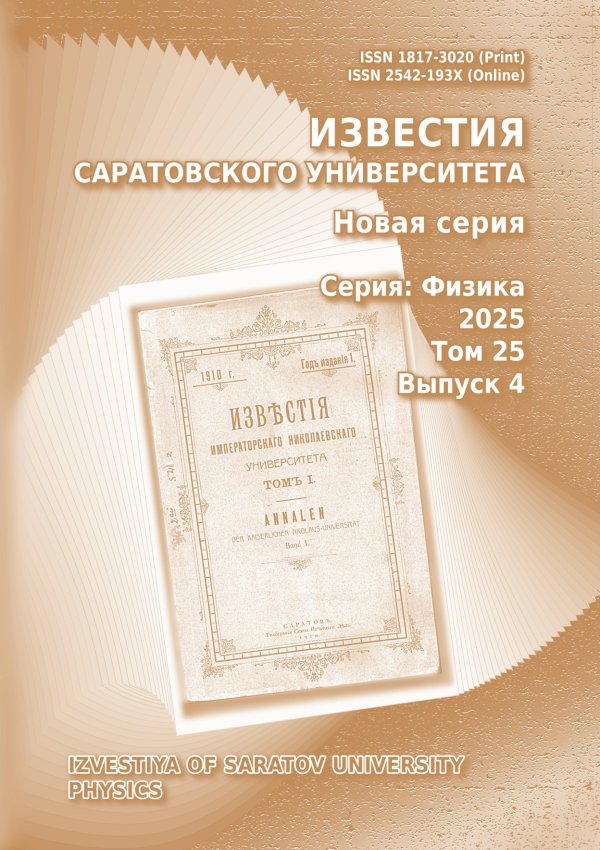
Izvestiya of Saratov University. Physics

ISSN (print): 1817-3020, ISSN (online): 2542-193X

Founder: Saratov State University

Editor-in-Chief: Koronovsky Alexey Alexandrovich, Doctor of Physics and Mathematics. sciences, professor

Frequency / Access: 4 issues per year / Open

Included in: White List (4th level), Higher Attestation Commission List, RISC, Scopus

Registration PI № FS77-76653 of 26 August, 2019.

The electronic version of the journal is open access.

The journal subscription index is 36015. The subscription is available in online catalogue Ural-Press Group of  Companies (ural-press.ru). The price is not fixed.

 All journal articles are published under a licence Creative Commons Attribution 4.0 International (CC BY 4.0)

History of the journal

The journal "Izvestiya of Saratov University. New series" (ISSN 1814-733Х) was published since 2001. Its predecessors were the journals "Izvestiya of Saratov University" (1910-1918) and "Scientific notes of Saratov State University" (1923-1962). In 2005  the journal "Izvestiya of Saratov University. New series"  launched  a separate series "Izvestia of Saratov University.  New series. SeriesPhysics", in 2021 the title changed for "Izvestia of Saratov University. Physics" (ISSN 1817-3020 print, ISSN 2542-193X online).

The journal is intended for readers involved in the field of physics and engineering education, physical science research workers, University professors, undergraduate and graduate students and organizers of production.

The purpose and objectives of the journal

The purpose of the journal is to reflect modern ideas about the physical picture of the world, contributing to the development of educational and research activities in the field of physics and its applications.

The objectives of the journal are:

  • publication of original scientific papers in various areas of physical science and its applications (including nanotechnology and other critical technologies) in accordance with the content of passports of specialties of scientists in theoretical physics, radiophysics, physical electronics, solid state electronics, optics, laser physics, biophysics;
  • publication of scientific and methodological materials that contribute to the improvement of the educational process in the physical and engineering-physical areas of training;
  • publication of scientific reviews on priority areas of science and high technologies;
  • publication of historical information about Saratov University, its mission in the field of physical education and physical science.

Articles should be prepared according to the rules of the journal.

The languages of publications are Russian and English.

Publications are free of charge.

Current Issue

Vol 25, No 1 (2025)

Radiophysics, Electronics, Acoustics

Control of spin wave propagation in a microwaveguide with a two-dimensional array of magnetic cylinders of variable configuration
Garanin F.E., Khutieva A.B., Lomova M.V., Sadovnikov A.V.
Abstract
Background and Objectives: The development of magnonics, focusing on the transfer of magnetic moment or electron spin instead of charge, has opened new opportunities for the application of spin waves (SW) in the design of devices for data processing, transmission, and storage in the microwave and terahertz ranges. Yttrium iron garnet (YIG) films are used as the magnetic material for forming spin-waveguiding structures due to their exceptionally low SW damping, even at nanometer thicknesses. One promising approach to controlling SW is the use of two-dimensional arrays of magnetic nanostructures, such as cylinders and half-cylinders made of magnetite. Materials and Methods: This study involves numerical micromagnetic modeling of a microwave waveguide with an array of magnetite cylinders and half-cylinders on its surface. The modeling focuses on varying the geometric parameters of the nanostructures and the direction of the external magnetic field to investigate their influence on SW propagation characteristics. Magnetite was chosen due to its unique magnetic properties and compatibility with modern micro- and nanofabrication technologies. The micromagnetic modeling was based on the numerical solution of the Landau–Lifshitz–Gilbert equation. Results: The results of the modeling provide insights into the ability to predict and control SW behavior depending on the geometry of the magnetic elements and the orientation of the external magnetic field. This opens new perspectives for the development of highly efficient magnonic devices. Identifying optimal configurations for the cylinders and half-cylinders could lead to the creation of more compact and energy-efficient components for magnonic logic circuits and other applications in the field of magnonics. Conclusion: The study has presented a significant step towards the development of new magnonic devices operating on the principles of spin electronics. The findings offer potential for further exploration and optimization of spin wave dynamics in nanostructured waveguides, contributing to the advancement of magnonic technology.
Izvestiya of Saratov University. Physics. 2025;25(1):4-11
pages 4-11 views
Frequency dependencies and scattering diagrams of combined metal-dielectric surfaces in frequency range of 16–25 GHz
Mazinov A.S., Boldyrev N.A., Padalinsky M.M., Fitaev I.S., Starosek A.V.
Abstract
Background and Objectives: It is known that the design of attenuating coatings is usually based on two main physical principles: scattering and absorption. The absorbing coatings include ultrathin films, which at nanoscale thicknesses of the conductive layer absorb up to 50% of the incident electromagnetic energy, and are also capable of attenuating the signal in a wide frequency range due to frequency-independent properties. One of the ways to achieve high scattering readings is the use of metastructural coatings. This work aims to develop compact scattering materials that are a combination of planar metastructures with thin nanoscale films. Combining metastructures and thin absorbing nanofilms allows utilizing the advantages of both approaches, providing high efficiency of attenuation of electromagnetic waves in the microwave range. This opens up new opportunities for the creation of multifunctional and highly efficient attenuation coatings, which can find wide application in various industries and science. Materials and Methods: Metastructures are a set of specially arranged subwavelength metallic or dielectric structures that interact resonantly with the electric or magnetic components of incident electromagnetic waves. The electromagnetic properties of such structures are mainly determined by the characteristics of the resonators and their mutual arrangement. Such a construction principle allows them to exhibit an effective electromagnetic response, which is unattainable in natural materials. As a source of ohmic losses, thin films based on metallic, carbon and organic structures have been investigated in this work. Thin film materials used in combination with metastructures were a glass or sital substrate with a functional layer deposited on them via magnetron sputtering. Due to the island structure formed at a certain thickness of the conducting material, such films allowed absorbing up to 35% of the incident radiation. Glass-textolite with one-sided copper metallization was used as a material for obtaining the tested structures. The topology of the conductive structure was formed by milling. Results: The research results have demonstrated that the magnitude of the normal component of the reflected electromagnetic wave is significantly reduced at a resonant frequency of 18.8 GHz due to the use of combination of these attenuating coatings. At this frequency, the attenuation coefficient reaches its peak value of 97.8% of the incident wave. The width of this resonant peak, at which the attenuation of the wave reaches at least 70%, is 450 MHz. But it should also be noted that the addition of a resistive film has the property of shifting the resonant peaks to a higher frequency region. Conclusion: Such materials can be used as protective coatings for buildings and structures in order to reduce the level of the passed electromagnetic radiation, but with a low reflection coefficient in the frequency range of 16–25 GHz. The low level of signal reflected from such a coating will contribute to the improvement of the electromagnetic environment and hygienic standards in the vicinity of radio transmitting facilities.
Izvestiya of Saratov University. Physics. 2025;25(1):12-23
pages 12-23 views

Optics and Spectroscopy. Laser Physics

IR spectra and structural-dynamic anharmonic models of cyclohexanol
Babkov L.M.
Abstract
Background and Objectives: The construction of quantum mechanical structural-dynamic models of molecular systems has become a necessary part of studies of the structure, optical spectra and properties of matter. The results obtained in the harmonic approximation followed by a scaling procedure guarantee a reliable interpretation of the fundamental vibration bands of the measured vibrational spectra. However, if the spectrum has a complex structure determined by fundamental vibrations, overtones, composite frequencies, resonances, the interpretation is not complete. An approach based on taking into account mechanical anharmonicity makes it possible to significantly minimize the discrepancy between calculated and measured frequencies of fundamental vibrations, identify overtones and composite frequencies in the measured spectra, and establish the presence of resonant interactions. The advantage of this approach manifests itself to varying degrees in specific cases. In this article, using the density functional theory method, taking into account mechanical anharmonicity, structural-dynamic models of two conformers of the cyclohexanol molecule are constructed. The goal is to identify in this particular case the advantages of taking anharmonicity into account, which consists in minimizing the discrepancies between calculated and measured frequencies, identifying overtones, composite frequencies and resonances, refining and replenishing the interpretation of the measured spectra. Materials and Methods: Cyclohexanol (C6H11OH), used in many industries, has been the subject of extensive scientific research. The IR spectra of samples of crystalline phases II and III of cyclohexanol were used, measured on a Bruker IFS-88 Fourier spectrometer at a temperature of 12 K. Using the B3LYP/6-31G(d) method using the GAUSSIAN’03 software package, structural-dynamic models of conformers 1 and 2 isolated cyclohexanol molecules with an equatorial orientation of the hydroxyl group relative to the carbon backbone of the molecule. Results: The main parameters of adiabatic potentials have been calculated: minimum energies, optimal geometries, dipole moments of conformers 1 and 2 of an isolated cyclohexanol molecule. The frequencies of normal vibrations in the anharmonic approximation and the intensities of fundamental bands in the IR spectra have been calculated. A vibrational analysis of the IR spectra of cyclohexanol samples in crystalline phases II and III, measured in the range 400–3800 cm–1, has been carried out in order to identify overtones, vibrations of compounds and resonances. An assessment of the results obtained in comparison with those obtained in the harmonic approximation has been given. Their interpretation of the measured IR spectra has been refined. Conclusions: Based on the results of taking into account mechanical anharmonicity when constructing structural-dynamic models of isolated conformers 1 and 2 of cyclohexanol, it has been established that the agreement between the measured and calculated frequencies in the regions of 1080–1550 cm–1 and 2800–2940 cm–1 of the IR spectrum has significantly improved compared to harmonic scaled frequencies. The consequence of this improvement is a refinement of the interpretation of the frequencies ν₄₀ and ν₄₁ of the stretching vibrations of the C–H bonds closest to the core of the H-complex, and the band with a maximum at a frequency of 1517 cm–1 in the spectrum of crystalline phase II, which is a superposition of the composite vibrations ν₈ + ν₁₈, ν₅ + ν₂₃, ν₉ + ν₁₆. It has been established that resonance interactions in cyclohexanol conformers are small and resonances are unlikely. This conclusion is consistent with experimental data on the IR spectra of cyclohexanol.
Izvestiya of Saratov University. Physics. 2025;25(1):24-36
pages 24-36 views

Physics of Condensed Matter

Structure, magnetic and electrical properties of La-Sr manganite doped with cerium and zinc
Derzhavin I.M., Badelin A.G., Karpasyuk V.K., Estemirova S.K.
Abstract
Background and Objectives: Doped manganites of La-Sr system exhibiting effects of colossal magnetoresistance, giant magnetostriction, and electrical switching are promising functional materials for various technical applications, in particular for sensor and information devices. However, the influence of characteristics of doping ions, especially those introduced into various sublattices, on the properties of manganites and their frequency dependences has not been sufficiently studied. The aim of this work is to establish the influence of Ce4+(5p6) and Zn2+(3d10) ions, which are donors and acceptors, on crystal lattice parameters of manganites, their magnetization, Curie point, magnetoresistance, and dependences of the resistance on the frequency and amplitude of electric field. Materials and Methods: For the first time, single-phase ceramic La0.625Sr0.35Ce0.025Mn0.975Zn0.025O3 manganite was synthesized. Parameters of crystal structure were determined from powder X-ray diffractograms. Specific magnetization measurements were performed in magnetic field with an induction of 0.56 T. Curie point was determined by the maximum modulus of the derivative of magnetic permeability with respect to temperature. Measurements of the resistance were performed in the frequency range from 100 kHz to 4 MHz at two values of measuring voltage. Dependences of magnetoresistance on the temperature were measured in transverse field with an induction of 0.92 T. Results: The synthesized manganite has a rhombohedral crystal structure. Specific magnetization (91.2 A · m2/kg at 80 K) is higher, and Curie temperature (222 K) is lower than that of the manganite of basic composition La0.65Sr0.35MnO3. A significant width of the temperature range of ferromagnetic–paramagnetic transition (about 45 K) indicates a high inhomogeneity of obtained manganite. At the temperatures exceeding 285 K, manganite exhibits semiconductor properties. The modulus of negative magnetoresistance varies with temperature nonmonotonically and reaches a maximum (18%) at the temperature of 231 K. With an increase in frequency in the range from 100 kHz to 4 MHz, the resistance of manganite decreases with a slowdown of the fall process in the region of 1.5–2 MHz. Conclusion: The results obtained are explained by diamagnetic dilution of octahedral sublattice with zinc ions, formation of Mn2+ ions, increase in spin fluctuations near Curie point, relationship of electronic band structure with magnetic subsystem of manganite, phase stratification and formation of the clusters of different-valence ions, competition and change of charge transfer mechanisms (hopping, tunneling, percolation) depending on temperature and frequency. Established dependencies are important for understanding the mechanisms of the effect of simultaneous introduction of quadrivalent and divalent ions into various sublattices of manganites on their properties, and are also of interest for obtaining manganites with required parameters.
Izvestiya of Saratov University. Physics. 2025;25(1):37-43
pages 37-43 views
Influence of crystallographic anisotropy of unsaturated yttrium iron garnet film on spin injection in platinum film by the mechanism of inverse spin Hall effect
Vysotskii S.L., Seleznev M.E., Amakhanov G.M., Nikulin Y.V.
Abstract
Background and Objectives: Thin-film structures of yttrium iron garnet ferrite film – platinum are actively studied due to the possibility of using the direct (for converting electric current in platinum into spin waves in ferrite) and inverse (injection of spin current from ferrite into platinum film) spin Hall effects for application in magnonics and spintronics devices. Materials and Methods: The structures studied in this work were obtained on the basis of yttrium iron garnet films of crystallographic orientations (100) and (111), from which waveguides were cut out, in which spin waves were excited. Their propagation was monitored using a vector network analyzer. A platinum film in the form of stripe oriented along the long axis of the waveguide was fabricated on the surface of the waveguides using magnetron sputtering, photolithography, and ion etching. Spin injection from ferrite film in the platinum film results in electric charge current generation. An experimentally measured value was the electromotive force between contacts to the platinum stripe. It was measured using a synchronous detector. The measurements were carried out at magnetization field values lower than the saturation field of the ferrite film, with the magnetic structure of the film being divided into domains. Results and Conclusions: It has been shown that for both crystallographic orientations the maximum spin injection is achieved when magnetizing the waveguides along the easy magnetization axis and symmetrical domain structure is formed.
Izvestiya of Saratov University. Physics. 2025;25(1):44-52
pages 44-52 views

Biophysics and Medical Physics

The appearance of the venuloarteriolar reflex during measurements microcirculation of blood by laser Doppler flowmetry caused by a change in the position of the hand
Skripal A.V., Verkhov D.G., Al-Badri F., Mashkov K.V., Usanov A.D., Sagaidachnyi A.A., Klochkov V.A.
Abstract
Background and Objectives: The venuloarteriolar reflex is a crucial part of the circulation regulation system, and it’s particularly evident in the lower limbs compared to the upper limbs due to the higher transmural pressure in the arteries and veins of the legs. When testing with changes in arm position, vascular responses to increased blood pressure are usually checked by lowering the arm below heart level. The proposed sample examines the vascular response to both a decrease in blood pressure and an increase to its initial level. Materials and Methods: The study was conducted on two groups of volunteers, one of which included 7 healthy young people aged 21–28 years, who did not have a pronounced venuloarteriolar reflex during the exercise test, and the second 7 people aged 45–65 years, in whom the venuloarteriolar reflex was well expressed. Using the method of laser Doppler flowmetry we measured the microcirculation index during the sequence of tests with the change of the hand position according to the set of parameters characterising the dynamics of blood circulation in the microvessels of the finger. Results: When raising the arm, the microcirculation index in the “up” arm position in young volunteers has decreased significantly, while in the age group, the microcirculation index in the “up” arm position has tended to increase after a sharp decrease. We have defined such a significant discrepancy in the blood flow response of young and aged volunteers as an appearance of the venulo-arteriolar reflex. The amplitudes of neurogenic and myogenic fluctuations of microvascular blood flow were mainly multidirectional in different age groups. The experimentally measured increase in blood filling of the arm vessels in age-related volunteers, caused by the appearance of fluctuations in blood flow in the neurogenic range, is explained by the reaction of the sympathetic nervous system, leading to the appearance of the venuloarteriolar reflex, which helps to restore the volume of blood filling. At a young age, the venulo-arteriolar reflex caused by a change in the position of the arm may not appear. Conclusion: The test with the change of limb position can provide valuable information on the preservation of peripheral innervation of microvessels, which justifies the prospect of using this test in the detection of various forms of neuropathies and age-related peculiarities of blood flow regulation.
Izvestiya of Saratov University. Physics. 2025;25(1):53-66
pages 53-66 views
Stochastic SIRS+V model of infections spread
Shabunin A.V.
Abstract
Background and Objectives: The aim of the paper is to construct a model of the spread of infection in the form of a system of stochastic differential equations that takes into account fluctuations in the parameters characterizing the processes of infection, restoration and loss of immunity. Methods: Numerical simulation of oscillations of a system of stochastic differential equations with Langevin sources. Results: A stochastic SIRS+V model of epidemic spread has been constructed in the form of a system of three differential equations with multiplicative sources of quasi-Gaussian noise. The model does not take into account the effect of the disease on the population size, while the population density is considered as a parameter affecting the course of the epidemic. The model demonstrates the long-term oscillatory dynamics observed in many viral diseases. Conclusion: Studies have shown that to model the course of infectious diseases, it is not enough to know the average values of the rates of infection, recovery and loss of immunity, but it is also necessary to know the intensity of fluctuations of these values. The different levels of such fluctuations lead to qualitatively different observed dynamics of the epidemic. The root-mean-square values of parameter fluctuations can be estimated during the analysis of empirical data obtained from observations of the spread of specific diseases, and then used in modeling. For example, when statistically analyzing a disease in the course of medical practice, it is not difficult to obtain a distribution of recovery times and loss of immunity. These observations will also make it possible to clarify the type of distribution functions for the Langevin sources used, which in practice may differ from Gaussian ones.
Izvestiya of Saratov University. Physics. 2025;25(1):67-75
pages 67-75 views
Microgels containing whey protein as a new way of treating bladder and renal diseases
Mayorova O.A., Gusliakova O.I., Saveleva M.S., Kulikov O.A., Inozemtseva O.A.
Abstract
Background and Objectives: This study covers the biophysical aspects of the use of emulsion microgels stabilized with whey protein isolate (WPI) for targeted drug delivery to the urinary system. Emulsion microgels were prepared by the ultrasonic homogenization method which leads to denaturation of the WPI adsorbed on the water-oil interface and formation of WPI microgel layer at the oil droplet. Materials and Methods: The study of the release profile of the model substance Cyanine 7 immobilized in emulsion microgels has demonstrated a prolonged pattern over 72 hours. The effect of emulsion microgels on the viability of various cell cultures (normal fibroblasts (L929), kidney cells (Hek239), renal carcinoma (Renca) and bladder carcinoma (T24)) has been studied, which has shown a dependence of the cytotoxicity level on the cell type. The Hek239 cells have demonstrated particularly increased sensitivity to emulsion microgels. Results: The accumulation and distribution behaviour of emulsion microgels in laboratory mice have also been studied depending on the route of their administration: intravesical or intravenous. The efficiency of targeting the microgels for urinary system components of the urinary system (kidney or bladder) has been assessed by biodistribution using in vivo fluorescence imaging. Systemic administration has demonstrated selective accumulation not only in the liver but also in the kidneys. Intravesical administration has made it possible to maintain a high local concentration of Cyanine 7 in the bladder at least during 2 h. Histological analysis has validated the safety of WPI-based microgels for delivery into the bladder and kidney. Conclusions: The presented delivery system based on the developed emulsion microgels opens up new prospects for the treatment of diseases of the urinary system using both systemic administration and minimally invasive intravesical instillations.
Izvestiya of Saratov University. Physics. 2025;25(1):76-85
pages 76-85 views
Experimental measurements of glucose concentration in blood with a prototype of optoacustic cytometer, assessment of measurement error
Kravchuk D.A.
Abstract
Background and Objectives: Preclinical experimental measurements of blood glucose levels using the optoacoustic method were carried out. The purpose of the work is to record blood glucose levels using the optoacoustic method and obtain a graduated curve. It is necessary to establish the factors influencing the error in measuring blood glucose concentrations. Modern problems arising in the field of optoacoustic studies of blood composition are considered. Materials and Methods: A block diagram of the experimental setup has been developed and a prototype of the device has been created. Methods for collecting and storing blood are described. The process of experimental measurements is given. Experimental studies have been conducted on different age groups of patients with the addition of heparin to stop the clotting process. Results: The obtained profiles of acoustic signals have made it possible to plot the dependence of the amplitude of the acoustic signal in a blood sample on the concentration of glucose in the blood, and the measurement error has been assessed taking into account temperature and concentration factors that influence the result of measuring glucose levels. Conclusion: The prospects for using and comparing the obtained data for in vivo device development have been discussed. The diagnostic accuracy of the optoacoustic method is reduced due to biological variability and heterogeneous tissue composition.
Izvestiya of Saratov University. Physics. 2025;25(1):86-92
pages 86-92 views

Nanotechnologies, Nanomaterials and Metamaterials

Perspectives for the creation and application of heterophase material CdS-FeS obtained by the Langmuir–Blodgett method
Stetsyura S.V., Kharitonova P.G., Kozlowski A.V.
Abstract
Background and Objectives: Cadmium sulfide (CdS) is one of the most promising materials for photovoltaic devices, but it is increasingly used as part of complex heterostructures and heterophase materials that provide expanded functionality and perspective for use. This article presents the results of studies on the production of semi-magnetic semiconductor material CdS-FeS, conventionally designated CdS:Fe, using the Langmuir–Blodgett technology. The morphology of the surface layers and the photoelectric characteristics of the obtained material are considered in detail in comparison with the original sample. Methods: A nanosized coating of iron arachinate (ArchFe) was prepared on the surface of CdS using the Langmuir–Blodgett method. The parameters of ArchFe monolayers were controlled using compression isotherms. The CdS/ArchFe structure was annealed in air. Energy-dispersive analysis and mass spectrometric studies were carried out to control the current processes before and after annealing. The main methods for studying hybrid structures of CdS/ArchFe and heterophase material CdS:Fe were atomic force microscopy and analysis of photoelectric characteristics using steady-state and kinetic approaches. Results: The resulting material is a matrix of CdxFe1–xS solid solution with nanoinclusions of the FeS phase. Analysis of atomic force microscopy images has confirmed the high reproducibility of the proposed method. We have shown the occurrence of the effect of “negative photofatigue” and an increase in integral photosensitivity by 70 times for a heterophase sample compared to “pure” CdS. Conclusion: It has been shown that the resulting material has unique properties, such as increased photosensitivity and negative photofatigue, which is very perspective for creating devices that can operate in conditions high illumination and whose characteristics can be controlled by illumination.
Izvestiya of Saratov University. Physics. 2025;25(1):93-105
pages 93-105 views
Computer simulation of conductivity fluctuations in a dynamic percolation model based on resistive networks
Kochkurov L.A., Zimnyakov D.A.
Abstract
Background and Objectives: Percolation models are widely used in the analysis of electrical, thermophysical and other properties of various systems with disordered structure, which causes their wide application in the theoretical consideration of near-critical behavior of such systems in various fields of modern science and technology. Studies of noise processes, in particular noise, in the context of percolation networks have significantly extended the understanding of how fluctuations can arise in this kind of systems. An important aspect that has often received less attention in classical approaches is the fact that local conductivity processes in a number of disordered materials occur in a dynamic environment. In this paper, we present results from computer simulations of fluctuations in the conductivity of a time-evolving random resistor network. The model calculates the conductance of a three-dimensional rectangular lattice in which about 70% of the total number of nodes is empty, corresponding to a percolation threshold. Materials and Methods: The modeled percolation network consists of 160000 nodes, connected in a three-dimensional rectangular lattice. A potential difference is applied to the opposite edges of the lattice along the long side containing each node, providing charge transfer in the system. The value of bond conductivity in the lattice could take either zero or finite value (two-phase system). The numerical value of the potential for each node and the current at each site are calculated by solving Kirchhoff’s equations. Dynamics was introduced into the system by assuming that a small fraction of the whole nodes are able to diffuse through the lattice, thus changing the conduction paths, but keeping on the other hand the total fraction of the conducting phase unchanged. Results: The process of exchange between neighboring conducting and non-conducting nodes between each other in space has been simulated, after which the conductivity of the network has been recalculated. After repeating this process many times, temporal realizations of the conductivity fluctuations have been obtained, which allows a systematic analysis of the system dynamics. The characteristic lifetime τ reflects the reconfiguration time of the conductive part of the grid. In the limit of high exchange rate υ → 1 it is expected that the power spectral density of the conductivity fluctuations will be white noise. Conclusion: The results are of particular interest for advancing fundamental understanding of charge transfer mechanisms in dispersed semiconductor materials, which are relevant to chemoresistive sensing and catalytic chemistry.
Izvestiya of Saratov University. Physics. 2025;25(1):106-112
pages 106-112 views

From the History of Physics

Oleg Antonov’s Saratov years: Glider designer and university student
Shashkina M.N., Anikin V.M.
Abstract
Background and Objectives: In the article, we highlight episodes from the biography of the outstanding Soviet designer of unique multipurpose and cargo aircraft Oleg K. Antonov (1906–1984), related to the almost 15-year period of his life in Saratov. Having arrived in Saratov with his parents in 1911–1912, he received his secondary education here, studying at the Alexander-Mariinsky Real School (in pre-revolutionary times) and the Unified Labor School. Even in his childhood, he was distinguished by a serious attitude to the history of aviation (he compiled his own chronicle of its development), aspiration to create perfect aircraft and a dream of becoming a pilot. The first stage of his path to the sky in the 1920s was the design of gliders in Saratov, in which he achieved professional mastery, publishing, in particular, brochures on the modeling and design of gliders. In 1922–1923, Oleg Antonov was a first-year student at the Faculty of Railway Engineering at Saratov University (until its closure). At the same time, in Saratov, he was engaged in organizing gliding, being the executive secretary of the sports section and gliding of the Society of Friends of the Air Fleet since 1923. Materials and Methods: By writing the article, we used the materials of the State Archives of the Saratov Region, the Saratov Regional Museum of Local History, the archives of the Saratov University, and the memoirs by O. K. Antonov. Conclusion: It has been noted that the Saratov period of Oleg K. Anton’s life became decisive in his choice of further study at the Leningrad Polytechnic Institute and many years of professional activity. On the house where he lived in Saratov and on the building of the former real school where he studied, memorial plaques were installed in his honor.
Izvestiya of Saratov University. Physics. 2025;25(1):113-128
pages 113-128 views

Personalia

On the 70th anniversary of the birth of Sergei A. Nikitov
Abstract
-
Izvestiya of Saratov University. Physics. 2025;25(1):129-130
pages 129-130 views

Согласие на обработку персональных данных с помощью сервиса «Яндекс.Метрика»

1. Я (далее – «Пользователь» или «Субъект персональных данных»), осуществляя использование сайта https://journals.rcsi.science/ (далее – «Сайт»), подтверждая свою полную дееспособность даю согласие на обработку персональных данных с использованием средств автоматизации Оператору - федеральному государственному бюджетному учреждению «Российский центр научной информации» (РЦНИ), далее – «Оператор», расположенному по адресу: 119991, г. Москва, Ленинский просп., д.32А, со следующими условиями.

2. Категории обрабатываемых данных: файлы «cookies» (куки-файлы). Файлы «cookie» – это небольшой текстовый файл, который веб-сервер может хранить в браузере Пользователя. Данные файлы веб-сервер загружает на устройство Пользователя при посещении им Сайта. При каждом следующем посещении Пользователем Сайта «cookie» файлы отправляются на Сайт Оператора. Данные файлы позволяют Сайту распознавать устройство Пользователя. Содержимое такого файла может как относиться, так и не относиться к персональным данным, в зависимости от того, содержит ли такой файл персональные данные или содержит обезличенные технические данные.

3. Цель обработки персональных данных: анализ пользовательской активности с помощью сервиса «Яндекс.Метрика».

4. Категории субъектов персональных данных: все Пользователи Сайта, которые дали согласие на обработку файлов «cookie».

5. Способы обработки: сбор, запись, систематизация, накопление, хранение, уточнение (обновление, изменение), извлечение, использование, передача (доступ, предоставление), блокирование, удаление, уничтожение персональных данных.

6. Срок обработки и хранения: до получения от Субъекта персональных данных требования о прекращении обработки/отзыва согласия.

7. Способ отзыва: заявление об отзыве в письменном виде путём его направления на адрес электронной почты Оператора: info@rcsi.science или путем письменного обращения по юридическому адресу: 119991, г. Москва, Ленинский просп., д.32А

8. Субъект персональных данных вправе запретить своему оборудованию прием этих данных или ограничить прием этих данных. При отказе от получения таких данных или при ограничении приема данных некоторые функции Сайта могут работать некорректно. Субъект персональных данных обязуется сам настроить свое оборудование таким способом, чтобы оно обеспечивало адекватный его желаниям режим работы и уровень защиты данных файлов «cookie», Оператор не предоставляет технологических и правовых консультаций на темы подобного характера.

9. Порядок уничтожения персональных данных при достижении цели их обработки или при наступлении иных законных оснований определяется Оператором в соответствии с законодательством Российской Федерации.

10. Я согласен/согласна квалифицировать в качестве своей простой электронной подписи под настоящим Согласием и под Политикой обработки персональных данных выполнение мною следующего действия на сайте: https://journals.rcsi.science/ нажатие мною на интерфейсе с текстом: «Сайт использует сервис «Яндекс.Метрика» (который использует файлы «cookie») на элемент с текстом «Принять и продолжить».