





 Email this article
 Analysis of the risks of death of personnel of the Federal Fire Service of EMERCOM of Russia in 2006-2020
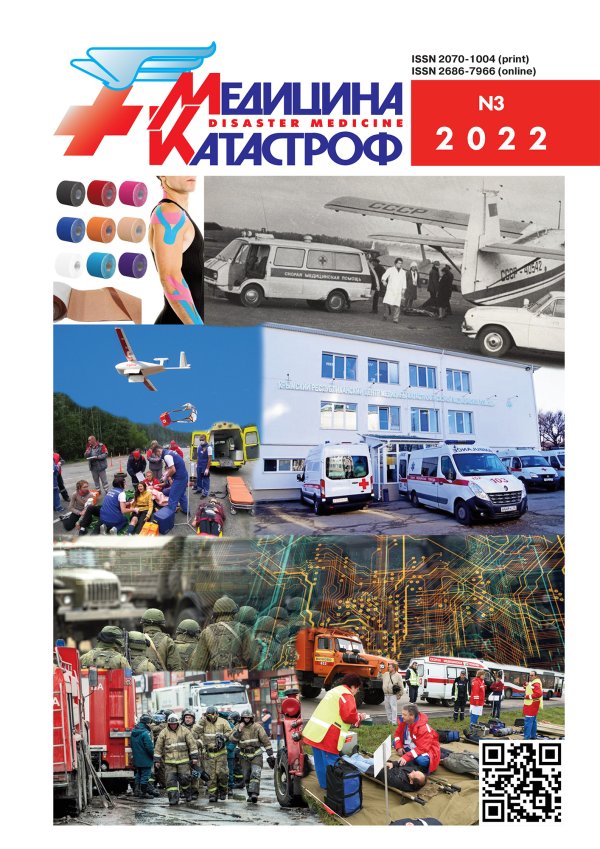
- Authors: Evdokimov V.I.1, Bobrinev E.V.2, Kondashov A.A.2, Gudz' Y.V.1, Magdanov D.F.1, Pankratov N.A.3
-
Affiliations:
- Nikiforov Russian Center of Emergency and Radiation Medicine, EMERCOM of Russia
- All-Russian Research Institute for Fire Protection, EMERCOM of Russia
- Department of Strategic Planning and Organizational Work, EMERCOM of Russia
- Issue: No 3 (2022)
- Pages: 17-22
- Section: Safety in Emergency Environment
- URL: https://journal-vniispk.ru/2070-1004/article/view/360240
- DOI: https://doi.org/10.33266/2070-1004-2022-3-17-22
- ID: 360240
Cite item
Full Text

Abstract
Summary. The aim of the study is to analyze the risks of fatalities among the personnel of the Federal Firefighting Service of the Ministry of Emergency Situations (EMERCOM) of Russia in 2006-2020 by categories of personnel, causes of fatal injuries, and types of professional activity.
Materials and research methods. Injury rates of Russian EMERCOM Federal Firefighting Service personnel were taken for 2006-2015 from the data bank on morbidity, injury, disability, and death during the performance of official duties in the Russian EMERCOM; for 2016-2020 — from the reports of the Ministry of Emergency Situations of Russia. Risks of death were calculated per 100 thousand people or ×10-5.
Results of the study and their analysis. Over 15 years (2006-2020), 224 members of the Federal Firefighting Service of the Russian EMERCOM died as a result of injuries received during the performance of their official duties, averaging (15±1) deaths per year. The average annual risk of death was (8.53±0.83)×10-5. That is statistically reliably lower, than the average risk for Russian Federation male workers — (13.23±1.12)×10-5 (p<0.01). The polynomial trends of the indicators of risk of death of Federal Firefighting service personnel and of male workers of the Russian Federation with different significance coefficients of determination show a decreasing trend in the data. The consistency of the trends is low and statistically insignificant (r=0.228; p>0.05), which may indicate the influence of different (multidirectional) leading factors on fatal injuries. The average annual risks of fatal injuries by causes of fatal injuries, types of professional activity and personnel categories were calculated.
About the authors
V. I. Evdokimov
Nikiforov Russian Center of Emergency and Radiation Medicine, EMERCOM of Russia
Email: 9334616@mail.ru
Dr. Sc. (Med.), Prof., Principal Research Associate St. Petersburg
E. V. Bobrinev
All-Russian Research Institute for Fire Protection, EMERCOM of Russia
Email: 9334616@mail.ru
Balashikha, Moscow region
A. A. Kondashov
All-Russian Research Institute for Fire Protection, EMERCOM of Russia
Email: 9334616@mail.ru
Balashikha, Moscow region
Yu. V. Gudz'
Nikiforov Russian Center of Emergency and Radiation Medicine, EMERCOM of Russia
Email: 9334616@mail.ru
St. Petersburg
D. F. Magdanov
Nikiforov Russian Center of Emergency and Radiation Medicine, EMERCOM of Russia
Email: 9334616@mail.ru
St. Petersburg
N. A. Pankratov
Department of Strategic Planning and Organizational Work, EMERCOM of Russia
Email: 9334616@mail.ru
Moscow
References
- Gammarano R. Quick guide on sources and uses of statistics on occupational safety and health. International Labour Organization. Geneva. 2020. 39 p.
- Takala J., Hämäläinen P., Saarela K.L., et. al. Global Estimates of the Burden of Injury and Illness at Work in 2012. J. Occup. Envir. Hyg. 2014;11:326-337. doi: 10.1080/15459624.2013.863131.
- Stanaway J.D., Afshin A., Gakidou E., et al. Global, Regional, and National Comparative Risk Assessment of 84 Behavioural, Environmental and Occupational, and Metabolic Risks or Clusters of Risks for 195 Countries and Territories, 1990–2017: a Systematic Analysis for the Global Burden of Disease Study 2017. Lancet. 2018;392(10159):1923-1994. doi: 10.1016/S0140-6736(20)30750-9.
- Ushakov I.B. Ekologiya Cheloveka Opasnykh Professiy = Ecology of Persons Engaged In Hazardous Occupations. Moscow, Voronezh Publ., 2000. 128 p. (In Russ.)
- Studenikin E.I. Vliyaniye Usloviy Professional’noy Deyatel’nosti na Nekotoryye Pokazateli Boyegotovnosti Lichnogo Sostava GPS = Influence of Professional Activity Conditions on Some Indicators of Combat Readiness of the Personnel of the State Fire Service. Extended abstract of candidate’s thesis in Technical Sciences. Moscow Publ., 1998. 24 p. (In Russ.)
- Aleksanin S.S., Bobrinev E.V., Evdokimov V.I., et al. Indicators of Occupational Traumatism and Mortality in Employees of Russian State Fire Service (1996–2015). Mediko-Biologicheskie i Social’no-Psikhologicheskiye Problemy Bezopasnosti v Chrezvychaynykh Situatsiyakh = Medicо-Biological and Socio-Psychological Problems of Safety in Emergency Situations. 2018;3:5-25. doi: 10.25016/2541-7487-2018-0-3-05-25 (In Russ.)
- Evdokimov V.I., Bobrinev E.V., Kondashov A.A., et al. Occupational Injuries in Categories of Personnel of Federal Fire Service of EMERCOM of Russia (2006–2020). Mediko-Biologicheskie i Social’no-Psikhologicheskiye Problemy Bezopasnosti v Chrezvychaynykh Situatsiyakh = Medicо-Biological and Socio-Psychological Problems of Safety in Emergency Situations. 2022;1:41-51. doi: 10.25016/2541-7487-2022-0-1-41-51 (In Russ.).
- Poroshin A.A., Kharin V.V., Bobrinev E.V., et al. Bank of Statistical Data on Morbidity, Injury, Disability and Death of Personnel of the EMERCOM of Russia Units in the Performance of Official Duties: Database Registration Certificate RU 2015621061, publ. 07/13/2015. (In Russ.)
- Matyushin A.V., Poroshin A.A., Kharin V.V., et al. Factorial Approach to Assessing the Injury Rate of Firefighters. Aktual’nye Problemy Pozharnoy Bezopasnosti = Actual Problems of Fire Safety. Scientific. Conf. Proceedings. Moscow Publ., 2015;3:222-227 (In Russ.)
- Afanas’ev V.N., Yuzbashev M.M. Analiz Vremennykh Ryadov i Prognozirovaniye = Time Series Analysis and Forecasting. Moscow Publ., 2001. 320 p. (In Russ.)
Supplementary files

