







 Email this article
 Specifics of Russian Paradiplomacy in the Post-Soviet Space
- Authors: Rustamova L.R.1, Calderon Anton J.2
-
Affiliations:
- Primakov National Research Institute of World Economy and International Relations, Russian Academy of Sciences
- University of Seville
- Issue: Vol 33, No 4 (2025)
- Pages: 578-593
- Section: International Relationships
- Submitted: 20.08.2025
- Accepted: 04.09.2025
- Published: 24.12.2025
- URL: https://journal-vniispk.ru/2413-1407/article/view/305296
- DOI: https://doi.org/10.15507/2413-1407.129.033.202504.578-593
- EDN: https://elibrary.ru/ljuzfa
- ID: 305296
Cite item
Full Text

Abstract
Introduction. The start of a special military operation in 2022 led to a rethinking of the priorities for the development of subnational foreign relations and an aggravation of the problem of lack of interaction with Russia's closest partners, the former territories of the USSR, which actualizes the study of the features of the paradiplomacy in the post-Soviet space. The purpose of the article is to study the specifics of paradiplomatic relations with the regions of the former Soviet republics and their participation in the development of integration processes.
Materials and Methods. The empirical basis of the study was formed by the available publications on the topic of interregional relations, the main documents regulating paradiplomatic relations, as well as materials from the websites of the Ministry of Foreign Affairs of the Russian Federation, institutional platforms through which external relations between regions and cities are carried out. The following methods are applied: historical and descriptive, comparative and qualitative content analysis.
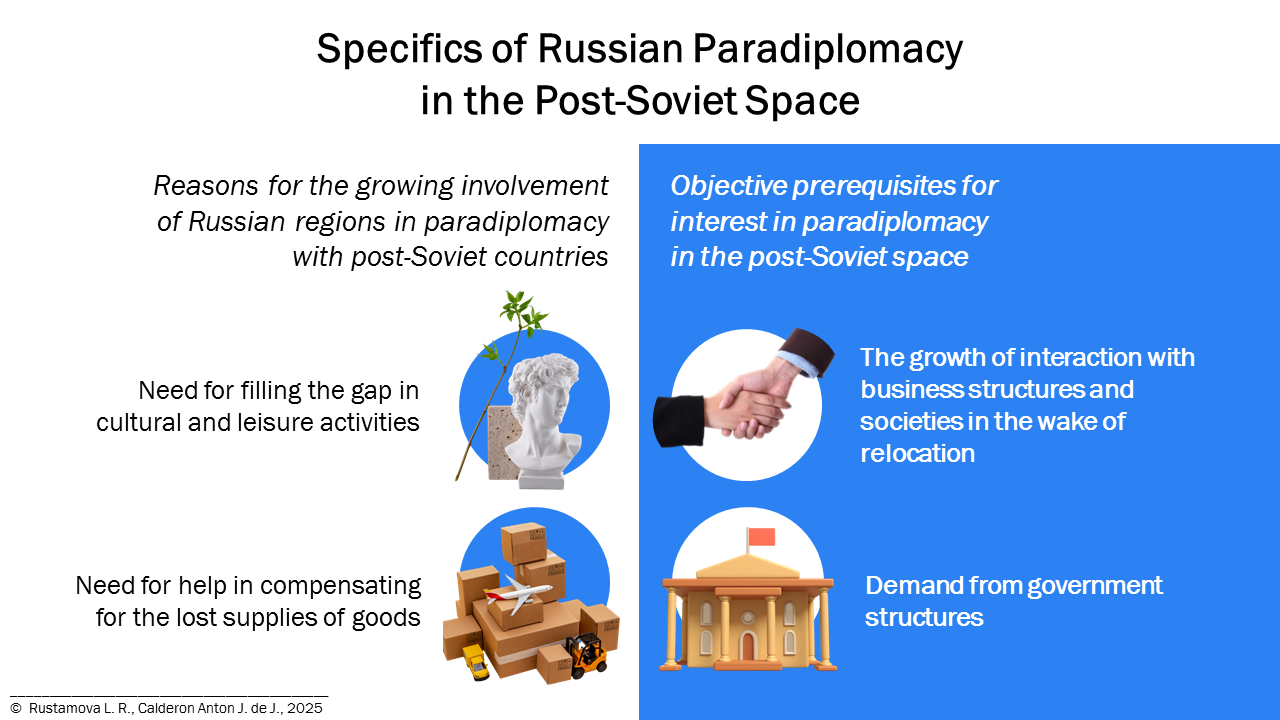
Results. It has been revealed that the transition of the regions from solving purely practical development issues within the framework of a paradigm shift to participating in integration projects began after the growing interdependence required progressive movement towards the introduction of further mechanisms for the freedom of movement of people, goods and services. After 2022, the regions became more actively involved in paradiplomacy with the countries of the former Soviet Union, because they could help compensate for the lost supplies of goods, as well as fill the gap in cultural and leisure activities. It is determined that the objective prerequisites for interest in paradiplomacy in the post-Soviet space were the growth of interaction with business structures and societies in the wake of relocation, as well as demand from government structures.
Discussion and Conclusion. The events of 2022 showed that there are significant limitations to paradiplomacy as a tool for influencing international relations, but it is a real tool for moving integration from below, through the involvement of local governments in solving common problems in the field of governance, socio-economic and problems related to cross-border threats in the post-Soviet space. The factors of trust in regional players as intermediaries of integration are the participation of representatives of non-governmental structures in projects of paradiplomacy, their focus on solving common development problems, taking into account territorial specifics. The results of the work can form the basis for further research, and will also be useful in developing foreign policy decisions by ministries and departments responsible for regional foreign relations in the post-Soviet space.
Full Text
Introduction
The term “paradiplomacy” has been conceptualized in Western academic circles and emerged in the late 20th century in political science and international relations scholarship in the context of globalization, European integration, and decentralization trends.
The “para” prefix signals subnational diplomacy that runs alongside national diplomacy. I. Duhaček defines that adding “para” to “diplomacy” denotes regional governments’ international policies which may be “parallel, coordinated, or complementary to the central government’s policies but could also conflict with the country’s international policies”1. In other words, paradiplomacy is an external activity that can support or even challenge national diplomacy, depending on context. International engagement undertaken by subnational political units, operating alongside and often in collaboration with the foreign policy apparatus of the central government, though potentially pursuing objectives that may complement or diverge from national diplomatic agendas.
I.Duhaček develops three different categories of paradiplomacy: (i) transborder2, which refers the international cooperation and policy-making conducted by subnational governments3; (ii) transregional, is the international engagement of subnational governments with counterparts in non-contiguous or distant regions, often based on shared interests, economic ties, cultural links, or policy goals rather than geographic proximity, and global paradiplomacy, that’s refers to the international outreach of subnational governments that extends beyond their immediate neighbors or regional partners, involving engagement with actors and institutions worldwide on economic, cultural, environmental, or political issues.
Russian paradiplomacy in the post-Soviet space is a distinct case because it blends subnational foreign outreach with the central government’s geopolitical strategy, often in ways that blur the line between local initiative and Moscow-driven policy. In the Russian context, paradiplomacy refers mainly to the international activities of the federal subjects (regions, republics, territories, and cities) that engage with counterparts in the former Soviet republics4 and regions and cities of the far abroad.
During the Soviet period, Soviet cities and regions actively built ties within the Warsaw Pact commonwealth. After the collapse of the USSR, many ties were destroyed and the paradiplomacy of the now former socialist republics and partners within the socialist bloc underwent changes, which affected the level of interstate relations and their intensity.
This article aims to study the specifics and evolution of paradiplomatic ties with the regions of the former Soviet republics, their participation in the development of integration processes since after the start of the special military operation in 2022, there was a rethinking of the priority areas for the development of paradiplomacy and an acute problem of lack of interaction with the closest partners in the post-Soviet space. The most acute need arose for connecting interregional ties in order to deepen integration in the post-Soviet space, improve the current socio-economic indicators of life of the population, etc. Despite the declared priority of the turn to the East, it is the post-Soviet space that, in terms of receiving advantages from paradiplomacy, stands out from other areas because, firstly, Russia has a common border with most countries of the post-Soviet space and, in general, the barriers are low due to the fact that there are agreements on a visa-free regime with almost all of them, except Georgia and Ukraine. Secondly, the post-Soviet space is united by a historical basis for interaction and established cultural ties, which facilitate dialogue at the local level. Thirdly, the post-Soviet states already have many formats of interaction within the framework of institutions for strengthening local self-government and paradiplomacy, which until now have not been sufficiently used to solve common problems that unite the countries of the region.
Literature Review
Studying how regions build paradiplomatic ties, a number of researchers also introduced their own terms to designate the factors that determine the reasons for regions entering the international arena. Thus, based on studying the experience of building external ties based on linguistic and ethno-cultural proximity of regions, Canadian political scientist S. Paquin introduced the concept of identification paradiplomacy [2]. N. Cornago introduced the concept of protodiplomacy, distinguishing it from paradiplomacy5. While paradiplomacy involves established subnational entities engaging in international relations, protodiplomacy pertains to emerging or nascent entities seeking to assert their presence and legitimacy on the international stage.
Russian researchers have also significantly enriched this research area. Thus, Y. Akimov introduced the concept of auxiliaries diplomacy, which implies joint international activities of the center and a subnational unit, in which the region acts as an instrument for achieving national goals [3]. The works of Russian authors on paradiplomacy note the great success of European regions in paradiplomacy and the main volume of works on the topic of paradiplomacy is concentrated on the study of the European experience or the study of how Russian regions interact with the regions of Western countries. Authors such as M. Strezhneva [4], O. Bogatyreva, N. Leskina [5], S. Arteev [6] study the phenomenon of European paradiplomacy in the context of globalization and European integration. A large group of authors devoted their works to the study of individual cases of external relations of Russian and European regions. Thus, I. Rogachev, S. Shubin [7] studied the interaction of the northern regions of Russia with the regions of Norway, A. Volkova devoted her works to the peculiarities of the interaction of Russian regions with the Finno-Ugric world [8]. L. Rustamova [9], G. Yarovoy [10], A. Bredikhin [11] wrote about special opportunities for paradiplomacy using the example of cooperation between border regions in the format of Euroregions. At the same time, the post-Soviet space also began to attract attention from the point of view of the possibilities of paradiplomacy to contribute to its formation. Some of the articles devoted to the post-Soviet space also paid attention to the adoption of European experience in the format of Euroregions. A. Kuznetsov [12], considered in their works the efficiency of the functioning of Euroregions created by the regions of Russia, Belarus and Ukraine.
A separate large category of studies is made up of works that focus on the study of cross-border cooperation of post-Soviet states, since the problems of border regions for Russia as a country with a huge border perimeter is of particular importance. In Russian science, a whole direction of studying border territories is being formed under the name of limology, which studies the functioning of borders. The works of L. Vardomsky [13], E. Shlapenko [14] are devoted to studies of the peculiarities of international activities of border regions of Russia with neighboring post-Soviet states. The works of such authors as I. Antokhonova, S. Kalenova6, F. Zolotarev [15], O. Bahlova, A. Slugina7 provide an understanding of the level of relations between Russian regions and regions of post-Soviet countries on economic issues, however, there are no comprehensive works on the influence of external relations of Russian regions and regions of post-Soviet countries on the development of integration in the post-Soviet space. The novelty of this article lies in the fact that it studies the formats of interregional cooperation that were created after 2022 thanks to paradiplomacy. Given that these processes have not yet received adequate coverage in the scientific literature, and it analyzes paradiplomacy without linking it to the integration processes that it actually facilitates this article aims to fill this gap.
Materials And Methods
Theoretical and methodological foundations of the research. The study is based on the neoliberal theory of international relations, which postulates that such non-state participants in world politics as regions and cities are capable of promoting the intensification of economic cooperation between states and their unification into integration unions. Interaction between regions and cities is interpreted here through the prism of the institutional approach, within the framework of which this sphere of interaction is designed to promote greater sustainability of integration associations in the post-Soviet space and the further development of the organizational and legal form of existing paradiplomatic platforms, since regions promote cooperation in the spheres of culture, sports and represent socio-political institutions responsible for managing social transformations, as well as the ideological, political and socio-economic basis of integration processes.
Neoliberal theory emphasizes the role of international institutions, rules, and cooperation mechanisms in shaping state and sub-state behavior. The approach pays attention to economic interdependence, trade, and social ties as instruments of influence.
The study design. The study is based on such qualitative methods of study as historical-descriptive and comparative methods of analysis. The historical-descriptive method will allow tracing the evolution of paradiplomatic ties between the states of the post-Soviet space, the historical basis of their interaction. To trace the historical dynamics of relations between regions and cities in the post-Soviet space, key milestones of their cooperation were identified, namely, accession to institutional platforms and the signing of bilateral agreements from 1991 to 2022 and then from 2022 to the present.
The comparative method of analysis will allow us to highlight the specifics of interregional cooperation in the post-Soviet space through a comparison of Russian-European forms of paradiplomacy and those that have developed between Russia and the former Soviet republics. This approach is suitable because neoliberalism allows us to see non-state actors (separatist governments, diaspora organizations, NGOs) as legitimate international players. The following main criteria were taken as the basis for comparison: the level of institutionalization (the presence or absence of Euroregions, local government organizations), the level of involvement of civil structures in paradiplomacy (the presence of non-governmental local government organizations, business structures, public diplomacy organizations in projects for the development of paradiplomacy), the level of barriers at borders (agreements on visa-free border crossing, the presence of projects for the joint resolution of cross-border problems), the main areas of cooperation in paradiplomacy (cultural events, socio-economic and infrastructure projects, management projects), the influence of the political situation on the nature of relations.
Based on a content analysis of documents such as the Agreement on the Council for Interregional and Cross-Border Cooperation of the Member States of the Commonwealth of Independent States, Convention on Cross-Border Cooperation among the CIS member states, the Agreement on the Belarusian-Russian Business Council, the Concept of Interregional and Cross-Border Cooperation of the CIS Member States, and the Declaration on the Development of Cross-Border Cooperation in the Altai Region, the authors analyzed the conceptual foundations of paradiplomacy. The analysis of these documents also allowed us to identify the specifics of the institutional platforms within which paradiplomatic relations between post-Soviet regions are implemented, and to draw conclusions regarding the goals and objectives of regions in building external relations with partners from the post-Soviet space.
Databases and materials. The materials in this work include studies by leading Russian and foreign authors on the topic of paradiplomacy and interaction between post-Soviet states at the interregional level. Statistical data were taken from official sources: the website of the Ministry of Foreign Affairs of the Russian Federation (regional information reports on external relations), as well as the websites of institutional platforms through which external relations between regions and cities are carried out: the International Assembly of Capitals and Major Cities of CIS, Twin Cities International Association (TCIA), the CIS website, the Portal for Interregional Cooperation in the EAEU, and websites that host key legal documents: the EAEU website, and websites of the international departments of individual constituent entities of Russia, which were taken as key cases for analysis due to their active involvement in paradiplomacy with the post-Soviet countries and ability to host major international events: the Republic of Tatarstan, the Republic of Bashkortostan, Altai Territory.
Results
The nature of paradiplomatic relations between Russian regions and post-Soviet ones until 2022. Attention to paradiplomacy instruments that would compensate for lost economic ties and mitigate the consequences of the formation of new borders after the collapse of the USSR began to be paid after the accession of the newly formed republics to the European Outline Convention on Transfrontier Cooperation between Territorial Communities or Authorities of 21 May 1980. At the same time, the way paradiplomacy was implemented relied to a large extent on the European experience. In particular, based on the European experience of interaction between border regions, Russian regions began to unite with post-Soviet ones in the form of Euroregions. Since the 2000s, the regions of Russia, Ukraine and Belarus have united into 4 Euroregions, “Dnipro” (2003), “Slobozhanshchina” (2003), “Yaroslavna” (2007) and “Donbass” (2010), in order to prevent the growth of barriers and jointly service the common Soviet infrastructure, stimulate the investment attractiveness of the regions. This helped the regions of Russia and post-Soviet states to join European local government organizations, where they could receive advanced local governance practices and share their experience in building foreign trade through paradiplomacy. Russian regions actively interacted with post-Soviet regions within the framework of the Congress of Local and Regional Authorities of the Council of Europe, which included representatives of Azerbaijan, Moldova, Armenia and Ukraine. At the same time, in contrast to the European experience, paradiplomacy in the post-Soviet space was characterized by low institutionalization and a small number of organizations that would engage in public diplomacy through external relations of regions.
Russian regions have not created local public diplomacy and paradiplomacy organizations with post-Soviet countries such as the Assembly of European Regions, which would lobby the interests of regions in integration associations: the Commonwealth of Independent States (CIS), the Eurasian Economic Union (EAEU) or intergovernmental organizations of the former Soviet Union. Certain institutional platforms have begun to appear relatively recently, including the Council for Interregional and Cross-Border Cooperation of the Member States of the Commonwealth of Independent States, created in 2008, which consists of heads of ministries responsible for interregional and cross-border cooperation, which essentially reflects its governmental level. A similar structure within the EAEU – the Eurasian Economic Commission for the Development of Interregional Cooperation was created on a similar model. The Commission pursues the same goal as the CIS Council for Interregional Cooperation: ensuring the participation of local authorities in resolving those issues on the international agenda that affect their interests.
Paradiplomacy of European regions leads to the formation of a “Europe of regions” through the abolition of old borders within the EU and, thus promotes integration processes at the horizontal level. In contrast to the EU experience, consolidation around the ideas of integration in the post-Soviet space through paradiplomacy has hardly advanced; for a long period of time, it was focused on solving purely practical problems. The regions of the post-Soviet space mainly implemented projects on practical issues of territorial management that are of primary importance for the socio-economic status of citizens, especially with regard to cooperation between border regions. On the one hand, this was due to the fact that a number of states participating in the integration processes did not want further delegation of sovereignty through such a mechanism. Thus, in the Convention on Interregional Cooperation of the Member States of the Commonwealth of Independent States until 2020, Tajikistan specifically stipulated that it was interested in precisely those areas of interregional cooperation that have practical significance8.
At the same time, practical projects for the development of mutual trade between regions, joint struggle against socio-economic challenges led to greater interest of regions in participation in integration processes, because such projects led to interdependence. Thus, since Belarus is the main trading partner of a number of border regions of Russia, this predetermined their interest in expanding cooperation in the cultural, humanitarian, information, educational spheres and the creation of the first institutional formats of interaction – business cooperation councils with Belarus, while, according to experts, interregional cooperation for a long time was not fixed as integration priorities in the main documents of the integration association “Union State of Russia and Belarus” [16].
In order to maintain the current level of investment attractiveness, attract tourists, and maintain an intensive level of trade, the regions needed to ensure progressive movement towards freedom of movement of goods, people, and services. The regions relied on paradiplomacy, implemented in the format of fairs, business forums, and conferences, in order to bring together entrepreneurs, investors, local authorities, and the expert community, and this created objective prerequisites for involving the regions in integration processes in the post-Soviet space. On the other hand, the states also saw the benefits of the multi-level interaction with various actors created by the regions and encouraged their participation through paradiplomacy in areas related to security. A number of regions of Russia and post-Soviet countries signed agreements on joint actions to eliminate and prevent emergency situations.
The influence of paradiplomacy on integration processes in the post-Soviet space. At the level of the CIS and EAEU integration associations, the goal of involving regions in deepening integration has been officially proclaimed since 2004, when the Concept of Interregional and Cross-Border Cooperation of the CIS Member States was signed9. The current concept of interregional cooperation of the CIS, adopted in 2020, already specifically stipulates that deepening regional cooperation pursues the goal of deepening integration10. After 2022, this goal has become strategic for Russia. Russian regions and regions of CIS countries can help each other in many ways, compensate for lost foreign supplies of goods, as well as fill the gap in cultural and leisure activities, cooperating in the cultural and humanitarian field. To stimulate the solution of these goals, the EAEU integration association created the Portal for Interregional Cooperation and thus transferred the initiative to deepen integration to the regions through its paradiplomatic activities. On the portal, any region of the member countries of the association can post information about the main economic indicators of the region, current regional preferences and benefits for investors, events and news, with the aim of attracting partners to cooperation11. This measure is aimed at stimulating the EAEU economy, since, as noted by experts on Eurasian integration from Kyrgyzstan K. Azhekbarov and D. Amangaldiev, the overwhelming majority of trade in the EAEU is carried out through large cities and capitals [16].
Analyzing the prospects of Eurasian integration, experts noted that one of the weak points in the Eurasian integration project for many years was the insignificant migration and tourism dynamics from Russia to the CIS/EAEU countries, against the background of the scale of labor migration to the Russian Federation. After the introduction of anti-Russian sanctions, tightening of visa restrictions and border closures, which limited the ability of Russian citizens to travel for tourism purposes to EU countries, the countries of the post-Soviet space have become more popular destinations for tourism from Russia. According to a study by the YouTravel marketing platform, almost all countries of the post-Soviet space in 2025 have become more attractive tourist destinations for Russians12. For the first time, business structures and individual citizens have begun to show great interest in paradiplomacy. On the wave of relocation, they began to invest in the attractive tourist regions of Central Asia and the South Caucasus and needed the help of regional authorities to do business. At the same time, this process became mutual. The departure of Western companies from the Russian market freed up space for the growth of investment by Central Asian countries in the Russian economy. In 2022, it grew fourfold compared to 2021 and amounted to more than $ 4 billion13.
A new stage in paradiplomacy in the post-Soviet space after 2022. The regional leaders themselves have shown activity in the area of paradiplomacy in the post-Soviet space in order to minimize the impact of sanctions pressure on the socio-economic situation in the regions. The regions began to look for alternative suppliers and alternative economic partners, primarily from the post-soviet countries closest to Russia. Thus, Tatarstan, in addition to the Middle East, has also become more active in Central Asia, organizing bilateral economic forums. This allowed the region to open new production capacities by creating joint ventures (for example, a car tire plant in the Karaganda region), maintain the high potential of special economic zones in the republic and create new jobs. At the same time, the international activity of the regions had a compensating effect on Russia's foreign policy, since the regions had more opportunities to organize significant international events and thus offset Russia's diplomatic isolation. Russian regions in the post-Soviet space have more opportunities for interaction even in the context of emerging tensions at the interstate level due to the preserved special cultural and historical ties. A number of regions of Russia and Central Asia interact as parts of the Turkic world and host many cultural events of international significance. Thus, Tatarstan and Bashkortostan took part in the Nomad Games, which were held in Astana in 2024 and won a large number of medals, which, given the vast geography of the participants (89 countries)14, contributed to strengthening the authority of not only the regions themselves, but also Russia as a whole.
Participation in paradiplomacy with Russian regions is in demand among the regions of post-Soviet countries, and this is evidenced by the fact that over the past 3 years the number of agreements on establishing twinning relations between Russian and post-Soviet cities has increased. Twinning agreements were concluded between Astrakhan and the Kazakh cities of Atyrau and Aktau, between Yaroslavl and the Belarusian city of Mogilev, between Yekaterinburg and the capital of Kyrgyzstan Bishkek, between Vologda and the Armenian Gyumri. In the tourist regions of the post-Soviet space, regional authorities support the construction of infrastructure and unique recreation areas, create organizations to attract tourists from Russia and exchange experiences. The regions of post-Soviet countries organize new formats of interaction, including Forum of Regions of the CIS Member States fist held in 2025 in Tashkent – a multilateral platform within which representatives of the CIS countries discuss key aspects of economic, social and humanitarian interaction15. The regions also demonstrated constructive cooperation across the entire spectrum of issues, including security. Thus, in 2023, the Atyrau region of the Republic of Kazakhstan and the Astrakhan Region of the Russian Federation signed an agreement on cooperation in providing assistance to people, ships and aircraft in distress in the Caspian Sea. These regions also involved business structures in the implementation of measures to resolve emergency situations. Thus, the UTair group of companies agreed to provide gratuitous assistance in eliminating natural and man-made emergencies, including fires, in Kazakhstan16.
Analyzing the current level of interregional relations in the post-Soviet space and the possibilities of paradiplomacy in this region, foreign researchers note that regional relations for the leadership of post-Soviet states perform the most important task of maintaining a balance of relations with all interested regional and extra-regional players17. Here it is more appropriate to say that due to the intensification of relations between the CIS countries with each other, extra-regional players need to make additional efforts to offer more favorable terms of cooperation. The expansion of paradiplomatic activity for the post-Soviet countries now is a real chance to gain access to innovations in urban planning and development, experience in solving practical problems of territorial management, and improving their socio-economic indicators. Russian regions have actively joined the implementation of projects in strategically important sectors of the economy for a number of post-Soviet states. Thus, cooperation with Tajikistan in ensuring food security has intensified. In early 2024, a Tajik-Russian agreement was reached on the supply of oilseeds from Russia to Tajikistan, their cultivation and processing, which will help reduce poverty at the local level18.
Russia employs a multifaceted approach in its paradiplomatic efforts in Transnistria or South Ossetia aiming to maintain influence in the post-Soviet space and counter Western integration efforts. This includes financial aid and economic integration with Russian markets, which helps sustain the region's economy and political stability.
At the same time, it cannot be denied that in the post-Soviet space, paradiplomacy is influenced by the situation in bilateral relations, when government agencies of the states limit contacts, including in the public sphere, by introducing restrictions on the movement of citizens, the exchange of information and the financing of bilateral paradiplomatic projects. As a result, the distinctive feature of paradiplomacy in the post-Soviet space remains the varying degrees of involvement in cooperation by country (high with Belarus and Kazakhstan, low with Georgia and Ukraine), as well as different levels of participation in paradiplomacy: somewhere there is a desire to participate at the level of integration associations, and somewhere only at the level of bilateral formats.
Discussion and Conclusion
Researchers highlight such objective problems of interregional cooperation in the post-Soviet space as disproportions in territorial development and financing, different degrees of interest in cooperation, discrepancies in the regulatory framework, etc., which affect the possibilities and limitations of paradiplomacy to act as an integration tool19. The inclusion of a wider range of participants in paradiplomacy programs and cooperation at the level of macroregions, especially in border regions, could help solve the problems of insufficient funding. The project “Our Common Home – Altai”, which was founded in 2004 by regions of Russia, Kazakhstan, Mongolia, China on the basis of the Declaration on the Development of Transborder Cooperation in the Altai Region, in this regard serves as a positive example of a skillful combination of cultural and economic projects for the prosperity of border regions of the entire macroregion. Within the macroregion, intrastate regions alternately hold cultural events, such as the tourist and sports festival “Big Altai”, thus building a balance of project financing, as well as encouraging interest in joint investment in circular tourist routes and the construction of new transport routes that accelerate contacts. This type of transport route includes the project of a new checkpoint “Karagay” on the border with Kazakhstan and the opening of an international terminal at the Gorno-Altaisk airport20. In order for paradiplomacy to contribute to integration processes, this practice must be extended to other territories.
The negative experience of terminating projects with European border regions, stopping interregional contacts with Ukraine and Georgia have led to the fact that paradiplomacy is strongly influenced by the negative political situation. The readiness of local authorities to strengthen contacts is influenced by statements by individual politicians, negative events occurring at the level of interstate relations, and the tense migration situation. This approach could be softened by strengthening the role of institutional structures that would create mechanisms to minimize the impact of the current situation in interstate relations on paradiplomacy projects. In the post-Soviet space, such a role could be taken on by the International Assembly of Capitals and Major Cities of CIS. The problem is that the potential of this organization remains poorly utilized; it is focused on the humanitarian agenda, which is less interesting for the former Soviet republics than economic issues or infrastructure projects to develop a network of transport corridors. In particular, the Assembly's events are held mainly on Russian territory and its agenda is heavily biased towards purely domestic specifics of regional development; they are focused on cultural projects and only a few are devoted to socio-economic issues21.
This problem is further exacerbated by the fact that little attention has been paid in the post-Soviet space to research on the functioning and institutionalization of interregional contacts and their contribution to strengthening integration between states. There are no separate research institutes that address these issues, lobby for interregional cooperation across the entire post-Soviet space, or provide information on the scope of paradiplomatic contacts or high-quality analysis of the problems and current state of interregional interaction. This is an objective limitation for this study as well. Such analysis would be of interest both to the regions themselves and to the supranational structures mandated by their governments to strengthen interactions between regions and cities.
The situation in relations also plays a lesser role if the regions are involved in solving national projects, sustainable development programs, which are long-term and involve a significant part of the population and business circles. Currently, in the post-Soviet space, there is a decline in interregional relations with the countries of the South Caucasus. Commenting on Russia's relations with the countries of the region, experts point out that the regions of Azerbaijan, Armenia and Georgia, located in a strategically important area connecting transport routes from China to Europe and back, could take part in paradiplomacy. By involving the regions in the construction of new transport routes, it would be possible to create conditions for mutually beneficial interdependence, and they name the construction of a main gas pipeline from Russia to Iran through the territory of Azerbaijan as a possible similar project. This project could include the modernization of the Russian-Azerbaijani Mozdok-Hajigabul gas pipeline22.
Low barrier borders in comparison with Europe also open the way to unfair use of the advantages of interregional cooperation, which leads to such border problems on the border with post-Soviet countries as smuggling, illegal migration and the whole range of cross-border security threats.
Tightening control measures and introducing other restrictive measures may lead to a slowdown in cooperation. On the contrary, involving local authorities in solving these problems and educating conscious youth aimed at jointly finding ways to solve problems through paradiplomacy can help in the fight against cross-border threats. Best practices in creating effective local government organizations indicate that long-term programs for the education of management personnel in the field of paradiplomacy help prepare regional leaders capable of preparing creative projects to solve the tasks that are usually set before paradiplomacy. So far, such work within the framework of paradiplomacy is carried out only with those states with which the most intensive cooperation has been built. In particular, in 2023, the Forum of Sister Cities of Belarus and Russia held for the first time a youth meeting of representatives of sister cities of Belarus and Russia.
In a good forecast scenario, Russian paradiplomacy will mature into a coordinated, well-resourced, and respected arm of foreign policy in the post-Soviet space. Regional actors are trusted as facilitators of integration, and their activities are seen not as extensions of the central policy, but as part of a shared Eurasian identity and mutual prosperity project, creating an integrated Eurasian community. This article presents part of an analysis of the potential and limitations of paradiplomacy to facilitate integration processes, strengthen economic cooperation, and enhance interaction with partners. This analysis has practical implications for interregional cooperation organizations, ministries and agencies overseeing regional external relations. Given that integration associations in the post-Soviet space are actively developing, their legal framework is expanding, and the process of conceptualizing the foundations of paradiplomacy in the post-Soviet space is underway, it is necessary to continue research on how paradiplomacy can advance integration.
Supplementary Information
Conflict of interest. The authors declare no conflict of interest.
Contribution of the authors:
L. R. Rustamova – conceptualization; methodology; visualization; investigation, data collection; writing – original draft preparation (including substantive translation).
J. de J. Calderón Antón – investigation, data collection; writing – original draft preparation (including substantive translation).
Availability of data and materials. The datasets used and/or analyzed during the current study are available from the authors on reasonable request.
1 Duchaček I.D. Perforated Sovereignties: Towards a Typology of New Actors in International Relations. In: Federalism and International Relations: The Role of Subnational Units. H. J. Michelmann, P. Soldatos. Oxford: Oxford University Press; 1990. Рр. 11–33.
2 Here is important to point the difference between cross-border and trans-border cooperation while the first refers to adjacent areas directly on either side of a shared border (local/region). The second is a broader term; can mean any activity or cooperation that crosses borders, including between distant regions or multiple countries.
3 This vision gives the concept a geographic focus in which emphasizes border regions (e.g., Karelia with Finland, Kaliningrad with Poland/Lithuania, Far East with China) and post-Soviet neighbors under CIS/Eurasian integration frameworks.
4 Ukraine, Belarus, Moldova, Estonia, Latvia, Lithuania, Georgia, Armenia, Azerbaijan, Uzbekistan, Kazakhstan, Kyrgyzstan, Tajikistan, and Turkmenistan.
5 Cornago N. Paradiplomacy and Protodiplomacy. In: Encyclopedia of Diplomacy. G. Martel (ed.). Oxford: Blackwell-Wiley; 2018. Pp. 1458–1466. https://doi.org/10.1002/9781118885154.dipl0211
6 Антохонова И.В., Каленова С.А. Потенциал и ограничения межрегионального экономического сотрудничества на евразийском пространстве. В кн.: Россия: тенденции и перспективы развития: Ежегодник. Вып. 12. 2017. Ч. 2. С. 207–209. URL: https://clck.ru/3PmRbn (дата обращения: 05.06.2025).
7 Бахлова О.В., Слугина А.Н. Приграничное сотрудничество регионов Российской Федерации и Республики Беларусь: возможности институционализации в формате Союзного Государства. В кн.: Россия: тенденции и перспективы развития… Вып. 2. 2021. С. 789–792. URL: https://clck.ru/3PmeRX (дата обращения: 05.06.2025).
8 Convention on Cross-Border Cooperation among the CIS member states, signed in September 2016 [Электронный ресурс]. Available at: https://cislegislation.com/document.fwx?rgn=96956&ysclid=mdza4aeeth316167295 (accessed 18.04.2025).
9 Концепция межрегионального и приграничного сотрудничества государств – участников СНГ [Электронный ресурс]. URL: https://e-ecolog.ru/docs/dGutIlkq20JXLGL9ntHgM/full (дата обращения: 18.04.2025).
10 Концепция межрегионального и приграничного сотрудничества государств – участников СНГ на период до 2030 г. и План мероприятий по ее реализации [Электронный ресурс]. URL: https://cis.minsk.by/reestrv2/doc/6289#text (дата обращения: 18.04.2025).
11 Развитие межрегионального торгово-экономического сотрудничества в ЕАЭС [Электронный ресурс]. URL: https://clck.ru/3PW65u (дата обращения: 11.05.2025).
12 Эксперты рассказали о спросе на туры в постсоветские страны [Электронный ресурс]. Прайм. URL: https://1prime.ru/20250727/eksperty-859990819.html (дата обращения: 18.06.2025).
13 Karavayev A. CIS and the Caspian Region: main outcomes and trends of 2023 [Электронный ресурс]. Caspian institute for strategic studies. URL: https://clck.ru/3PW6ZD (дата обращения: 18.06.2025).
14 Хасанов С. Больше трети медалей в копилке Татарстана: как прошли 5-ые Всемирные Игры Кочевников [Электронный ресурс]. Миллиард татар. URL: https://clck.ru/3PW6df (дата обращения: 18.06.2025).
15 Генеральный секретарь СНГ С. Лебедев выступил на пленарном заседании первого Форума регионов государств – участников СНГ [Электронный ресурс]. Официальный сайт СНГ. URL: https://e-cis.info/news/564/127067/?ysclid=mdmay67u49526790253 (дата обращения: 18.06.2025).
16 UTair and Kazaviaspas expand cooperation [Электронный ресурс]. K&M Information agency. URL: https://www.akm.ru/eng/press/utair-and-kazaviaspas-expand-cooperation/?ysclid=me0s33m22j603377944 (дата обращения: 18.06.2025).
17 Symeonidis D. Regional Paradiplomacy in Central Asia: New Opportunities? [Электронный ресурс]. Central Asian Bureau for Analytical Reporting. URL: https://cabar.asia/en/regional-paradiplomacy-in-central-asia-new-opportunities (дата обращения: 18.06.2025).
18 Таджикистан–Россия: ускорение экономического сотрудничества в условиях геополитических перемен [Электронный ресурс]. Интернет-портал СНГ. URL: https://e-cis.info/news/566/117904/?ysclid=m8jz38ho5e449436320 (дата обращения: 18.06.2025).
19 Vardomsky L.B. Cross-border cooperation on the “new and old” borders of Russia. Eurasian Economic Integration. 2008;1(1):90–107.
20 Заседание Международного совета «Наш общий дом – Алтай» [Электронный ресурс]. Информационный портал о выборах. URL: https://clck.ru/3PW79c (дата обращения: 18.06.2025).
21 План мероприятий Международной Ассамблеи столиц и крупных городов (МАГ) на 2025 год [Электронный ресурс]. URL: https://e-gorod.ru/wp-content/uploads/2025/06/2025_plan_mag.pdf (дата обращения: 18.06.2025).
22 Задача на $8 млрд: какие мегапроекты позволят Азербайджану и России нарастить товарооборот [Электронный ресурс]. Интернет-портал СНГ. URL: https://e-cis.info/news/566/125980/ (дата обращения: 18.06.2025).
About the authors
Leili R. Rustamova
Primakov National Research Institute of World Economy and International Relations, Russian Academy of Sciences
Author for correspondence.
Email: leili-rustamova@yandex.ru
ORCID iD: 0000-0001-9803-9904
SPIN-code: 2941-9393
Scopus Author ID: 56469579000
Cand. Sci. (Polit.), Researcher at the Center for Post-Soviet Studies
Russian Federation, 23, Profsoyuznaya Str., Moscow, 117997Jose de Jesus Calderon Anton
University of Seville
Email: joscalant@alum.us.es
ORCID iD: 0009-0008-2877-3036
PhD candidate, Research Assistan
Spain, 4 San Fernando St., Seville 41004References
- Tarasova A.S. Modern Trends in Paradiplomacy: A Case of Russian-Finnish Regional Cooperation. Baltic Region. 2023;15(3):83–99. (In Russ., abstract in Eng.) https://doi.org/10.5922/2079-8555-2023-3-5
- Paquin S. Identity Paradiplomacy in Québec. Quebec Studies. 2018;(66):3–26. https://doi.org/10.3828/qs.2018.14
- Akimov Yu.G. International Activities of Subnational Actors and Foreign Policy of the Nation State: Models of Interaction and Interpretations. Comparative Politics. 2021;12(3):33–41. (In Russ., abstract in Eng.) Available at: https://www.sravpol.ru/jour/article/view/1363 (accessed 10.05.2025).
- Strezhneva M.V. Supranationality and the Subsidiarity Principle in the European Union and Beyond. World Eсonomy and International Relation. 2016;6(60):5–14. (In Russ., abstract in Eng.) https://doi.org/10.20542/0131-2227-2016-60-6-5-14
- Bogatyreva O.N., Leskina N.V. Educational Diplomacy of European Regions. Izvestiya Uralskogo federalnogo universiteta. Seriya 3: Obshchestvennye nauki. 2018;3(179):67–78. (In Russ.). Available at: http://elar.urfu.ru/handle/10995/62856 (accessed 10.05.2025).
- Arteev S.P. Subnationalization as a Megatrend: World Development after Westphalia. Journal of Law and Administration. 2024;20(4):3–14. (In Russ., abstract in Eng.) https://doi.org/10.24833/2073-8420-2024-4-73-3-14
- Rogachev I.V., Shubin S.I. Arctic Universities of Russia and Norway Expand Cooperation in the Barents Euro-Arctic Region. Тomsk State University Journal of History. 2019;(58):194–196. (In Russ., abstract in Eng.) https://doi.org/10.17223/19988613/58/29
- Volkova A.E. The Concept of the “Finno-Ugric World”: Centrifugal Trends and Impact on the Domestic and Foreign Policy of the Russian Federation. Central Russian Journal of Social Sciences. 2015;10(3):226–234. (In Russ., abstract in Eng.) Available at: https://naukaru.ru/en/nauka/article/6162/view (accessed 05.06.2025).
- Rustamova L.R. Problems and Prospects of Cross-Border Cooperation in Euroregions with Russian Participation. Russian Journal of Regional Studies. 2019;27(4):711–733. (In Russ., abstract in Eng.) https://doi.org/10.15507/2413-1407.108.027.201904.711-733
- Yarovoy G. EU-Russian Cross-Border Cooperation between (de-)Securitization and Paradiplomacy: In Search of New Approaches towards Cross-Border Governance. Vestnik of Saint Petersburg University. International Relations. 2021;14(2):156–181. (In Russ., abstract in Eng.) https://doi.org/10.21638/spbu06.2021.203
- Bredihin A.V. Agglomerations and Cross-Border Cooperation: A Case Study of Donbass Region. Cossacks. 2016;(18):36–48. (In Russ., abstract in Eng.) Available at: https://clck.ru/3PmPFB (accessed 05.06.2025).
- Kuznetsov A.V., Kuznetsova O.V. The Changing Role of Border Regions in Regional Policies of the EU and Russia. Baltic Region. 2019;11(4):58–75. (In Russ., abstract in Eng.) https://doi.org/10.5922/2079-8555-2019-4-4 (аccessed 05.10.2025).
- Vardomskiy L.B. Post-Soviet Integration and Economic Growth of the New Borderland of Russia in 2005–2015. Spatial Economics. 2017;(4):23–40. (In Russ., abstract in Eng.) https://doi.org/10.14530/se.2017.4.023-040
- Shlapeko E.A. Models of Cross-Border Cooperation of Russian Regions. Society. Environment. Development. 2018;(1):20–24. (In Russ., abstract in Eng.) Available at: https://clck.ru/3PmQsM (accessed 08.06.2025).
- Zolotarev F.E. Social Network Analysis for Subnational Units’ External Relations of Russia. Post-Soviet Studies. 2023;4(6):457–471. (In Russ., abstract in Eng.) Available at: https://www.postussr.org/journals/230604/5.%20Золотарев%20Ф.Е_.pdf?ysclid=mgcyq4g4k3972958001 (accessed 05.06.2025).
- Ajekbarov К.А., Amangeldiev D.D. On the Development of Interregional Cooperation within the Framework of the EAEU. Scientific Notes of the Russian Academy of Entrepreneurship. 2024;23(3):9–13. (In Russ., abstract in Eng.) https://doi.org/10.24182/2073-6258-2024-23-3-9-13
Supplementary files
