




 Enviar artigo por via de e-mail
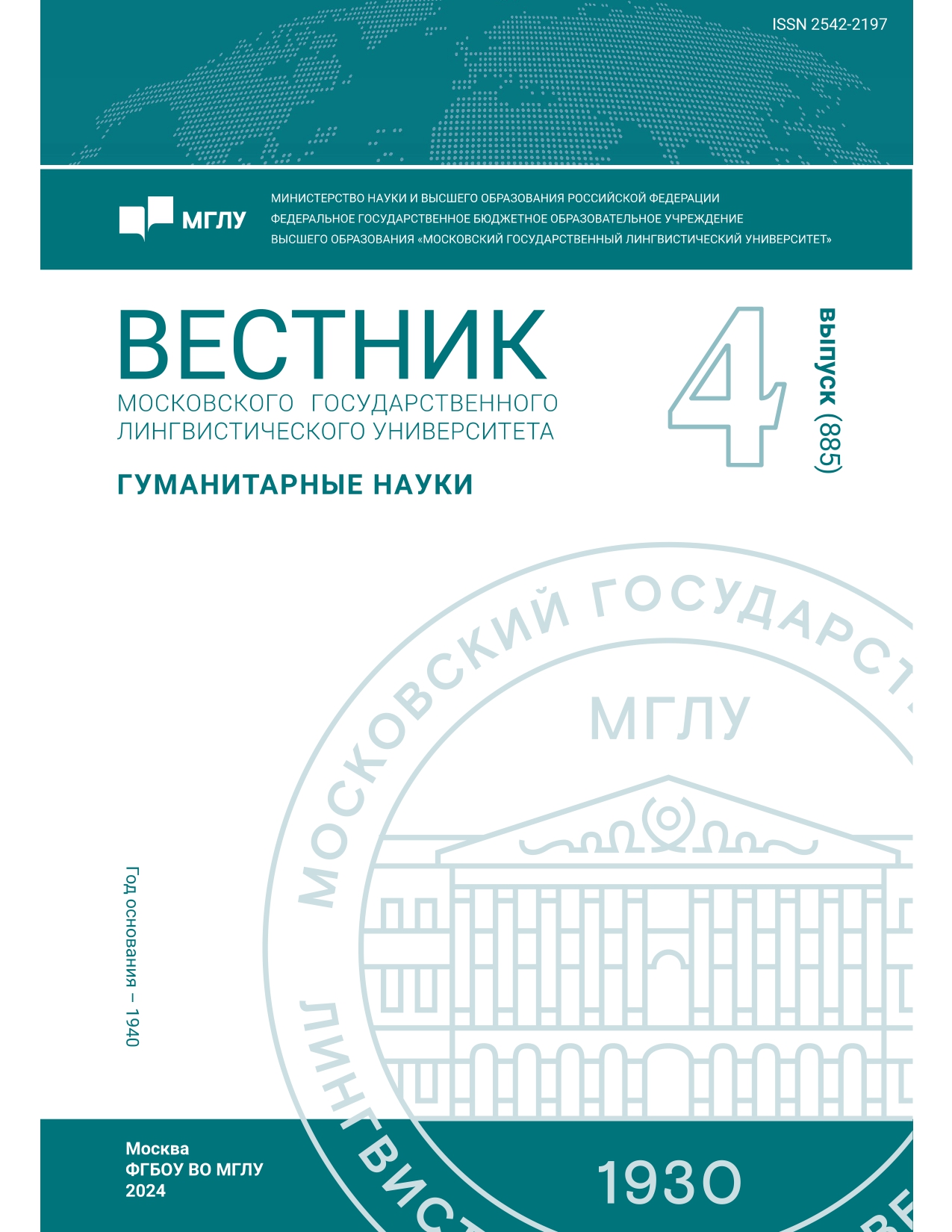
Dialectics “Norm – Anomaly, or Another Norm” as Foundation of Notional Agreement
- Autores: Sal'kova M.A.1
-
Afiliações:
- Moscow State Linguistic University
- Edição: Nº 4(885) (2024)
- Páginas: 111-118
- Seção: Linguistics
- URL: https://journal-vniispk.ru/2542-2197/article/view/306528
- ID: 306528
Citar

Resumo
The article presents the results of a reflexive speculation about anomaly in structures with notional agreement in modern English. Application of a dialectic method prompts a review of the known treatments of the phenomenon and suggests discussing it as a representation of ‘another’ norm, which seems erroneous for a formal-and-prescriptive analysis but relevant for a functional-anddescriptive interpretation, the latter explaining language deviations as cognitive and communicative demands of language users.
Palavras-chave
Sobre autores
Marina Sal'kova
Moscow State Linguistic University
Autor responsável pela correspondência
Email: bestgrammar@yandex.ru
PhD in Philology, Associate Professor, Head of Department of Grammar and History of the English Language
RússiaBibliografia
- Kobrina, N. A. [et al.] (1999). A grammar of the English language. Morphology. Syntax. A teaching manual for pedagogical institute students and universities with № 2103 “Foreign languages” profile / N. A. Kobrina, E. A. Korneeva, M. I. Ossovskaya, K. A. Guzeeva. St. Petersburg: Sojuz. (In Russ.)
- Bilyalova, A. A. (2011). Facultativity in the system of languages changes: based on grammar variation in English. Vestnik of Irkutsk State Technical University. Humanities, № 3 (50), 193–197. (In Russ.)
- Leont`ev, A. A. (1970). Nekotory`e problemy` obucheniya russkomu yazy`ku kak inostrannomu (psixolingvisticheskie ocherki) = Some issues of teaching Russian as a second language (psycholingiosctic reviews). Moscow.: Moscow State University. (In Russ.)
- Cejtlin, S. N. (2022). Rechevye oshibki i ikh preduprezhdenie = Speech mistakes and their control: A teaching manual. Moscow: LENAND. (In Russ.)
- Apresyan, Yu. D. (1990). Language anomalies: types and functions. Res Philologica: Filologicheskie issledovaniya (pp. 50–71). Moscow – Leningrad: Nauka. (In Russ.)
- Arutyunova, N. D. (1987). Anomalies in language (contributing to the problem of the world language mapping). Voprosy jazykoznanija, 3, 3–19. (In Russ.)
- Radbil`, T. B. (2006) Yazy`kovy`e anomalii v xudozhestvennom tekste: Andrej Platonov i drugie = Language anomalies in a literary text: Andrej Platonov and others. Moscow: Moscow Pedagogic State University. (In Russ.)
- Borzilov, A. D., Salkova, M. A. (2023). Notional Agreement in Modern English and Semantics of Compositionality of the Subject. Vestnik of Moscow State Linguistic University. Humanities, 3(871), 22–30. (In Russ.).
- Shherba, L. V. (1974). O troyakom aspekte yazy`kovy`x yavlenij i ob e`ksperimente v yazy`koznanii = About the three-side aspect of language phenomena and the experiment in linguistics. In: Yazykovaya sistema i rechevaya deyatel’nost’ (pp. 24–39). Leningrad: Nauka. (In Russ.)
- Kry`sin, L. P. (2005). Language norm and speech practice. Otechestvenny`e zapiski: Obshhestvo v zerkale yazy`ka, 2, 36–47. (In Russ.)
- Frei, A. (2006). Grammatika oshibok = Grammar of mistakes. Moscow: KomKniga. (In Russ.)
- Bache, C. (2000). Essentials of Mastering English: A Concise Grammar. Walter de Gruyter. Berlin ; New York.
- Quirk, R., Greenbaum, S., Leech, G., Svartvik, J. (1985). A Comprehensive Grammar of the English Language. London: Pearson Longman.
- Krylova, I. P., Gordon, E. M. (2003). A grammar of modern English: A book for foreign language institutes and departments. 9th ed. Moscow: Knizhnii dom “Universitet”: Visshaya shkola. (In English)
- Gordon Loberger, G., Shoup, K. (2009). Webster’s New World English Grammar Handbook. 2nd ed. Hoboken, NJ: Wiley Publishing.
- Krysin, L. P. (2010). Problema sootnoshenija jazykovoj sistemy, normy i uzusa = The problem of correlation between language system, norm, and usage. In Sovremennyj russkij jazyk: sistema — norma — uzus. V.V. Vinogradov Russian Language Institute of the Russian Academy of Sciences. Moscow: Jazyki slavjanskih kul’tur. (in Russ.)
Arquivos suplementares

