





 Enviar artigo por via de e-mail
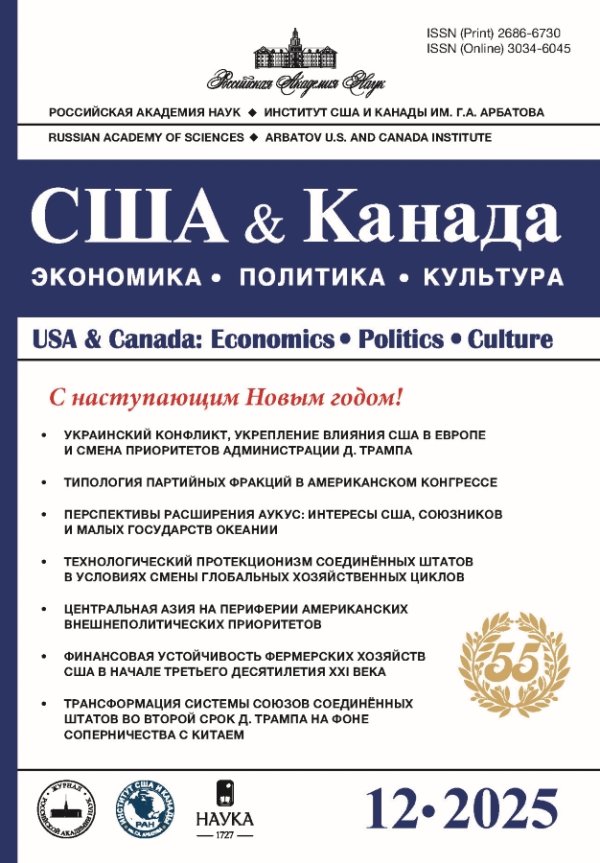
 Transformation of the US Alliance System under Trump 2.0
- Autores: Xu B.1, Ding Y.1
-
Afiliações:
- Jilin University
- Edição: Nº 12 (2025)
- Páginas: 44–55
- Seção: U.S. and the World
- URL: https://journal-vniispk.ru/2686-6730/article/view/360008
- DOI: https://doi.org/10.7868/S3034604525120045
- ID: 360008
Citar
 Acesso aberto
 Acesso está concedido
 Somente assinantes

Resumo
Alliance is a vital tool for great powers to achieve their foreign policy objectives. After the Cold War, the alliance system established by the United States to counterbalance the USSR gradually evolved into a bidirectional alliance system aimed at hegemonic maintenance, rooted in unipolar dominance and shared values, and consisting of the transatlantic alliance and the transpacific alliance. After Trump came to power again in 2025, he explicitly defined the goal of the alliance system as competing with China. While weakening the material and ideological foundations of the US alliance system, he has established reciprocal economic and trade relations as the new basis for alliances. Trump is driving the US alliance system toward a phase of reconstructive dynamism by shifting the structural focus to the Indo-Pacific region, which will have profound implications for American hegemony, regional dynamics, and international order. In the context of the US alliance system increasingly being instrumentalized to serve the objectives of American foreign policy toward China during Trump’s second term, the transformation of the US alliance system has intensified China-US tensions in security affairs. However, centrifugal forces have emerged within the US alliance system, leaving some room for maneuver in China-US relations. The underlying motivation for the US to adjust its alliance system is still to maintain American hegemony, which will lead to an overall trend of conservatism in China-US relations over the long term. Currently, academic research on American alliance policy tends to focus on the adjustment of alliance system objectives driven by changes in external threats. However, Trump’s second term not only made concentrated adjustments to alliance system objectives but also involved changes in the foundations and structures of the US alliance system, which reflect domestic political changes such as shifts in the ideas of American political elites and strategic community perceptions. These changes provide an important case study to understand changes in American foreign policy as well as to analyze the evolution of alliance functions in the international system.
Palavras-chave
Sobre autores
Bo Xu
Jilin University
Email: bxu2@jlu.edu.cn
ORCID ID: 0000-0002-0461-4611
Professor, Deputy Director of the Institute for Northeast China and Northeast Asian Studies Changchun, People’s Republic of China
Yi Ding
Jilin University
Email: dinghw21@mails.jlu.edu.cn
ORCID ID: 0009-0001-5488-9234
Doctoral Candidate, Northeast Asian Studies College Changchun, People’s Republic of China
Bibliografia
- A Free and Open Indo-Pacific: Advancing a Shared Vision. U.S. Department of State, 2019. Available at: https://www.state.gov/wp-content/uploads/2019/11/Free-and-OpenIndo-Pacific-4Nov2019.pdf (accessed: 27.10.2025).
- Defence Expenditure of NATO Countries (2014–2024). NATO, 2024. Available at: https://www.nato.int/nato_static_fl2014/assets/pdf/2024/6/pdf/240617-def-exp-2024-en.pdf (accessed: 27.10.2025).
- Burden Sharing: Benefits Government and Costs Associated with the U.S. Military Presence in Japan and South Korea. U.S. Accountability Office, 2021. Available at: https://www.gao.gov/products/gao-21-270 (accessed: 27.10.2025).
- The Federal Budget in Fiscal Year 2024: An Info-graphic. U.S. Congress Budget Office, 2024. Available at: https://www.cbo.gov/publication/61181 (accessed: 27.10.2025).
- The White House Office of Management and Budget Releases the President’s Fiscal Year 2026 Skinny Budget. White House, 2025. Available at: https://www.whitehouse.gov/briefingsstatements/2025/05/the-white-house-office-of-management-and-budget-releases-the-presidents-fiscal-year-2026-skinny-budget/ (accessed: 27.10.2025).
- NATO Leaders Pledge to Increase Defense Spending. U.S. Department of Defense, 2025. Available at: https://www.defense.gov/News/News-Stories/Article/Article/4226009/natoleaders-pledge-to-increase-defense-spending/ (accessed: 27.10.2025).
- Cha Se-hyeon. Trump Pressures Japan and Korea to Drastically Boost Defense Spending. Korea JoongAng Daily, 2025. Available at: https://koreajoongangdaily.joins.com/news/2025-0702/opinion/columns/Trump-pressures-Japan-and-Korea-to-drastically-boost-defense-spending/2342865 (accessed: 27.10.2025).
- Franke B. Munich Security Conference 2025: Speech by J. D. Vance and Selected Reactions, 2025, pp. 15–24.
- Grant C. Taking the Pulse: Is the Transatlantic Relationship at a Breaking Point. Carnegie Endowment, 2025. Available at: https://carnegieendowment.org/europe/strategic-europe/2025/02/taking-the-pulse-is-the-transatlantic-relationship-at-a-breaking-point?lang=en (accessed: 27.10.2025).
- Annex I. White House, 2025. Available at: https://www.whitehouse.gov/wp-content/uploads/2025/04/Annex-I.pdf (accessed: 27.10.2025).
- USS Carl Vinson Drills with Japanese, South Korean Forces; Moscow Draws Complaint from Seoul Over Military Flights. U.S. Naval Institute, 2025. Available at: https://news.usni.org/2025/03/20/uss-carl-vinson-drills-with-japanese-south-korean-forcesmoscow-draws-complaint-from-seoul-over-military-flights (accessed: 27.10.2025).
- Talisman Sabre. Australian Government Department of Defence, 2025. Available at: https://www.defence.gov.au/defence-activities/exercises/talisman-sabre (accessed: 27.10.2025).
- Jones E. Taking the Pulse: With Trump, Has Europe Capitulated. Carnegie Endowment, 2025. Available at: https://carnegieendowment.org/europe/strategic-europe/2025/08/takingthe-pulse-with-trump-has-europe-capitulated?lang=en (accessed: 27.10.2025).
- White Paper for European Defence-Readiness 2030. European Commission, 2025. Available at: https://commission.europa.eu/document/download/e6d5db69-e0ab-4bec-9dc03867b4373019_en (accessed: 27.10.2025).
- The Hague Summit Declaration. North Atlantic Treaty Organization, 25 June 2025. Available at: https://www.nato.int/cps/en/natohq/official_texts_236705.htm (accessed: 27.10.2025).
- Remarks by Secretary of Defense Pete Hegseth at the 2025 Shangri-La Dialogue in Singapore (As Delivered). U.S. Department of Defense, 2025. Available at: https://www.defense.gov/News/Speeches/Speech/Article/4202494/remarks-by-secretary-of-defense-petehegseth-at-the-2025-shangri-la-dialogue-in/ (accessed: 27.10.2025).
- U.S. and Australian Forces Conduct Joint Sail. U.S. Indo-Pacific Command, 2025. Available at: https://www.pacom.mil/Media/NEWS/News-Article-View/Article/4166868/us-andaustralian-forces-conduct-joint-sail/ (accessed: 27.10.2025).
- Philippines, U.S. Conclude Exercise Balikatan 25. U.S. Pacific Fleet, 2025. Available at: https://www.cpf.navy.mil/Newsroom/News/Article/4181821/philippines-us-conclude-exercise-balikatan-25/ (accessed: 27.10.2025).
- Nimitz Carrier Strike Group Conducting Routine Flight Operations in the South China Sea. U.S. Indo-Pacific Command, 2025. Available at: https://www.pacom.mil/Media/NEWS/News-Article-View/Article/4214393/nimitz-carrier-strike-group-conducting-routine-flight-operations-in-the-south-c/ (accessed: 27.10.2025).
- French Carrier Strike Group with FNS Charles De Gaulle Makes Stopovers in Malaysia and Indonesia as Part of Its Mission CLEMENCEAU 25. Embassy of France in Kuala Lumpur, 2025. Available at: https://my.ambafrance.org/French-Carrier-Strike-Group-with-FNS-CharlesDe-Gaulle-makes-stopovers-in (accessed: 27.10.2025).
- UK Aircraft Carrier in Indo-Pacific on Rare Deployment. BBC News, 2025. Available at: https://www.bbc.co.uk/news/articles/cx2gp07yqnjo (accessed: 27.10.2025).
- Trump Determined to Keep 25% Tariff on Japanese Autos. Nikkei Asia, 2025. Available at: https://asia.nikkei.com/Economy/Trade-war/Trump-tariffs/Trump-determined-to-keep25-tariff-on-Japanese-autos (accessed: 27.10.2025).
- Japan Scraps U.S. Meeting after Washington Demands More Defense Spending – FT. The Asahi Shimbun, 2025. Available at: https://www.asahi.com/ajw/articles/15856826 (accessed: 27.10.2025).
- Adler E., Barnett M. 1998. A Framework for the Study of Security Communities. In: Security Communities. Cambridge: Cambridge University Press, p. 51.
- Colby E. 2021. The Strategy of Denial. New Haven; London: Yale University Press.
- Fan X. J. 2025. The Axisization of the US-Japan Alliance and Its Implications. Modern International Relations, No. 1, p. 84.
- Ge H. W. 2019. The United States’ Alliance Policy and Alliance System in the Trump Era. World Economy and Politics Forum, no. 1, p. 10.
- Ikenberry J. G. 2000. After Victory: Institutions, Strategic Restraint, and the Rebuilding of Order after Major Wars. Princeton: Princeton University Press.
- Lake D. A. 2009. Hierarchy in International Relations. New York: Cornell University Press.
- Liu F. 2019. Alliance and International Order. Contemporary American Review, no. 3, p. 13.
- Walt S. M. 1990. The Origins of Alliances. New York: Cornell University Press.
- Zhong F.T. 2019. Trumpism and the Transformation of the U.S. Alliance System. Contemporary American Review, no. 3, p. 43.
Arquivos suplementares
