



The immune response after vaccination in recipients against different subtypes of tick-borne encephalitis virus (Flaviviridae: Orthoflavivirus)
- Authors: Orlova E.A.1, Ivanova A.L.1, Mishchenko V.A.2, Bykov I.P.2, Vyalykh I.V.2, Fadeeva N.L.3, Patlusova V.V.3, Vorovitch M.F.1, Kolyasnikova N.M.1
-
Affiliations:
- M.P. Chumakov Federal Scientific Center for Research and Development of Immunobiological Drugs of the Russian Academy of Sciences (Polio Institute)
- Federal Scientific Research Institute of Viral Infections «Virome» Federal Service for Surveillance on Consumer Rights Protection and Human Wellbeing
- 5th Military Clinical Hospital of the Troops of the National Guard of the Russian Federation
- Issue: Vol 70, No 6 (2025)
- Pages: 559-569
- Section: ORIGINAL RESEARCHES
- URL: https://journal-vniispk.ru/0507-4088/article/view/375505
- DOI: https://doi.org/10.36233/0507-4088-348
- EDN: https://elibrary.ru/voteax
- ID: 375505
Cite item

Abstract
Introduction. There are three antigenic subtypes of tick-borne encephalitis virus (TBEV): the European, Far Eastern and Siberian subtypes. The article discusses the topic of cross-protective neutralizing antibodies against different subtypes of TBEV.
Objective ‒ the study of the immune response after vaccination against TBE in recipients immunized with Russian-made vaccines in relation to Siberian, Far Eastern, and European subtypes.
Materials and methods. 100 serum samples obtained from recipients vaccinated against TBE. ELISA reagent kit was used to detect IgG antibodies to TBEV. The neutralization reaction on cell culture was used to analyze the titer of neutralizing antibodies.
The following TBEV strains were used: Sofyin; Vasilchenko; Absettarov; Ekb_1887_1.
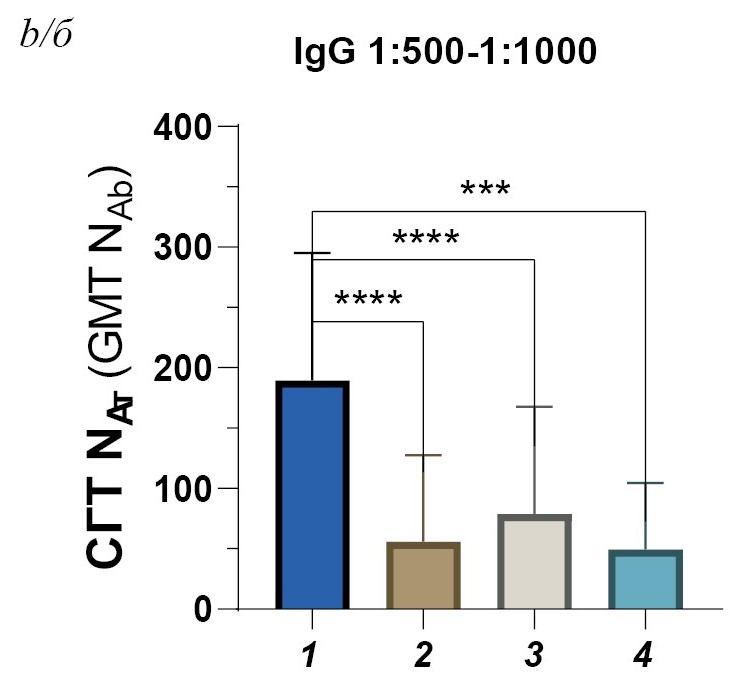
Results. A decrease in the levels of neutralizing antibodies against heterologous strains compared to the vaccine strain was observed: for the Siberian strains Ekb_1887_1 and the Vasilchenko, a decrease was of 3.9 and 2.4 times, respectively; for the European strain, a 4.9-fold decrease compared to vaccine strain was observed. In case when IgG antibody titers were below 1 : 500, the titers of antibodies to TBEV strains heterologous to the vaccine did not exceed the minimum detectable value of 1 : 10. For individuals with IgG antibody titers below 1 : 100, antibodies to Sofyin strain were not detected. Individuals with reduced titers of virus-specific antibodies more often had deviations from the recommended vaccination schedule.
Conclusion. Given the widespread distribution and genetic variability of the Siberian subtype, as well as the limited cross-neutralization capabilities of existing vaccines, the task of developing a combined vaccine that includes antigens of several virus subtypes seems relevant.
About the authors
Ekaterina A. Orlova
M.P. Chumakov Federal Scientific Center for Research and Development of Immunobiological Drugs of the Russian Academy of Sciences (Polio Institute)
Email: orlova_ea@chumakovs.su
ORCID iD: 0009-0009-4175-0493
Junior Researcher, Laboratory of Tick-Borne Encephalitis and Other Viral Encephalitis
Russian Federation, 108819, MoscowAlla L. Ivanova
M.P. Chumakov Federal Scientific Center for Research and Development of Immunobiological Drugs of the Russian Academy of Sciences (Polio Institute)
Email: ivanova_al@chumakovs.su
ORCID iD: 0009-0002-3086-0581
Employment
Russian Federation, 108819, MoscowVladimir A. Mishchenko
Federal Scientific Research Institute of Viral Infections «Virome» Federal Service for Surveillance on Consumer Rights Protection and Human Wellbeing
Email: mischenko_va@niivirom.ru
ORCID iD: 0000-0003-4280-283X
Researcher
Russian Federation, 620030, EkaterinburgIvan P. Bykov
Federal Scientific Research Institute of Viral Infections «Virome» Federal Service for Surveillance on Consumer Rights Protection and Human Wellbeing
Email: i.p.bykov@mail.ru
ORCID iD: 0000-0002-5157-646X
Ph.D. in medicine, Senior Researcher
Russian Federation, 620030, EkaterinburgIvan V. Vyalykh
Federal Scientific Research Institute of Viral Infections «Virome» Federal Service for Surveillance on Consumer Rights Protection and Human Wellbeing
Email: vyalykh_iv@niivirom.ru
ORCID iD: 0000-0002-3123-8359
Ph.D. in veterinary medicine, Head of the Laboratory of Vector-borne Viral Infections and Tick-borne Encephalitis, Lead researcher
Russian Federation, 620030, EkaterinburgNatalia L. Fadeeva
5th Military Clinical Hospital of the Troops of the National Guard of the Russian Federation
Email: ntellina@mail.ru
ORCID iD: 0009-0008-3944-3219
the head of the Admissions Department
Russian Federation, 620030, EkaterinburgVeronica V. Patlusova
5th Military Clinical Hospital of the Troops of the National Guard of the Russian Federation
Email: patlusovavv@mail.ru
ORCID iD: 0009-0008-5493-7655
Ph.D., Head of the Insurance Medicine Group
Russian Federation, 620030, EkaterinburgMikhail F. Vorovitch
M.P. Chumakov Federal Scientific Center for Research and Development of Immunobiological Drugs of the Russian Academy of Sciences (Polio Institute)
Email: vorovich_mf@chumakovs.su
ORCID iD: 0000-0002-7367-6357
Ph.D. in biology, Head of the Encephalitis Vaccine Department, Leading Researcher of the Laboratory of Tick-borne Encephalitis and Other Viral Encephalitis
Russian Federation, 108819, MoscowNadezhda M. Kolyasnikova
M.P. Chumakov Federal Scientific Center for Research and Development of Immunobiological Drugs of the Russian Academy of Sciences (Polio Institute)
Author for correspondence.
Email: kolyasnikova_nm@chumakovs.su
ORCID iD: 0000-0002-9934-2582
Doctor of Medicine, Head of the Laboratory of Tick-borne Encephalitis and Other Viral Encephalitis, Leading Researcher
Russian Federation, 108819, MoscowReferences
- TBE Book. Chapter 12: Epidemiology of TBE. Available at: https://tbenews.com/tbe/chapter-12-epidemiology-of-tbe/
- Demina T.V., Dzhioev Y.P., Verkhozina M.M., Kozlova I.V., Tkachev S.E., Plyusnin A., et al. Genotyping and characterization of the geographical distribution of tick-borne encephalitis virus variants with a set of molecular probes. J. Med. Virol. 2010; 82(6): 965–76. https://doi.org/10.1002/jmv.21765
- Dai X., Shang G., Lu S., Yang J., Xu J. A new subtype of eastern tick-borne encephalitis virus discovered in Qinghai-Tibet Plateau, China. Emerg. Microbes Infect. 2018; 7(1): 74. https://doi.org/10.1038/s41426-018-0081-6
- Tkachev S.E., Babkin I.V., Chicherina G.S., Kozlova I.V., Verkhozina M.M., Demina T.V., et al. Genetic diversity and geographical distribution of the Siberian subtype of the tick-borne encephalitis virus. Ticks Tick Borne Dis. 2020; 11(2): 101327. https://doi.org/10.1016/j.ttbdis.2019.101327
- Leonova G.N. tick-borne encephalitis in the far east focal region of the Eurasian continent. Zhurnal mikrobiologii, epidemiologii i immunobiologii. 2020; 97(2): 150–8. https://doi.org/10.36233/0372-9311-2020-97-2-150-158 https://elibrary.ru/mquzvv (in Russian)
- Jääskeläinen A., Tonteri E., Pieninkeroinen I., Sironen T., Voutilainen L., Kuusi M., et al. Siberian subtype tick-borne encephalitis virus in Ixodes ricinus in a newly emerged focus, Finland. Ticks Tick Borne Dis. 2016; 7(1): 216–23. https://doi.org/10.1016/j.ttbdis.2015.10.013
- TBE Book. Estonia. Available at: https://tbenews.com/tbe/13-10-7/
- TBE Book. Latvia. Available at: https://tbenews.com/tbe/13-19-7/
- Pierson T.C., Diamond M.S. Molecular mechanisms of antibody-mediated neutralisation of flavivirus infection. Expert. Rev. Mol. Med. 2008; 10: e12. https://doi.org/10.1017/S1462399408000665
- Savinova Yu.S. European subtype of tick-borne encephalitis virus. Literature review. Acta Biomedica Scientifica. 2021; 6(4): 100–13. https://elibrary.ru/guqppn (in Russian)
- Ruzek D., Avšič Županc T., Borde J., Chrdle A., Eyer L., Karganova G., et al. Tick-borne encephalitis in Europe and Russia: Review of pathogenesis, clinical features, therapy, and vaccines. Antiviral. Res. 2019; 164: 23–51. https://doi.org/10.1016/j.antiviral.2019.01.014
- Wittermann C., Schöndorf I., Gniel D. Antibody response following administration of two paediatric tick-borne encephalitis vaccines using two different vaccination schedules. Vaccine. 2009; 27(10): 1661–6. https://doi.org/10.1016/j.vaccine.2008.10.003
- Holzmann H., Kundi M., Stiasny K., Clement J., McKenna P., Kunz C., et al. Correlation between ELISA, hemagglutination inhibition, and neutralization tests after vaccination against tick-borne encephalitis. J. Med. Virol. 1996; 48(1): 102–7. https://doi.org/10.1002/(SICI)1096-9071(199601)48:1<102::AID-JMV16>3.0.CO;2-I
- Füzik T., Formanová P., Růžek D., Yoshii K., Niedrig M., Plevka P. Structure of tick-borne encephalitis virus and its neutralization by a monoclonal antibody. Nat. Commun. 2018; 9(1): 436. https://doi.org/10.1038/s41467-018-02882-0
- Yang X., Qi J., Peng R., Dai L., Gould E.A., Gao G.F., et al. Molecular basis of a protective/neutralizing monoclonal antibody targeting envelope proteins of both tick-borne encephalitis virus and louping ill virus. J. Virol. 2019; 93(8): e02132-18. https://doi.org/10.1128/JVI.02132-18
- Agudelo M., Palus M., Keeffe J.R., Bianchini F., Svoboda P., Salát J., et al. Broad and potent neutralizing human antibodies to tick-borne flaviviruses protect mice from disease. J. Exp. Med. 2021; 218(5): e20210236. https://doi.org/10.1084/jem.20210236
- Chidumayo N.N., Yoshii K., Kariwa H. Evaluation of the European tick-borne encephalitis vaccine against Omsk hemorrhagic fever virus. Microbiol. Immunol. 2014; 58(2): 112–8. https://doi.org/10.1111/1348-0421.12122
- Collins M.H., McGowan E., Jadi R., Young E., Lopez C.A., Baric R.S., et al. Lack of durable cross-neutralizing antibodies against Zika virus from dengue virus infection. Emerg. Infect. Dis. 2017; 23(5): 773–81. https://doi.org/10.3201/eid2305.161630
- Fritz R., Orlinger K.K., Hofmeister Y., Janecki K., Traweger A., Perez-Burgos L., et al. Quantitative comparison of the cross-protection induced by tick-borne encephalitis virus vaccines based on European and Far Eastern virus subtypes. Vaccine. 2012; 30(6): 1165–9. https://doi.org/10.1016/j.vaccine.2011.12.013
- Chernokhaeva L.L., Rogova Y.V., Vorovitch M.F., Romanova L.Iu., Kozlovskaya L.I., Maikova G.B., et al. Protective immunity spectrum induced by immunization with a vaccine from the TBEV strain Sofjin. Vaccine. 2016; 34(20): 2354–61. https://doi.org/10.1016/j.vaccine.2016.03.041
- Morozova O.V., Bakhvalova V.N., Potapova O.F., Grishechkin A.E., Isaeva E.I. Study of the immunogenic and protective effects of inactivated tick-borne encephalitis (TBE) vaccines against modern TBE virus strains. Natsional’nye prioritety Rossii. 2011; (2): 61–3. https://elibrary.ru/xqxlzb (in Russian)
- Afonina O.S., Barkhaleva O.A., Sarkisyan K.A., Vorobieva M.S., Movsesyants A.A., Olefir Yu.V., et al. The study of protective properties of vaccines against virulent strains of the virus tick-borne encephalitis three genotypes: European, Far Eastern and Siberian (experimental research). Epidemiologiya i Vaktsinoprofilaktika. 2017; 16(1): 62–7. https://doi.org/10.31631/2073-3046-2017-16-1-62-67 https://elibrary.ru/yjcgxf (in Russian)
- Shcherbinina M.S., Skrynnik S.M., Levina L.S., Gerasimov S.G., Bochkova N.G., Lisenkov A.N., et al. The condition of post-vaccination immunity to the tick-borne encephalitis virus in the population highly endemic area with Siberian subtype domination. Epidemiologiya i vaktsinoprofilaktika. 2018; 17(2): 27–36. https://doi.org/10.24411/2073-3046-2018-10003 https://elibrary.ru/xnsxbr (in Russian)
- Jarmer J., Zlatkovic J., Tsouchnikas G., Vratskikh O., Strauß J., Aberle J.H., et al. Variation of the specificity of the human antibody responses after tick-borne encephalitis virus infection and vaccination. J. Virol. 2014; 88(23): 13845–57. https://doi.org/10.1128/JVI.02086-14
- Orlova E.A., Ivanova A.L., Mishchenko V.A., Bykov I.P., Vyalykh I.V., Fadeeva N.L., et al. Assessment of the neutralizing activity of sera from vaccinated individuals against various subtypes of the tick-borne encephalitis virus. Natsional’nye prioritety Rossii. 2024; (4): 60–4. https://elibrary.ru/leufow (in Russian)
- Bluestone J.A. Mechanisms of tolerance. Immunol. Rev. 2011; 241(1): 5–19. https://doi.org/10.1111/j.1600-065X.2011.01019.x
- Pogodina V.V., Shcherbinina M.S., Gerasimov S.G., Kolyasnikova N.M. Modern problems of tick-borne encephalitis specific prevention communication i: vaccinal prevention in area with Siberian virus subtype domination. Epidemiologiya i vaktsinoprofilaktika. 2015; 14(5): 77–84. https://elibrary.ru/umtahv (in Russian)
- Demina T.V., Dzhioev Yu.P., Kozlova I.V., Verkhozina M.M., Tkachev S.E., Doroshchenko E.K., et al. Genotypes 4 and 5 of the tick-borne encephalitis virus: features of the genome structure and possible scenario for its formation. Voprosy virusologii. 2012; 57(4): 13–8. https://elibrary.ru/puiewf (in Russian)
- Tkachev S.E., Chicherina G.S., Golovljova I., Belokopytova P.S., Tikunov A.Y., Zadora O.V., et al. New genetic lineage within the Siberian subtype of tick-borne encephalitis virus found in Western Siberia, Russia. Infect. Genet. Evol. 2017; 56: 36–43. https://doi.org/10.1016/j.meegid.2017.10.020
- Chitimia-Dobler L., Dobler G., Lang D., Bormane A., Ranka R., Schaper S., et al. Distribution and genotypic landscape of tick-borne encephalitis virus in ticks from Latvia from 2019 to 2023. Pathogens. 2025; 14(9): 950. https://doi.org/10.3390/pathogens14090950
Supplementary files

