


The effect of heat treatment on the structure and properties of metallic layered composite materials formed by explosive welding of heterogeneous steels thin plates
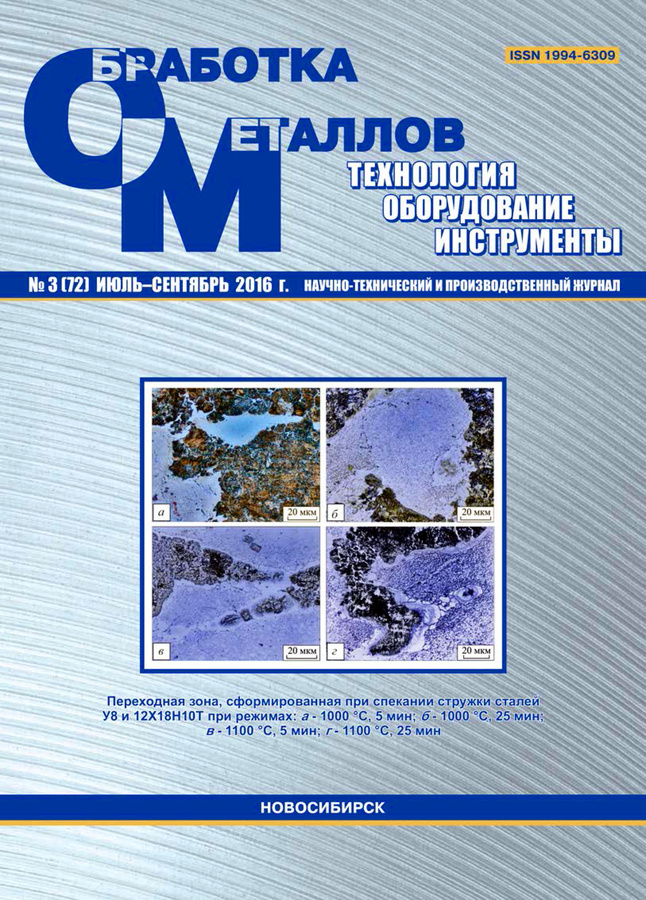
- Authors: Lozhkina E.A1, Lozhkin V.S1, Mali V.I2, Esikov M.A2
-
Affiliations:
- Novosibirsk State Technical University
- Lavrentyev Institute of Hydrodynamics of the Siberian Branch of the RAS
- Issue: No 3 (2016)
- Pages: 31-40
- Section: MATERIAL SCIENCE
- URL: https://journal-vniispk.ru/1994-6309/article/view/302139
- DOI: https://doi.org/10.17212/1994-6309-2016-3-31-40
- ID: 302139
Cite item
Full Text

Abstract
About the authors
E. A Lozhkina
Novosibirsk State Technical University
Email: helens_case@ngs.ru
20, Prospect K. Marksa, Novosibirsk, 630073, Russian Federation
V. S Lozhkin
Novosibirsk State Technical University
Email: Logkaa@mail.ru
20, Prospect K. Marksa, Novosibirsk, 630073, Russian Federation
V. I Mali
Lavrentyev Institute of Hydrodynamics of the Siberian Branch of the RAS
Email: mali@hydro.nsc.ru
15, Ac. Lavrentieva ave., Novosibirsk, 630090, Russian Federation
M. A Esikov
Lavrentyev Institute of Hydrodynamics of the Siberian Branch of the RAS
Email: EsikovMaxim@ngs.ru
15, Ac. Lavrentieva ave., Novosibirsk, 630090, Russian Federation
References
- Энтин Р.И., Курдюмов Г.В. Пути повышения прочности и пластичности конструкционных сталей // Вестник Академии наук СССР. - 1967. - № 8. - С. 20-26.
- Тушинский Л.И. Структурная теория конструктивной прочности материалов. - Новосибирск: Изд-во НГТУ, 2004. - 400 с.
- Новиков И.И. Теория термической обработки металлов. - М.: Металлургия, 1986. - 480 с.
- Бернштейн М.Л., Займовский В.А., Капуткина Л.М. Термомеханическая обработка стали. - М.: Металлургия, 1983. - 480 с.
- Лахтин Ю.М., Арзамасов Б.Н. Химико-термическая обработка металлов. - М.: Металлургия, 1985. - 256 с.
- Korzhov V.P., Kiiko V.M., Karpov M.I. Structure of multilayer microcomposite Ni/Al obtained by diffusion welding // Inorganic Materials: Applied Research. - 2012. - Vol. 3, iss. 4. - P. 314-318. - doi: 10.1134/S2075113312040107.
- Optimizing the diffusion welding process for alloy 800H: thermodynamic, diffusion modeling, and experimental work / R.E. Mizia, D.E. Clark, M.V. Glazoff, T.E. Lister, T.L. Trowbridge // Metallurgical and Materials Transactions: A. - 2013. - Vol. 44, iss. 1, suppl. - P. 154-161. - doi: 10.1007/s11661-011-0991-6.
- Harach D.J., Vecchio K.S. Microstructure evolution in metal-intermetallic laminate (MIL) composites synthesized by reactive foil sintering in air // Metallurgical and Material Transaction: A. - 2001. - Vol. 32, iss. 6. - P. 1493-1505. - doi: 10.1007/s11661-001-0237-0.
- Resistance-curve and fracture behavior of Ti-Al3Ti metallic-intermetallic laminate (MIL) composites / A. Rohatgi, D.J. Harach, K.S. Vecchio, K.P. Harvey // Acta Materialia. - 2003. - Vol. 51, iss. 10. - P. 2933-2957. - doi: 10.1016/S1359-6454(03)00108-3.
- Luo J.-G., Acoff V.L. Using cold roll bonding and annealing to process Ti/Al multi-layered composites from elemental foils // Materials Science and Engineering: A. - 2004. - Vol. 379, iss. 1-2. - P. 164-172. - doi: 10.1016/j.msea.2004.01.021.
- Kong F., Chen Y., Zhang D. Interfacial microstructure and shear strength of Ti6Al4V/TiAl laminate composite sheet fabricated by hot packed rolling // Materials and Design. - 2011. - Vol. 32, iss. 5. - P. 3167-3172. - doi: 10.1016/j.matdes.2011.02.052.
- The increase of structural strength of multilayered materials produced by explosive welding of dissimilar steels thin plates / E.A. Prikhodko, V.S. Lozhkin, V.I. Mali, M.A. Esikov // The 8 International Forum on Strategic Technologies (IFOST 2013): proceedings, Mongolia, Ulaanbaatar, 28 June - 1 July 2013. - Ulaanbaatar, 2013. - Vol. 1. - P. 37-40.
- The effect of heat treatment on the microstructure and mechanical properties of multilayered composites welded by explosion / E.A. Prikhodko, I.A. Bataev, A.A. Bataev, V.S. Lozhkin, V.I. Mali, M.A. Esikov // Advanced Materials Research. - 2012. - Vol. 535-537. - P. 231-234. - doi: 10.4028/
- Лысак В.И., Кузьмин С.В. Создание композиционных материалов сваркой взрывом // Вестник Южного научного центра. - 2013. - Т. 9, юбилейный вып. - С. 64-69.
- Лысак В.И., Кузьмин С.В. Сварка взрывом. - М.: Машиностроение, 2005. - С. 121-138.
- Батаев И.А. Структура и механические свойства многослойных материалов, сформированных по технологии сварки взрывом тонколистовых заготовок из низкоуглеродистой стали: дис.. канд. техн. наук. - Новосибирск, 2010. - 266 с.
- ASM Handbook. Vol. 9. Metallography and Microstructures / ed. by G.F. Vander Voort. - Materials Park, Ohio, USA: ASM International Publ., 2004. - 1184 p. - ISBN: 978-0-87170-706-2.
- Голованенко С.А., Фонштейн Н.М. Двухфазные низколегированные стали. - М.: Металлургия, 1986. - С. 85.
- Биронт В.С., Крушенко Г.Г. Влияние термической и термоциклической обработки на структуру и свойства мартенситно-стареющей стали // Журнал Сибирского федерального университета. Серия: Техника и технологии. - 2008. - Т. 1, № 3. - P. 247-255.
- Батаев А.А. Композиционные материалы: строение, получение, применение: учебник. - Новосибирск: Изд-во НГТУ, 2002. - 383 с. - ISBN 5-7782-0315-2.
Supplementary files

