


About a destruction of diamond grains in the grinding process
- Authors: Popov V.Y1, Yanyushkin A.S1, Khlystov A.N1
-
Affiliations:
- Bratsk State University
- Issue: No 4 (2016)
- Pages: 16-23
- Section: EQUIPMENT. INSTRUMENTS
- URL: https://journal-vniispk.ru/1994-6309/article/view/302143
- DOI: https://doi.org/10.17212/1994-6309-2016-4-16-23
- ID: 302143
Cite item
Full Text

Abstract
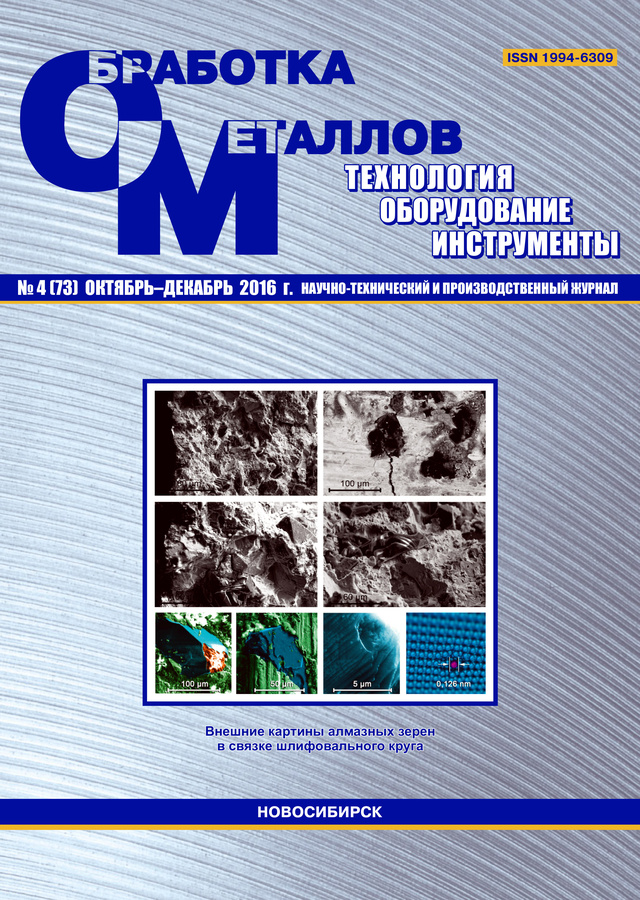
An analysis of modern trends in the area of metal processing shows that at the moment the diamond tool is at the peak of its popularity. It can be confirmed by the fact that the diamond tools are stay ahead in the number of search queries on the Internet. It leaves behind tool made of cubic boron nitride, silicon carbide and green silicon carbide. Moreover, there is a tendency on the steady increase of interest to the diamond grinding wheel in the metal processing industry and mechanical engineering complex. This popularity is due to the fact that manufacturing based on the latest research learned how to effectively use the tools of synthetic diamond. However, experience shows that almost every diamond has various defects that have a characteristic influence on its destruction and deterioration that should be considered in the operation of devices and products containing diamonds. Defects occur in diamond crystals during its synthesis, give rise to the formation of more complex defects that occur in the operational process of diamonds. Under external influence these defects have immediate strong effect on production characteristics of devices, products or instruments containing diamonds. The analysis of the scanning electron microscopy images shows that even on the surface of the diamond grains and on their edges that are not involved in the process of cutting, there are typical traces of lattice disturbance both on micro and macro levels. This indicates that disturbance of the diamond grains usually happens due to bulk defects, which have a length of several nanometers to micrometers, and represent blocks of the crystal lattice, between which cracks and cracks are usually filled with metallic inclusions. A visualization method, developed on the basis of modern digital technology and molecular dynamics, shows it for atomic-scale.
About the authors
V. Y Popov
Bratsk State University
Email: berkutoff@rambler.ru
40, Makarenko st., Bratsk, 665709, Russian Federation
A. S Yanyushkin
Bratsk State University
Email: yanyushkin@brstu.ru
40, Makarenko st., Bratsk, 665709, Russian Federation
A. N Khlystov
Bratsk State University
Email: alexey.khlystov@gmail.com
40, Makarenko st., Bratsk, 665709, Russian Federation
References
- Rowe W.B. Principles of modern grinding technology. - 2nd ed. - Oxford: Elsevier, 2014. - 480 p. - ISBN: 978-0-12-810166-7.
- Попов В.Ю., Хлыстов А.Н., Бондин А.В. Атомная визуализация алмазного резания // Компьютерные исследования и моделирование. - 2016. - Т. 8, № 1. - С. 161-172.
- Voidites in polycrystalline natural diamond / J.H. Chen, D. Bernaerts, J.W. Seo, G. Van Tendeloo, H. Kagi // Philosophical Magazine Letters. - 1998. - Vol. 77 (3). - P. 135-140. - doi: http://dx.doi.org/10.1080/095008398178561.
- Включения в кристаллах синтетических алмазных высокопрочных порошков / Н.В. Новиков, Г.П. Богатырева, Г.Д. Ильницкая, Г.Ф. Невструев, Г.А. Петасюк, В.Н. Ткач, Р.К. Богданов, А.М. Исонкин, А.П. Закора, И.Н. Зайцева // Физика и техника высоких давлений. - 2009. - Т. 9, № 2. - С. 48-53.
- Фундаментальные и прикладные исследования микро- нанополикристаллических алмазных агрегатов и их практическое применение / В.А. Петровский, А.Е. Сухарев, В.П. Филоненко, С.Н. Виноградов // Минералого-технологическая оценка месторождений полезных ископаемых и проблемы раскрытия минералов: сборник статей по материалам V Российского семинара по технологической минералогии. - Петрозаводск: КарНЦ РАН, 2011. - C. 190-196. - ISBN 978-5-9274-0460-5.
- Винс В.Г. Оптически активные дефекты в алмазе - закономерности образования и взаимной трансформации: дис.. д-ра физ.-мат. наук: 01.04.07 / Алтайский государственный технический университет им. И.И. Ползунова. - Барнаул, 2011. - 252 c.
- Ширяев А.А. Дефекты и микровключения в алмазах как индикаторы условий кристаллообразования и постростовых изменений: дис.. д-ра хим. наук: 02.00.21 / Федеральное государственное образовательное учреждение высшего профессионального образования «Московский государственный университет». - М., 2013. - 251 c.
- Солопова Н.А. Кристаллизация алмаза в карбонатных расплавах минералогического значения (эксперимент при 5,5-84,0 ГПа): дис.. канд. геол.-минерал. наук: 25.00.05 / Федеральное государственное образовательное учреждение высшего профессионального образования «Московский государственный университет». - М., 2014. - 112 c.
- Зависимость прочности алмазных шлифпорошков от структуры кристаллов алмаза / Н.В. Новиков, Г.П. Богатырева, Г.Ф. Невструев, Г.Д. Ильницкая, И.Н. Зайцева // Физика и техника высоких давлений, 2007. - Т. 17, № 2. - С. 96-99.
- Влияние прочностных характеристик алмазных шлифпорошков на работоспособность бурового инструмента / Н.В. Новиков, Г.П. Богатырева, Р.К. Богданов, Г.Д. Ильницкая, А.М. Исонкин // Сверхтвердые материалы. - 2009. - № 6. - С. 75-80.
- Сверхтвердые материалы в геологоразведочном бурении / П.В. Зыбинский, Р.К. Богданов, А.П. Закора, А.М. Исонкин. - Донецк: Норд-Пресс, 2007. - 244 с.
- Влияние обработки высоковольтным электрическим разрядом на морфометрические характеристики алмазных порошков / Г.П. Богатырева, О.Н. Сизоненко, Н.А. Олейник, Г.А. Петасюк, Г.Д. Ильницкая, В.С. Шамраева, Г.А. Базалій, Э.И. Тафтай, А.Д. Зайченко, А.С. Торпаков, Е.В. Липян // Породоразрушающий и металлообрабатывающий инструмент - техника и технология его изготовления и применения: сборник научных трудов. - Киев: Изд-во ИСМ им. В.М. Бакуля НАН Украины, 2011. - Вып. 14. - С. 272-277.
- Popov V.Yu., Yanyushkin A.S., Zamashchikov Y.I. Diffusion phenomena in the combined electric diamond grinding // Applied Mechanics and Materials. - 2015. - Vol. 799-800. - P. 291-298. - doi: 10.4028/
- Popov V.Y., Yanyushkin A.S. Adhesion-diffusion interaction of contact surfaces with the treatment diamond grinding wheels // Eastern European Scientific Journal. - 2014. - N 2. - P. 301-310. - doi: 10.12851/EESJ201404ART46.
- Popov V.Yu., Yanyushkin A.S. Combined electro-diamond grinding of high speed steels // International Journal of Advances in Machining and Forming Operations. - 2012. - Vol. 4, N 1. - P. 91-102.
- MD simulation of cluster-surface impacts for metallic phases: soft landing, droplet spreading and implantation / K. Kholmurodov, T. Ebisuzaki, I. Puzynin, W. Smith, K. Yasuoka // Computer Physics Communications. - 2001. - Vol. 141, iss. 1. - P. 1-16. - doi: 10.1016/S0010-4655(01)00292-2.
- Контактные процессы при алмазной обработке инструментальных материалов / В.Ю. Попов, А.С. Янюшкин, О.И. Медведева, В.Ю. Скиба // Системы. Методы. Технологии. - 2014. - № 3 (23). - С. 68-74.
- Integration of production steps on a single equipment / V. Skeeba, V. Pushnin, I. Erohin, D. Kornev // Materials and Manufacturing Processes. - 2015. - Vol. 30, iss. 12. - P. 1408-1411. - doi: 10.1080/10426914.2014.973595.
- Шлифовальный инструмент на основе силикокарбида титана / Г.И. Смагин, В.Н. Филимоненко, Н.Д. Яковлев, М.А. Корчагин, В.Ю. Скиба // Обработка металлов (технология, оборудование, инструменты). - 2011. - № 1. - С. 27-30.
- Иванцивский В.В., Скиба В.Ю. Повышение поверхностной микротвердости стали при интеграции поверхностно-термической и финишной механической обработок // Научный вестник НГТУ. - 2006. - № 3. - С. 187-192.
- Иванцивский В.В., Скиба В.Ю., Пушнин В.Н. Методика назначения режимов обработки при совмещении операций абразивного шлифования и поверхностной закалки ТВЧ // Обработка металлов (технология, оборудование, инструменты). - 2011. - № 4. - С. 19-25.
- Hybrid processing: the impact of mechanical and surface thermal treatment integration onto the machine parts quality / V.Yu. Skeeba, V.V. Ivancivsky, A.V. Kutyshkin, K.A. Parts // IOP Conference Series: Materials Science and Engineering. - 2016. - Vol. 126. - P. 012016. - doi: 10.1088/1757-899X/126/1/012016.
- Ivancivsky V., Parts K., Popov V. Depth distribution of temperature in steel parts during surface hardening by high frequency currents // Applied Mechanics and Materials. - 2015. - Vol. 788. - P. 129-135. - doi: 10.4028/
- Zamashchikov Y.I. Duality in metal cutting: impact to the surface layer residual stress // Materials and Manufacturing Processes. - 2006. - Vol. 21, iss. 5. - Р. 551-566. - doi: 10.1080/10426910500471706.
- Сивухин Д.В. Общий курс физики. Термодинамика и молекулярная физика. - М.: Физматлит, 1970. - 565 c.
Supplementary files

