





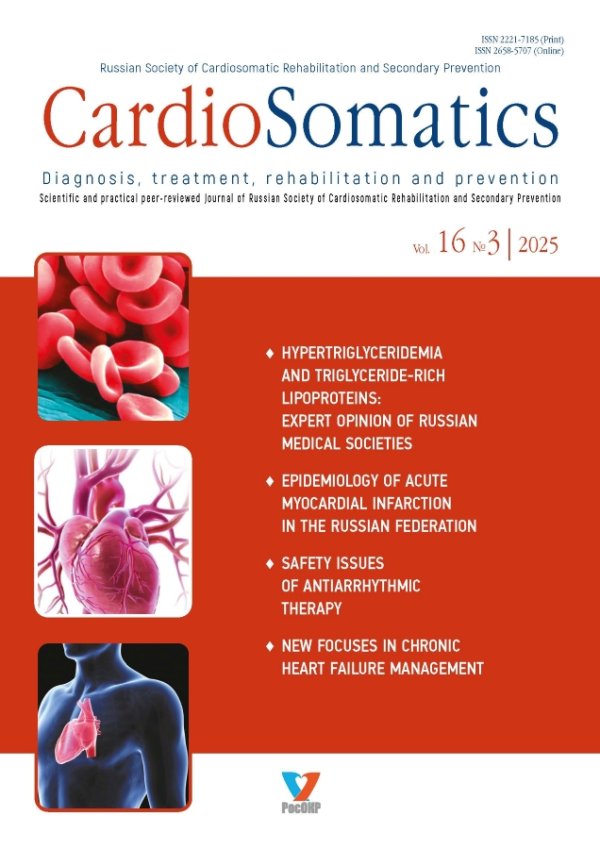
CardioSomatics
Peer-review medical journal
ISSN (print): 2221-7185, ISSN (online): 2658-5707
Media registration certificate: ПИ №ФС77-64546 от 22.01.2016
Founder: Russian Society of Cardiosomatic Rehabilitation and Secondary Prevention
Editor-in-chief
- Prof. David Aronov, MD, Dr. Sci. (Med.), Honored Scientist of the Russian Federation
ORCID ID https://orcid.org/0000-0003-0484-9805
Deputy Editor-in-Chief
- Prof. Marina Bubnova, MD, Dr. Sci. (Med.)
ORCID ID https://orcid.org/0000-0003-2250-5942
Official publication
- Russian society of cardiosomatic rehabilitation and secondary prevention (http://www.rosokr.ru/aboutEn).
Publisher
- Eco-Vector Publishing group
About
CardioSomatics includes many medical scientific and clinical disciplines, as well as issues of organizing and conducting medical rehabilitation (cardiological and cardiosomatic), preventive medicine, public health discipline, which are aimed at maintaining a healthy lifestyle, eliminating the causes of chronic non-infectious and cardiovascular diseases with comorbidity.
The Journal publishes original researches, reviews, clinical studies, clinical guidelines, educational articles, notes and case reports.
The goal is to improve understanding of the pathogenetic mechanisms of disease development, approaches to primary and secondary prevention, medical rehabilitation, diagnostics features, principles of pharmacological and surgical treatment of cardiovascular diseases with cardiac or other somatic comorbidities. An important task of the journal is to improve the quality of researches in the field of fundamental and clinical medicine. This covers different areas of medicine: aspects of pathology, genetics, physiology, electrophysiology, nutrition, pharmacology, rehabilitation, prevention, clinical and social sciences, as well as any disciplines related to the prevention of cardiovascular diseases and somatic comorbidity. Published articles provide researchers and clinicians with the information they need to make decisions in difficult situations.
Research fields
- Acute coronary syndrome, myocardial infarction and stable coronary artery disease.
- Disorders of heart rhythm and conduction.
- Arterial hypertension, pulmonary hypertension.
- Heart failure and myocarditis.
- Lipid metabolism disorders and lipid-lowering therapy.
- Atherosclerotic diseases.
- Pharmacological treatment of cardiovascular diseases and comorbidity.
- Risk factors for cardiovascular diseases and other non-infectious chronic diseases.
- Comorbidities: stroke, pulmonary diseases, diabetes mellitus, prediabetes, obesity and hypothyroidism, nonalcoholic fatty liver disease and other liver diseases, gastrointestinal.
- diseases, neurological disorders, and kidney diseases.
- Medical rehabilitation for cardiovascular diseases and comorbidity.
- Pathophysiological aspects of the impact of exercise training.
- Genetic aspects of cardiovascular diseases.
Types of accepted articles
- reviews;
- systematic reviews and meta-analysis;
- original study articles;
- case reports and series of cases;
- letters to the editor;
- hystorical articles
Publication, distribution and indexation
- Russian and English full-text articles;
- issues publish quarterly, 4 times per year;
- no APC, Platinum Open Access
- articles distributr under the Creative Commons Attribution-NonCommercial-ShareAlike 4.0 International License (CC BY-NC-SA 4.0).
Indexation
- Russian Science Citation Index (elibrary.ru)
- DOAJ
- CrossRef
- Google Scholar
- WorldCat
- Ulrich's Periodicals Directory
- CyberLeninka
最新一期
卷 16, 编号 3 (2025)
- 年: 2025
- 文章: 8
- URL: https://journal-vniispk.ru/2221-7185/issue/view/24364
- DOI: https://doi.org/10.17816/CS.2025163
完整期次

Consensus
Hypertriglyceridemia (triglyceride-rich lipoproteins and their remnants): role in development of atherosclerotic cardiovascular diseases and control strategy consensus statement of the expert Committee of the Russian Society of Cardiology (RSC), the National Atherosclerosis Society (NAS), and the Russian Society of Cardiovascular Prevention and Rehabilitation (RosOKR)
摘要
This expert consensus document discusses the high prevalence of cardiovascular diseases (CVDs) caused by atherosclerosis. It is now evident that the causes and pathogenesis of atherosclerotic cardiovascular diseases (ASCVD) cannot always be explained solely by lipid metabolism disorders associated with low-density lipoproteins (LDL). In recent years, an increasing number of studies have focused on hypertriglyceridemia (HTG), including its mechanisms and role in atherothrombogenesis. In this regard, it has become necessary to update key aspects that define the root causes of ASCVD in HTG and the role of triglyceride-rich lipoproteins (TRLs) and their remnants in this process. Epidemiologic and genetic studies have demonstrated a causal relationship between HTG and the development of ASCVD, independent of LDL-C levels. The role of TRLs in determining high residual cardiovascular risk under conditions of LDL-C control has been established, and evidence has been obtained supporting the preventive benefits of lowering elevated plasma triglyceride levels. This document presents the consensus positions of experts regarding the classification, etiology, and mechanisms of HTG, the importance of assessing TRLs/remnants, and a detailed discussion of their metabolism and pathophysiologic role in atherothrombosis. The experts also address the clinical assessment and patient management pathways for HTG, outlining both nonpharmacologic and pharmacologic strategies for its correction.
 192-218


Original study articles
Effect of αα2-adrenoceptor stimulation on the isolated rat heart after acute myocardial infarction
摘要
Background: α2-Adrenoceptors (α2-ARs) are a family of G protein–coupled receptors. They are located on presynaptic membranes of adrenergic fibers, postsynaptic membranes of cardiomyocytes and vascular smooth muscle cells, as well as in the peripheral and central nervous systems, intestinal and renal epithelium, and the sarcolemma of cardiomyocytes. The cardioprotective properties of myocardial α2-ARs have been demonstrated. However, the specific contribution of α2-ARs to myocardial responses after infarction remains insufficiently understood.
AIM: The work aimed to investigate the effect of α2-AR stimulation on functional parameters of the isolated rat heart in a model of acute myocardial infarction.
METHODS: The experiment involved 48 outbred rats aged 100–120 days with a mean body weight of 200–250 g. Myocardial infarction was induced by ligation of the left anterior descending coronary artery. Ex vivo experiments were performed on isolated hearts. To evaluate the effects of α2-AR stimulation, clonidine hydrochloride was administered at concentrations of 10–9 M and 10–6 M.
RESULTS: Activation of α2-ARs (10–9 M, 10–6 M) produced opposite effects on the functional parameters of the isolated heart: it increased left ventricular developed pressure and coronary flow in sham-operated rats and those with acute myocardial infarction, whereas it decreased these parameters in healthy animals. Heart rate decreased in all groups during α2-AR stimulation, whereas in healthy rats the α2-AR agonist (10–6 M) induced bidirectional changes. Stimulation of α2-ARs (10–9 M) reduced contraction duration and increased relaxation and total contraction cycle duration of the left ventricular myocardium in healthy and sham-operated rats, whereas bidirectional effects were observed in rats with acute myocardial infarction. Activation of α2-ARs (10–6 M) induced bidirectional changes in contraction, relaxation, and contraction cycle duration of the left ventricular myocardium in healthy rats. Clonidine hydrochloride (10–6 M) did not affect contraction duration but increased relaxation and total contraction cycle duration in sham-operated rats and in those with acute myocardial infarction.
CONCLUSION: Activation of α2-ARs in rats with acute myocardial infarction alters the parameters of left ventricular developed pressure and coronary flow, decreases heart rate, and exerts bidirectional effects on the time–velocity characteristics of the left ventricular myocardium.
219-229
Reviews
Safety monitoring of antiarrhythmic therapy: current state of the problem. A review
摘要
Antiarrhythmic therapy is associated with a high risk of adverse effects, including extracardiac and cardiac (particularly proarrhythmic) complications, as well as events related to drug–drug interactions. Currently, safety monitoring during treatment with antiarrhythmic drugs (AADs) includes electrocardiographic surveillance and assessment of hepatic, renal, thyroid, and pulmonary function, along with screening for underlying cardiac pathology, including latent conduction system disorders (eg, congenital long QT syndrome). However, these measures do not always prevent adverse drug reactions. A search was conducted in PubMed and eLibrary for the period from January 2019 through December 2024 (in some cases, because of the limited number of sources, the range was extended). The total search depth spanned 1979–2024. This review summarizes contemporary approaches to safety monitoring for the most commonly prescribed AADs in clinical practice, including class IC agents (propafenone, lappaconitine hydrobromide, and diethylaminopropionylethoxycarbonylaminophenothiazine) and class III agents (amiodarone and sotalol). Prospects for implementing therapeutic drug monitoring and pharmacogenetic testing of AADs are also discussed.
230-239
Key updates in clinical guidelines for the management of patients with chronic heart failure
摘要
Chronic heart failure (CHF) is an increasingly important issue in the context of global population aging and advances in health care. This article analyzes key updates in the clinical guidelines of the European Society of Cardiology and the Russian Society of Cardiology for the management of patients with CHF, including revised classification and therapeutic approaches. A systematic search was conducted in PubMed, Google Scholar, and eLibrary.ru. The new classification emphasizes prevention of CHF rather than solely focusing on therapeutic strategies for established disease. The article discusses the roles of sodium–glucose cotransporter 2 inhibitors, angiotensin receptor–neprilysin inhibitors, and highlights the novel mineralocorticoid receptor antagonist finerenone. A synthesis of recent studies and expert opinions provides clinicians with current evidence-based knowledge on the management of CHF. The most important aspect of the updated recommendations is the preventive approach aimed at reducing CHF incidence. These data may be useful for primary care physicians, hospital-based clinicians, and clinical researchers, contributing to improved quality and outcomes of patient care.
240-249
Epidemiology of acute myocardial infarction in the Russian Federation and abroad from 2017 to 2024
摘要
Acute myocardial infarction (AMI) remains a major public health concern worldwide. The aim of this narrative review was to identify and summarize the results of epidemiological studies on AMI incidence in Russia and abroad. Russian and international publications were searched in the databases eLibrary, PubMed, and Google Scholar. The search covered the previous 5 years. The analysis showed that the incidence rate of AMI in the Russian population during the study period remained high, reaching 140.8 cases per 100,000 population by 2022. This rate was lower compared with some CIS countries (Belarus, 174.5 cases) and European countries (Sweden, 288.0 cases; United Kingdom, 288.0 cases; France, 180.2 cases; Hungary, 177.5 cases; Spain, 169.0 cases; Cyprus, 160.0 cases), as well as New Zealand (536.0 cases), the United States (439.9 cases), Japan (389.7 cases), Australia (352.0 cases), Iran (343.0 cases), China (231.6 cases), and Tanzania (172.0 cases). These findings indicate that the incidence of AMI remains high both in Russia and globally, with an upward trend among middle-aged individuals. This highlights the need for future multicenter epidemiological studies of AMI incidence in Russia, particularly among adults aged 45–59 years, to support the development of new diagnostic and therapeutic strategies.
263-274
Asprosin as a novel biological marker of atherosclerosis and carbohydrate metabolism disorders
摘要
Cardiovascular diseases represent a major global medical, social, and economic challenge. Active research is being conducted to identify new biological markers and therapeutic targets to develop effective approaches for risk stratification and secondary prevention of cardiovascular diseases. Despite the identification of numerous cardiovascular biomarkers, their translation into clinical practice has largely been unsuccessful. Recently, researchers have increasingly focused on asprosin. The primary objective of this article is to analyze existing studies on the role of asprosin as a biomarker in atherosclerosis and carbohydrate metabolism disorders. An increasing body of experimental evidence indicates that this biomarker contributes to the development and progression of atherosclerosis, diabetes mellitus, obesity, and polycystic ovary syndrome. Asprosin regulates various physiological processes, including appetite stimulation, glucose release, insulin secretion, apoptosis, and inflammation. Based on available clinical data, asprosin appears to be a promising molecule with both diagnostic and prognostic value in the context of atherosclerosis and carbohydrate metabolism disorders. Further research is needed to explore asprosin as an additional laboratory biomarker. Modulation of asprosin concentration and expression may become a promising therapeutic strategy for patients with atherosclerosis and carbohydrate metabolism disorders.
250-262
Case reports
Cardiomyopathy associated with noncompaction myocardium in a patient with dextrocardia: a case report
摘要
BACKGROUND: The coexistence of cardiomyopathy and dextrocardia is of considerable clinical interest due to its rarity and the complexity of its pathogenesis, which may involve common embryogenetic abnormalities. A clinical case analysis was performed in a 45-year-old patient with dextrocardia who was admitted to the cardiology department. Data from physical examination, laboratory testing (complete blood count, biochemical analysis of blood and urine), and instrumental studies (echocardiography, electrocardiography, chest radiography, and cardiac magnetic resonance imaging) were used.
CASE DESCRIPTION: The article highlights current data on the etiology, genetic aspects, and clinical manifestations of the coexistence of cardiomyopathy and dextrocardia. Particular attention is given to mixed etiology, in which the interaction of genetic mutations (over 1,400 identified genes, including those encoding sarcomeric proteins) with exogenous factors (toxins, inflammation, and metabolic disorders) contributes to the complex pathogenesis and clinical course. An example of such a combined disorder is presented in a clinical case involving a rare anatomical anomaly—dextrocardia, in which the heart is located in the right hemithorax. This combination is quite rare in modern clinical practice; therefore, special attention should be given to a comprehensive diagnostic approach that considers genetic, environmental, and comorbid factors, as well as to the importance of an interdisciplinary strategy aimed at improving prognosis and quality of life.
CONCLUSION: The presented case underscores the importance of thorough diagnostics, including advanced imaging modalities (MRI), for identifying specific cardiomyopathy phenotypes such as left ventricular noncompaction (LVNC) in patients with rare anatomical anomalies. A comprehensive, individualized approach enables the successful implementation of standard therapeutic regimens and achievement of favorable outcomes. The need for further genetic testing is emphasized.
275-283
A case report of coral reef aorta requiring complex differential diagnosis and successful conservative management
摘要
BACKGROUND: Coral reef aorta is a rare condition resulting from an advanced atherosclerotic process in the aorta, leading to organ dysfunction and potentially life-threatening complications. Awareness of this entity among clinicians is essential for timely diagnosis.
CASE DESCRIPTION: This report describes an elderly female patient who developed a rare complication of coral reef aorta. The clinical presentation and diagnostic findings required comprehensive differential diagnosis due to suspected acute coronary syndrome, pulmonary embolism, and acute cerebrovascular accident. In contrast to most previously published cases, a conservative treatment strategy was selected. The patient was followed up for two years after discharge.
CONCLUSION: Owing to its rarity and the limited number of published reports, diagnosing coral reef aorta remains challenging. Timely recognition enables surgical intervention before the onset of severe symptoms, organ injury, or life-threatening complications. Another critical component of management is secondary prevention of atherosclerosis through correction of modifiable risk factors. Appropriate pharmacotherapy may slow disease progression and preserve organ function.
284-293