
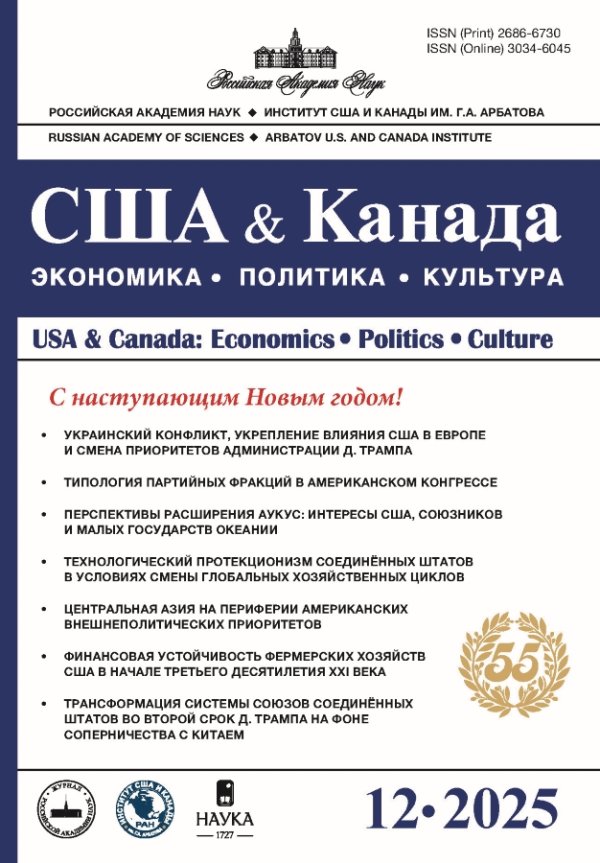
USA & Canada: Economics, Politics, Culture

The monthly publication “USA & Canada: Economics – Politics – Culture” (“USA & Canada” Journal) was founded in 1970 as “USA – Economics, Politics, Ideology” (since 1998 Canada was added). It's main purpose was and still is to inform readers about all aspects of domestic and foreign policies of the USA and Canada as well as current theoretical and practical issues of the international policy, world economic relations, development in different countries of the world. It publishes materials representing results of researches carried out by Russian specialists and foreign analysts on Russian – U.S. and Russian – Canada relations. Now it is the leading journal in Russia and CIS on all these matters. Also the journal publishes articles on such matters as security and defense policies, globalization and integration processes, innovation, scientific and technological progress, international terrorism and counter-terrorism, environmental challenges and cultural issues (literature, music, cinema, arts and architecture) etc.

Mission of the Journal is to provide a platform for authoritative researchers from Russia and the CIS countries to discuss processes and events taking place in the USA and Canada.

Among readers of “USA & Canada” journal are: international researchers and students of above mentioned issues, teachers, post-graduate students and students of higher education institutions, executives and staff of federal and regional state authorities, managers and analysts of banks, corporations, large enterprises.

Among the authors of the journal are: the leading analysts of the Institute of USA & Canada Studies, Russian Academy of Sciences, researchers from other Russian academic and non-academic think-tanks of international profile, foreign researchers, industry analysts and banking experts, professors of the universities and higher education institutions, post-graduate students, representatives of the legislative and executive bodies of the Russian Federation and the CIS countries.

The journal is included in the Russian Higher Attestation Commission List of peer-reviewed scientific publications.

The “USA & Canada: Economics – Politics – Culture” journal is distributed by advance subscription only, and is not offered for sale. The subscription may be accomplished in every post-office in Russia using the Federal Postal Service union catalogue, section “ARSMI», the journal index 70925. The subscription may start from every month, for any number of issues.

Since 2009 it has been possible to receive the full-text online version. The subscription for it is done centrally through the Russian Electronic Library system https://elibrary.ru/title_about.asp?id=8241

Editor-in-Chief of the journal - A. Panov.

Media registration certificate: ПИ № ФС 77 - 71487 от 13.11.2017

Current Issue

No 2 (2026)

Global Security

U.S. Designing of Security in Postwar Europe
Prikhodko O.V.
Abstract
After the Second World War, US national security strategy underwent a fundamental overhaul that resulted in perception of Europe as an area of US vital interests and the abandonment of isolationism. Washington lacked off-the-shelf recipes for securing American interests in postwar Europe. Although deliberation on the issue had been initiated in the war years, the concept of transatlantic collective defense actually took shape in 1948. While encouraging Western European countries to pool their scarce resources, Washington quickly realized that their capabilities were insufficient to counter the Soviet military might on their own. The escalating confrontation between the former allies of the anti-Hitler coalition led architects of American foreign policy to a decision to keep a substantial US military presence in Europe and align the security arrangements of Western Europe and the United States. However, there were divergent opinions within the Truman administration on how to implement this design, as it required a radical revision of the fundamental tenets of grand strategy.
USA & Canada: Economics, Politics, Culture. 2026;(2):05-19
pages 05-19 views

U.S. and the World

Donald Trump's Policy in the Post-conflict Settlement around Nagorno-Karabakh
Gegelashvili N.A.
Abstract
This article examines Donald Trump's policy toward the post-conflict settlement in Nagorno-Karabakh. It provides a comparative analysis of American policy toward the Nagorno-Karabakh conflict during the presidency of Joe Biden as well as Donald Trump. The article identifies the ways and means of implementing Washington's policy in the Transcaucasus region, culminating in the "Grand Bargain". It examines the reasons for Washington's intensified policy in the region in a situation where pragmatism and an emphasis on a deal are becoming the main principle of the current American administration. Under these circumstances, the construction of transit corridors, expanded trade, energy development, and strengthening security are fully consistent with the policies of US President Donald Trump.
USA & Canada: Economics, Politics, Culture. 2026;(2):20-32
pages 20-32 views
U.S. Sanctions Against Iranian Exports in Second Term of President D. Trump
Grafov D.B.
Abstract
The article assesses US sanctions restrictions on Iran's export of oil and petrochemical products, which are most important for budget revenues. The shadow tanker fleet and shadow banking network play a crucial role in exporting oil and evading sanctions. The author comes to the conclusion that Iran's system of evading sanctions is effective. US efforts to target Iranian the maritime oil trade have failed to achieve the goal of "net zero" exports. From time to time, the US Treasury Department takes action against individuals and companies from Iran, China, India, the UAE and Singapore, as well as against ships under the flags of Panama, Tanzania, Comoros, San Marino, that evade sanctions, but others appear in their place. Market interest facilitates the circumvention of trade sanctions. Iran has seen steady GDP growth since 2020, according to the World Bank. After the diversification and restructuring of Iran's economy, the share of oil revenues in GDP is about 23%, which excludes the possibility of the economy being strangled by "net zero" oil export sanctions.
USA & Canada: Economics, Politics, Culture. 2026;(2):33–49
pages 33–49 views

Media and Society

Donald Trump's Media Policy During His Presidency
Nerentz D.V.
Abstract
Donald Trump is known in the media space as an unpredictable politician and leader, capable of making unexpected and even shocking decisions. In both his first and second terms, relations between the 47th President of the United States and the media were difficult and tense. Traditional media such as television, radio and the press were of secondary importance to D. Trump from the very beginning, since he initially chose social networks as a platform for communicating with the public. Despite all the twists and turns, scandals and court proceedings, during the beginning of his second presidential term, the president continued his media policy, demonstrating a clear negative attitude towards mainstream publications and continuing his active presence in the online space, only using his own resources. The article analyzes the media policy of the current President of the United States. In particular, the conditions in which the first presidential term took place and what were the advantages and disadvantages of the strategy of communication with traditional and new media chosen by D. Trump were noted. In addition, a study of D. Trump's interaction with media resources at the beginning of his second presidential term is presented. In particular, a number of nuances are indicated that make it possible to determine his political identity and the established media image against the background of making certain decisions.
USA & Canada: Economics, Politics, Culture. 2026;(2):50–64
pages 50–64 views

Society and Religion

Preaching as Performance: An Analysis of the African American Religious Discourse
Sebryuk A.N.
Abstract
This article explores African American Christian preaching as a unique phenomenon of religious discourse that has played a significant role in shaping the collective identity and historical memory of African Americans. The sermon is examined as a hybrid form of ethnocultural rhetoric that interweaves elements of West African oral tradition, Christian homiletics, and American public speech. Drawing on sermons delivered by a contemporary Black preacher, the article analyzes key discursive strategies, stylistic and rhetorical features, and communicative functions that allow the African American sermon to maintain its influence in both the religious and socio-political life of the United States.
USA & Canada: Economics, Politics, Culture. 2026;(2):65–82
pages 65–82 views

History

The 1986 Reykjavik Summit: A Soviet–Icelandic Dimension
Pankov E.S.
Abstract
The article puts the 1986 Gorbachev-Reagan summit in Reykjavik in the context of Soviet-Icelandic relations: the bilateral relations prior to the summit are analyzed, light is shed on the preparation of the meeting and the content of the Soviet-Icelandic official talks and events. To answer the main question about the influence of this summit on the state of the Soviet–Icelandic relations, the author makes use of unpublished sources from the State Archive of the Russian Federation (GARF), the Russian State Archive of Contemporary History (RGANI), as well as the recollections of a member of the Soviet delegation (an interview with Mikhail Gorbachev’s translator Pavel R. Palazhchenko). The article highlights the role of Raisa M. Gorbacheva, as her image subsequently had not only a meaningful influence on the image of the USSR, but also corresponded to social trends in Iceland, where the ideas of gender equality and broader political participation of women were rapidly gaining momentum. The study also sheds light on the reasons for the homecoming of the Soviet Ambassador Evgeni A. Kosarev following the summit. It emphasizes that despite the reserved attitude of the Icelandic government towards the foreign policy initiatives of Mikhail S. Gorbachev in 1985-1986, his visit to Reykjavik led to a significant but short-lived change in the Icelandic authorities' attitude to the dialogue with Moscow: the first visit of the leader of the Soviet Union to Iceland in the history of the bilateral relations improved the image of the Soviet state, as evidenced by the letters from Icelandic citizens to the Soviet leader; however, the parties still failed to overcome the negative influence of systemic factors on the Soviet-Icelandic dialogue: just a year after the summit, publications accusing the Soviet Union still appeared in major Icelandic media, as in the previous stages of the Cold War.
USA & Canada: Economics, Politics, Culture. 2026;(2):83-100
pages 83-100 views
Geography of the US Banking System in 2010–2025 (On the 15th Anniversary of the Dodd–Frank Act)
Nikitin L.V.
Abstract
The passage of the Dodd–Frank Wall Street Reform and Consumer Protection Act in 2010 was a very important milestone in the contemporary economic history of the United States. This Act was seen as a strong reaction to the just-ended 2008–2009 economic crisis and the destructive role that some financial institutions played in causing the Great Recession. On the basis of this Act, additional mechanisms for control over banks and other corporations from the financial sector were created, and the system of constant monitoring and early receiving of signals about possible economic crises was expanded. Despite revisions of several rules in 2018, the Dodd–Frank Act remains in effect in its core provisions to this day. The article, based on the large set of statistical materials, examines how the US banking system has developed (mainly in its territorial parameters) after the adoption of the new Act. It is shown that in many aspects the situation has changed significantly compared to previous decades: for example, during the 2010s and the first half of the 2020s, there was a smaller degree of gaps between cities in key indicators of banking activity. It is also very important that under the new conditions the intensity of rank changes among the country’s leading banking centers has decreased. Overall, based on the results of 15 years, we can speak of fairly pronounced stabilization effects associated with the Dodd–Frank Act.
USA & Canada: Economics, Politics, Culture. 2026;(2):101–115
pages 101–115 views

Reader’s Deliberations

Will there Be a New "Reset" of Russian-American Relations?
Samuylov S.M.
Abstract
The article-review analyzes the content of the fundamental scientific monograph of the authoritative Russian Americanist, Doctor of Historical Sciences V.I. Batyuk, devoted to the study of the evolution of Russian-American relations from the time of the collapse of the Soviet Union to the present. The author, as a qualified specialist, pays special attention to the problems of strategic arms control and convincingly substantiates that this sphere of bilateral relations has lost leading role in their constructive maintenance. It is quite possible to agree with the author that at present Russian-American relations are experiencing a period of the second Cold War.
USA & Canada: Economics, Politics, Culture. 2026;(2):116-126
pages 116-126 views

Согласие на обработку персональных данных


Используя сайт https://journals.rcsi.science, я (далее – «Пользователь» или «Субъект персональных данных») даю согласие на обработку персональных данных на этом сайте (текст Согласия) и на обработку персональных данных с помощью сервиса «Яндекс.Метрика» (текст Согласия).