

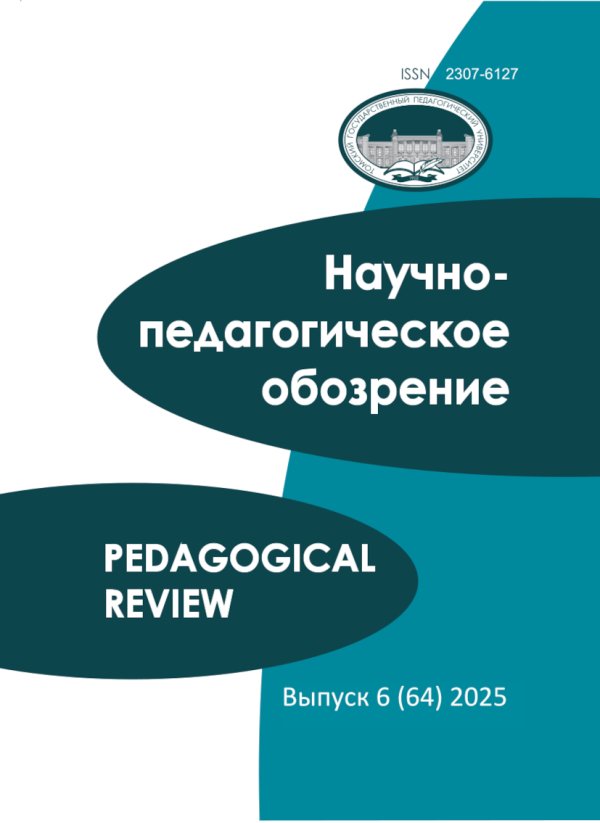
Pedagogical Review

Welcome to the website of the academic journal "Pedagogical Review". The journal publishes scientific material on the following subjects:

  • 5.3.1. General psychology, personality psychology, history of psychology (psychological sciences),
  • 5.3.4. Educational psychology, psychological diagnostics of digital educational environments (psychological sciences),
  • 5.8.1. General Pedagogy, History of Pedagogy and Education (Pedagogical Sciences),
  • 5.8.2. Theory and methods of training and education (by areas and levels of education) (pedagogical sciences),
  • 5.8.7. Methodology and technology of vocational education (pedagogical sciences).

The journal is included in the list of the leading reviewed academic journals and publications, publishing the most significant results of doctoral and postdoctoral theses, as approved by the Higher Attestation Comission of the Ministry of Education and Science of the Russian Federation.

Publication frequency: 6 issues per year.

The website has an ARCHIVE that contains annotations of the articles, key words, information on the authors in Russian and English and also full-text versions of the articles.

The founder of the academic journal is Tomsk State Pedagogical University

The journal is included in the "Russian Press" subscription catalog. Index: 82680.

Indexing the journal

  • The journal is included in the database of periodicals "ULRICHSWEB"
  • The journal is included in the database of periodicals "GOOGLE SCHOLAR"
  • The journal is included in the database of periodicals "WORLDCAT"

Information on the Russian Science Citation Index

Information on the published articles is regularly sent to the system of the Russian Science Citation Index.

Dear readers!

The journal "Pedagogical Review" is aimed at acquainting the general scientific and pedagogical community with current research in the fields of pedagogy, psychology and methods of learning and teaching.

The publication of our journal is triggered by developments within higher pedagogical education in both Russia and the international community. Such developments include globalization, activating the need for an exchange of Russian and international scientific and educational experience, as well as humanization and the openness of education at all levels. Our journal is a space for publishing materials and results of modern humane, psycho-pedagogical and methodological research from specialists in Siberia, Russia and other countries.

The journal acquaints readers with contemporary issues of psycho-pedagogical and methodological research within the logic of the system-activity, competency, axiological and humanitarian approaches; with innovative technologies and forms of organization of educational activity of children, youth and adults (project and problem-based learning, joint activity, development of critical thinking, portfolio). It publishes information (reviews) on new authors and collective monographs on pedagogy, issued in Tomsk and other universities in Siberia, as well as survey-based research.

Among the thematic directions of the journal are: philosophy of education, history of pedagogy and psychology, pedagogical and educational technology (student-oriented, humanitarian, technologies of joint training, active methods of learning), competence approach in education, psychological studies (general, age, educational, social and clinical psychology, acmeology), implementation of the new federal educational standards of the FSES, general pedagogy, pedagogy and didactics of higher school, andragogy, inclusive education and comparative education.


Current Issue

No 6 (2025)

GENERAL PEDAGOGY, HISTORY OF PEDAGOGY AND EDUCATION

On the possibility of using the experience of spiritual and moral education of the orthodox old believers in modern education
Sazonova N.I.
Abstract
The article analyzes the possibilities of using the experience of spiritual and moral education of the Old Believers in education. The material for analysis is the basic principles of spiritual and moral education developed by the religious denomination, as well as the experience of representing the Old Believer culture in the educational environment of a modern pedagogical university. The most important principles of spiritual and moral education in the Old Believer community are respect for the child’s personal freedom, the absence of coercion, and the use of personal example. The knowledge about religious culture that the child receives is adapted to their age and capabilities. These approaches to education are in line with modern pedagogical approaches and technologies, making them suitable for use in modern education. However, experience in working with the confession shows that the translation of the principles of spiritual and moral education into the modern educational environment is associated with a number of problems. Among them, we can mention the change in the target audience: instead of representatives of the confession, it is made up of people who are “spiritually alien” to them. In addition, when working with a secular audience, the goal is not to integrate into the confession, but to gain knowledge about it. All of this necessitates the adaptation of existing methods and approaches to the new situation. Another problem is the long-term isolation of the denomination, which leads to the perception of the non-denominational audience as “foreign” and complicates the presentation of the culture, as was established during the attempt by representatives of the denomination to present the Old Believer culture at the exhibition-seminar “Tomsk Old Believers: History and Modernity”. However, the audience was most interested in learning about the everyday elements of the denomination, the environment in which the upbringing of the denomination takes place.
Pedagogical Review. 2025;(6):7 - 18
pages 7 - 18 views
The values of cultural sovereignty in Russia and China: an educational perspective
Leontyev E.P.
Abstract
The article provides a rationale for the emergence of the term “cultural sovereignty” and its substantive development in foreign and Russian science, as well as its definition in the Fundamentals of the State Cultural Policy of the Russian Federation. Based on an analysis of Russian and Chinese legal sources, the article identifies the position of state cultural policy and the policy of preserving and strengthening traditional values, as well as the key means of cultural sovereignty for states, such as education and upbringing. The author highlights the traditional spiritual and moral values that are characteristic of the cultures of both countries and provides examples of anti-values. The paper clarifies the fundamental components of “Russian” and “traditional” values and presents a hierarchy (system) of the spiritual and moral (“core”) values of Chinese society. The Russian and Chinese traditional spiritual and moral values presented in the work are defined as key integrators of the cultural sovereignty of both countries under consideration, and the established legal framework is a reflection of the state policy aimed at protecting, consolidating, and regulating traditional values in the field of education, as well as a fundamental basis for updating the content of Russian and Chinese education. The author proposes methods for creating a unified value space within the educational system of the Russian Federation and the People’s Republic of China. As examples, the high importance of the implementation of the Ministry of Education of the Russian Federation’s project “Conversations about Important Things” and the integrated “Ideological and Political Course” in the practice of teaching in schools and universities in the People’s Republic of China has been revealed, within the framework of which the objectives and ideas of traditional spiritual and moral education of students and undergraduates in both countries will be implemented. The article proposes a regulation on the development of scientific and methodological support for comprehensive work in schools and universities, aimed at forming a system of skills, values, and behavioral patterns, as well as the need to update the system of educational activities in pedagogical universities in working with future teachers through modern and innovative approaches to teaching that meet the state policy in the context of cultural sovereignty.
Pedagogical Review. 2025;(6):19 - 30
pages 19 - 30 views

THEORY AND METHODS OF TEACHING AND EDUCATION

Designing individualized educational routes in teaching master’s degree students oral foreign language communication
Matsalak T.V., Obdalova O.A.
Abstract
The article explores the key aspects of designing individualized educational routes in teaching oral foreign language communication to Master’s degree students. The technology of designing an individual educational route in teaching oral foreign language communication is defined, which includes content planning, resource selection and organization of both student’s and teacher’s activities. For the implementation of an individual educational route we suggest a structured, multi-faceted approach, based on a variable practice in oral foreign language communication, a modular course design, and use of blended learning technologies. The peculiarities of basic-invariant (essential for all learners), differentiated (tailored to individual learners’ needs), and variant-developmental components (focused on advancing professional skills) of individual educational routes are considered. The study identifies potential communicative barriers (linguistic, didactic, evaluative and self-management) and proposes strategies to overcome them. The design process is revealed by two algorithms of activities: for a teacher and a student. The teacher’s design algorithm consists of five stages: diagnostic, projective-reflexive, motivational, organizational-activity and resultant-reflexive; the student’s algorithm consists of organizationalmotivative, activity and resultant-reflexive. The article describes the possibilities of the proposed designing technology that allow building trajectory of individualized alignment of students’ foreign language skills and speech abilities, necessary for creating equal opportunities for their participation in foreign language communication. The didactic potential of the designed algorithm for individualizing the process of Master’s degree students teaching foreign language communication skills manifests itself in expanding research-oriented foreign language experience and varying degree of learner autonomy and specialization.
Pedagogical Review. 2025;(6):31 - 44
pages 31 - 44 views
The potential of simulation and game-based technologies in teaching the fundamentals of safety and homeland defense
Sinogina E.S., Lomovskaya S.A., Peshkicheva T.V.
Abstract
The article analyzes the problems and prospects of implementing simulation and game-based technologies in teaching the subject “Fundamentals of Security and Defense of the Homeland” (FSDH) under resource constraints. The relevance of the study is determined by the need to improve the quality of students’ training for actions in emergency situations, to develop stable practical skills, as well as to stimulate interest in military service and promote military-patriotic education. The aim of the research was to identify problem areas and barriers limiting the use of simulation and game-based methods, as well as to define pedagogical conditions that contribute to their effective integration into the educational process. The empirical basis of the study consisted of a survey of 19 teachers of FSDH. Methods of descriptive statistics and content analysis were applied. The analysis showed that traditional methods (lectures, discussions) dominate in teaching practice, while role-playing games, quests, and virtual simulations are used significantly less frequently due to the lack of material and technical resources and methodological support. The key problems identified include equipment shortage, low student motivation, and the absence of up-to-date methodological guidelines. Despite the regular organization of additional militarypatriotic activities, only a small number of students demonstrate a steady interest in military service, which indicates the need to revise the content and forms of the subject. The theoretical significance of the study lies in clarifying the role of simulation and game-based technologies as a comprehensive didactic mechanism that integrates cognitive, practical, and motivational components of learning. The findings are consistent with D. Kolb’s experiential learning concept, confirming the importance of combining theory with active experimentation for the formation of sustainable skills. The practical significance of the study is determined by the possibility of applying the obtained results in the development of modernization programs for the FSDH course, updating methodological materials, and improving teachers’ qualifications. In particular, the need for equipping educational institutions with specialized training simulators, virtual simulation tools, and personal protective equipment is substantiated, along with strengthening partnerships with military and rescue organizations. The implementation of these recommendations will improve the effectiveness of teaching FSDH, overcome the gap between theory and practice, and foster students’ readiness for actions in risky conditions, thus ensuring a high level of personal and collective security.
Pedagogical Review. 2025;(6):45 - 55
pages 45 - 55 views
Information perception and understanding in children with disabilities: characteristics, problems, and solutions
Myodova N.A., Kryukovskaya N.V., Sergeyeva A.I.
Abstract
The article examines the features of perception and understanding of information in children with disabilities. It analyzes the main problems these children face in the process of receiving and processing information and proposes ways to address them. Special attention is given to the integration of pedagogical and speech therapy strategies for more effective development of communication skills and improved text comprehension in students. This approach allows combining teaching methods with corrective techniques, contributing to a more comprehensive and individualized development of speech and cognitive processes. The authors argue that when working with textual material, children with disabilities need to use techniques based not only on active reading methods, such as highlighting key words and phrases, formulating content-related questions, and creating diagrams and tables to structure information, but also on linguistic, non-linguistic, cultural, pragmatic, and inclusive approaches to text adaptation. These approaches help improve cognitive processes related to perception and information processing, as well as enhance the level of communicative and analytical skills in students with learning difficulties. This article presents the results of an empirical study examining the cognitive and perceptual characteristics of text comprehension in preschool and primary school-aged children in educational institutions in Tomsk (Tomsk Oblast, Russian Federation) and Grodno (Republic of Belarus). The experimental study included a comprehensive analysis of the mechanisms of adaptation to text stimuli, with an emphasis on identifying specific deficits due to individual differences in cognitive development and language skills. The authors systematized the identified deficits, classifying them into categories (e.g., phonemic, semantic, and pragmatic impairments), and proposed adaptive techniques for perceiving text information that take into account the specific perceptual processes of the study group.
Pedagogical Review. 2025;(6):56 - 66
pages 56 - 66 views

METHODOLOGY AND TECHNOLOGY OF PROFESSIONAL EDUCATION

Developing the research potential of students in educational organizations: a differentiated approach
Znikina L.S.
Abstract
In modern professional education, one of the priority indicators of the quality of the educational process and the competencies acquired by students is the level of their readiness for scientific activity. The issue of finding ways to organize the educational process that ensures the development of students’ research potential at all stages of education is relevant. Special attention is paid to the preparation of postgraduate students and young researchers for research activities. The purpose of this research is to develop scientific and methodological foundations for a differentiated approach to enhancing students’ research and motivational resources, which has led to the scientific novelty of the presented material: the development of a framework model for pedagogical support of young researchers. The framework model is presented in the form of an algorithm, i.e., a specific sequence of stages that have the nature of qualitative iterative changes (in our case, the development of students’ research potential). As a result of the research, in addition to the framework model, a cognitive technology is presented as the basis for implementing the pedagogical idea of developing students’ research potential, based on a differentiated approach to organizing the learning process. In the context of the problem under consideration, the concept of “activity” is defined, and the possibility of applying general scientific principles of the systemic-synergetic approach to pedagogical issues is demonstrated. The article also describes the specific scientific principles (potential and actual, and the principle of scaffolding, evaluation regulation) for constructing a cognitive technology. The results obtained can be used as methodological foundations for organizing the educational process in preparing students, postgraduate students, and young researchers for research activities.
Pedagogical Review. 2025;(6):67 - 76
pages 67 - 76 views
A competency-based training model for national healthcare systems: the experience of Mudanjiang Medical University
Li C.
Abstract
The article systematizes the experience of Mudanjiang Medical University in the field of personnel training for the domestic healthcare system, which can be used in the educational activities of medical universities in other countries, primarily Russia. The result of the generalization is a competency-based model for training qualified doctors who are able to demonstrate effective and innovative approaches to solving professional problems, taking into account the specifics of the current situation. The study is based on the results of an analysis of current problems in the training of doctors for medical institutions in the northeastern regions of China bordering Russia. The situations common to Russia and China in the work of medical institutions are noted, related to the shortage of personnel in basic medical institutions, the aging of medical personnel, and the low level of professional competencies. These factors determine the need to develop new solutions. As an option for such a solution, it is proposed to introduce an innovative model of graduate training at a modern medical university, which is being implemented at Mudanjiang Medical University. The model is based on the integration of 3 types and 3 specializations in the training of medical personnel: applied, innovative, complex types of training and such areas of specialization of training as intellectualization, versatility, adaptation to elderly patients (abbreviated as “three types and three specializations”). The article substantiates the choice of appropriate pedagogical strategies, tactics and technologies in the form of restructuring curricula, creating intelligent practical platforms and developing ways and mechanisms of social support for professional personnel. The described model integrates achievements in the field of technological support, the introduction of innovative educational technologies, the implementation of scientific and applied content and social support for students of medical universities. It solves the problem of improving the efficiency of medical care, including primary health care, in border regions and optimizes the work of national medical services, in accordance with the government’s “China’s Health” strategy. This educational initiative and the experience gained as a result of its implementation in the learning process of medical students can be considered as a development option by Russian medical universities.
Pedagogical Review. 2025;(6):77 - 87
pages 77 - 87 views
Working with the regional education system’s management personnel reserve: designing changes
Smyslyaeva L.G., Neradovskaya O.R., Kiseleva N.A., Minin M.G.
Abstract
The article outlines the current challenges of developing general education from the perspective of the new national strategy and regional practices, which have been identified based on the method of theoretical analysis and the study of existing federal legal documents. The article also highlights the current features of working with management personnel reserves in the education system at the regional level, including aspects of their formation based on the personal and professional characteristics of applicants. The article emphasizes the importance of finding new effective approaches to developing the management personnel potential of regional education systems, which is crucial for their transformational changes in the new sociocultural environment. The article sets an andragogical focus on analyzing the current approaches to working with management personnel reserves in the regional education system and designing the necessary changes. The results of an empirical study (conducted in the period 2024–2025 at the Tomsk Regional Institute for Advanced Training and Retraining of Education Workers) are presented, reflecting an understanding of the nature of the necessary changes in working with the considered group of management reserves. Reasoned ways and means of implementing such changes are proposed, which actualize integration processes, accelerate career meanings, and provide individual educational support for reservists, including mentoring. The research data were obtained from regional empirical material using survey methods, focus groups, and expert methods. The practical significance of the research materials lies in the possibility of using them to develop regional practices for working with management personnel reserves in the education system through the design of changes aimed at improving the efficiency of this work. The article formulates specific proposals that are important for improving the personnel policy in the general education system of the region and the country in terms of working with management personnel reserves.
Pedagogical Review. 2025;(6):88 - 101
pages 88 - 101 views

PSYCHOLOGY

Competing with generative artificial intelligence and gadgets: possibilities of modern educational practice in university
Polyanina O.I., Shevkova E.V.
Abstract
The article outlines current trends characterizing the modern educational practice of higher education. Two groups of challenges faced by education entities are presented. The first group is associated with the “hyperconnectivity” of education entities to the Internet. The second group of challenges is associated with the effects of using generative artificial intelligence in training. A number of phenomenaconsequences of the interaction of education entities with the digital environment are listed. Using the example of the phenomenon of multitasking, optimistic and pessimistic research expectations and forecasts concerning the outcomes of the detected transformation of the cognitive sphere of students are described. The currently unfolding technological transformation stimulates changes in the cognitive sphere and metacognitive functions of subjects. This situation in the higher education system requires psychological and pedagogical reflection. The novelty of the study lies in the fact that, in relation to the psychological consequences of the digital revolution in university education, a realistic answer is proposed that recognizes the inevitability of the changes taking place and at the same time assumes support for students’ subjectivity – self-regulation of their activities, awareness, organization of access to resources. The following are proposed as a methodological framework for designing learning relevant to the goals of developing subjectivity characteristics: a self-regulatory approach to learning, the concept of mental experience, and conscious learning. Within each approach, the targets of pedagogical interventions are listed, such as the processes of the self-regulation cycle of learning, components of mental experience, and recognition of the learning context. Possible tools for pedagogical interventions are also provided.
Pedagogical Review. 2025;(6):102 - 112
pages 102 - 112 views
Features of the formation of pedagogical thinking in novice higher education teachers
Vinogradova G.A., Nikitin A.V.
Abstract
The article presents the results of an empirical study investigating the psychological characteristics of pedagogical thinking among young lecturers in higher education institutions, a crucial area given the ongoing transformations in higher education that demand enhanced pedagogical capabilities. The study was conducted on a sample of 102 lecturers from Samara region universities, possessing varied lengths of service, academic positions, and degrees. Four main parameters of pedagogical thinking were meticulously examined using specially adapted diagnostic methodologies creativity, reflexivity, criticality, and flexibility. Subsequent statistical analysis revealed statistically significant differences in these pedagogical thinking parameters when lecturers were grouped by length of service, position, and academic degree. Notably, it was established that young lecturers with up to three years of experience demonstrate lower levels of creativity and reflexivity in their pedagogical thinking compared to their more experienced colleagues. Furthermore, seemingly paradoxical patterns emerged in the distribution of reflexivity among groups with different academic degrees and positions, suggesting complex interactions between academic seniority and self-assessment tendencies in teaching. For instance, those with the highest academic credentials did not always exhibit the highest reflexivity. These research results contribute substantially to the understanding of the psychological mechanisms underpinning the nuanced trajectory of professional development for higher education lecturers. The findings are of considerable practical value and can be directly utilized for the design and implementation of more effective and targeted professional development programs for academic staff, tailored to address specific needs at different career stages and thereby fostering a more adaptive and innovative teaching workforce.
Pedagogical Review. 2025;(6):113 - 124
pages 113 - 124 views
Assessment of professional well-being of student group tutors in the context of ensuring educational environment safety
Filippova S.A.
Abstract
The study is aimed at studying the issues of psychological safety and preventing the risk of professional-emotional burnout of teachers-curators of student groups of the university. Attention is paid to the influence of the psychological climate, professional well-being of the teaching staff on the safety of the educational environment. As hypotheses, it is suggested that the academic and educational environment of the university, in general, meets the safety requirements in terms of the psychological well-being of teachers and curators, while some curators may need psychological support; there is a link between measures of psychological well-being and job satisfaction. The study involved 93 curators of student groups of a pedagogical university, of which: 79 women, 14 men, age range 22-66 years. The safety of the educational environment was assessed through the criteria: satisfaction with work, professional burnout, psychological health of the curators of student groups. Diagnostic tools: Symptom Checklist-90 (SCL-90), «Integral Index of Job Satisfaction», «Professional Burnout Diagnosis» (C. Maslach, S. Jackson, adapted by N.E. Vodopyanova). It has been established that, in general, the academic and educational environment of the university meets the safety requirements in terms of the psychological well-being of teachers and curators, while some curators experience certain manifestations of psychological distress, they require psychological assistance. Weak correlations between the symptoms of burnout and general satisfaction with the profession were identified, demonstrating the complex dynamics of factors affecting the psychological health of teachers. The work emphasizes the need for an integrated approach to ensuring the psychological well-being of the teacher, especially given the influence of curators to create a safe space for students. These conclusions can be used in the implementation of the educational process in universities and help develop programs to support university employees.
Pedagogical Review. 2025;(6):125 - 134
pages 125 - 134 views
The Role of Self-Regulation in the Formation of Conflict Culture in Adolescents
Mukhina S.E., Gavrilova A.Y.
Abstract
In the modern world, the actualization of the problem of developing conscious self-regulation, one of the personal resources, active volitional and cognitive control of the subject over his emotional sphere, affects and behavior in a conflict, is becoming significant. Conflictological culture is a complex formation, the highest level of a person’s preparedness for a conflict situation and methods of action within it in order to prevent the escalation of the conflict. The purpose of the study is to identify the relationship between self-regulation of the individual and conflictological culture in adolescence. A set of psychological methods was used in the empirical study: Self-regulation style of behavior by V.I. Morosanova; Methodology for studying self-government by Yu. Kul and A. Furman (adapted by O.V. Mitina and E.I. Rasskazova); Methodology for studying the conflictological culture of personality by O.I. Shcherbakova. The empirical sample consisted of 70 subjects aged 14-15 years, students of Lyceum No. 13 in Krasnoobsk, Novosibirsk Region. The results of the study showed that there is a relationship between self-regulation and conflictological culture in adolescence, and the higher the severity of self-regulation indicators, the more pronounced is the level of conflictological culture and its individual components. The core of the relationship between conflictological culture and selfregulation are the parameters of self-sensitivity, flexibility, action programming, and stress level. Experiencing stress reduces the possibility of using conflictological culture in communication, while sensitive perception and the ability to manage one’s feelings, behavior, and activities have the opposite tendency. The theoretical significance of the study consists in obtaining new data on the development of self-regulation and conflictological culture during adolescence, and in their relationship with each other, which makes it possible to propose ways of forming these psychological phenomena. The practical significance of the work consists in the potential for using the results in the educational work of a teacher-psychologist, when creating programs and work plans for the formation of a favorable school climate.
Pedagogical Review. 2025;(6):135 - 147
pages 135 - 147 views
Psychological features of motives of information activity of a person with different levels of advertising suggestiveness
Zekeryayev R.I.
Abstract
One of the most common phenomena of the modern media space is advertising, the purpose of which is to influence the target audience, convincing it to purchase a product or service. At the same time, its content, which includes various methods of information influence, implicitly transmits attitudes and beliefs to recipients, creates new values, meanings and motives in them, manipulates the emotional state, etc. At the same time, the strongest aspects of advertising – its relatively easy accessibility, attractiveness provided by special effects and persuasiveness conditioned by a complex of methods of hidden influence – lead to the fact that it becomes more difficult for potential recipients to show reflection and control their emotional reactions to the content they view. Consequently, advertising suggestiveness, which determines the characteristics of a person’s perception of advertising content and the ability to resist its negative impact, becomes an important phenomenon that requires detailed study. Despite the large number of studies devoted to this issue, the psychological characteristics of the person associated with this phenomenon remain insufficiently studied. One of these may be the components of information activity that determine the nature of a person’s interaction with the media environment. The empirical base of the study consisted of a randomly selected sample of 50 people, including 16 boys and 34 girls, with an age distribution of 18–25 years. The methodological support for the study consisted of the questionnaire “Motivational structure of information activity” (G.N. Malyuchenko, V.M. Smirnov, A.S. Kopovoy) and the research questionnaire “Advertising suggestiveness of personality” (R.I. Zekeryaev). The study revealed that with the growth of such motivations in the structure of information activity as communicative, relaxation, reactivating and compensatory, the degree of advertising suggestibility of the individual also increases. The practical significance of the study is that its results can be used by practicing psychologists in the process of individual consultations and psychological support of the process of media socialization of the individual.
Pedagogical Review. 2025;(6):148 - 157
pages 148 - 157 views
Development of ideas about tactile interaction: from Aristotle to the present day
Leontyeva D.V., Belovol E.V.
Abstract
This article explores the evolution of concepts related to tactile interaction as a fundamental element of human embodiment, perception, and communication. It investigates how touch has been interpreted across historical periods—from a basic physiological function to a complex process deeply embedded in emotional regulation, personal identity, and social integration. The analysis incorporates philosophical perspectives on bodily experience, psychological theories that examine the role of tactile stimuli in human development, and recent neuroscientific findings on the functioning of sensory systems involved in touch. Emphasis is placed on the transformative nature of tactile contact in building a sense of safety, empathy, and interpersonal trust. The study addresses how cultural practices and social norms shape tactile behavior and how the reduction of physical contact in the digital era affects human interaction. As communication increasingly occurs in virtual environments, the loss of real touch raises critical concerns about emotional isolation and sensory deprivation. The article underscores the necessity of preserving embodied experience and rethinking the function of tactile interactions in education, therapy, and everyday social life. The shift toward digital and technologically mediated relationships makes the human body more abstract and potentially disconnected from authentic sensory feedback. Through an interdisciplinary lens combining philosophy, psychology, neuroscience, and cultural studies, the article argues for the ongoing relevance of tactile engagement in maintaining psychological well-being and fostering meaningful human connection. The conclusion is made about the need to preserve bodily experience as an important factor in emotional and social regulation in changing technological conditions.
Pedagogical Review. 2025;(6):158 - 165
pages 158 - 165 views

OVERVIEWS

Ivan Semyonovich Klyuzhev – teacher, reformer and statesman of Russia at the beginning of the twentieth century
Voytekhovskaya M.P., Kochurina S.A.
Abstract
The historical experience of developing reforms in the process of establishing the Russian education system at the beginning of the 20th century has great potential for understanding the development features and specifics of the modern Russian school. I.S. Klyuzhev had a distinguished career as a teacher and, as an experienced practitioner who deeply understood the challenges of school education, attained a respected social position and the right to represent the interests of the Samara province in the Russian parliament. One of the brightest representatives of this galaxy of public and pedagogical figures was Ivan Semenovich Klyuzhev, who made a significant contribution to the development of a whole series of bills on the organization of schools, submitted for discussion in the State Duma of Russia. I.S. Klyuzhev made a brilliant career as a teacher and, being an experienced practitioner who understood the problems of school education well, achieved a social position and the right to represent the interests of the Samara province in the Russian parliament. He became an active participant in the sections and committees of the Duma dealing with issues of Russian education, where he sought to implement ideas that, in his opinion, contributed to the solution of key issues of the state’s educational policy. Klyuzhev co-authored the most important bills on universal education in Russia, on the reform of teacher training institutes and a number of other laws that contributed to the development of schooling in the country. After the February Revolution of 1917, he joined the Special Committee under the Ministry of Public Education to work on similar laws under the Russian Provisional Government. He was the head of the department of the Ministry of Public Education of the Kolchak government, where he also participated in resolving the most important issues of education in the territories under his jurisdiction and was engaged in organizing a broad discussion of the new school legislation. The article is written on a broad, previously unused source base, revealing key aspects and supplementing little-known facts in the biography of I.S. Klyuzhev.
Pedagogical Review. 2025;(6):166 - 179
pages 166 - 179 views
Technological and cultural sovereignty of Russia and education: a review of publications
Semenova N.A., Pozdeeva S.I.
Abstract
The article is based on the analysis of scientific publications (for the period from 2021 to 2025) devoted to the issues of achieving cultural and technological sovereignty of the country, as well as the role of general and pedagogical education in these issues. It is noted that the relevance of the topic is due to the state’s attention to achieving cultural and technological sovereignty, which strategically should begin with the transformation of the content of general and pedagogical education. An overview of regulatory documents, scientific articles on cultural and technological sovereignty is presented, the main areas of research are described, and an emphasis is placed on the author’s positions indicating the possibilities of the education system for the formation of cultural and technological sovereignty. It has been established that the aspect of the relationship between cultural and technological sovereignty is insufficiently represented in the scientific content. It is emphasized that the basis of cultural sovereignty is the cultural and historical heritage and spiritual and moral values of the country, and cultural sovereignty, in turn, is the foundation of technological sovereignty. Most of the publications analyzed by the authors are devoted to issues of technological sovereignty of the country. It was revealed that less attention is paid to issues of cultural sovereignty. There is a shortage of studies proposing ways to change the content and methodology of general education to form students’ attitudes towards cultural sovereignty. Researchers very rarely touch upon issues of sovereignty formation in the context of pedagogical practice. The authors note the need to study the problem of training future teachers to form students’ value attitudes in order to achieve cultural and technological sovereignty.
Pedagogical Review. 2025;(6):180 - 192
pages 180 - 192 views

Согласие на обработку персональных данных с помощью сервиса «Яндекс.Метрика»

1. Я (далее – «Пользователь» или «Субъект персональных данных»), осуществляя использование сайта https://journals.rcsi.science/ (далее – «Сайт»), подтверждая свою полную дееспособность даю согласие на обработку персональных данных с использованием средств автоматизации Оператору - федеральному государственному бюджетному учреждению «Российский центр научной информации» (РЦНИ), далее – «Оператор», расположенному по адресу: 119991, г. Москва, Ленинский просп., д.32А, со следующими условиями.

2. Категории обрабатываемых данных: файлы «cookies» (куки-файлы). Файлы «cookie» – это небольшой текстовый файл, который веб-сервер может хранить в браузере Пользователя. Данные файлы веб-сервер загружает на устройство Пользователя при посещении им Сайта. При каждом следующем посещении Пользователем Сайта «cookie» файлы отправляются на Сайт Оператора. Данные файлы позволяют Сайту распознавать устройство Пользователя. Содержимое такого файла может как относиться, так и не относиться к персональным данным, в зависимости от того, содержит ли такой файл персональные данные или содержит обезличенные технические данные.

3. Цель обработки персональных данных: анализ пользовательской активности с помощью сервиса «Яндекс.Метрика».

4. Категории субъектов персональных данных: все Пользователи Сайта, которые дали согласие на обработку файлов «cookie».

5. Способы обработки: сбор, запись, систематизация, накопление, хранение, уточнение (обновление, изменение), извлечение, использование, передача (доступ, предоставление), блокирование, удаление, уничтожение персональных данных.

6. Срок обработки и хранения: до получения от Субъекта персональных данных требования о прекращении обработки/отзыва согласия.

7. Способ отзыва: заявление об отзыве в письменном виде путём его направления на адрес электронной почты Оператора: info@rcsi.science или путем письменного обращения по юридическому адресу: 119991, г. Москва, Ленинский просп., д.32А

8. Субъект персональных данных вправе запретить своему оборудованию прием этих данных или ограничить прием этих данных. При отказе от получения таких данных или при ограничении приема данных некоторые функции Сайта могут работать некорректно. Субъект персональных данных обязуется сам настроить свое оборудование таким способом, чтобы оно обеспечивало адекватный его желаниям режим работы и уровень защиты данных файлов «cookie», Оператор не предоставляет технологических и правовых консультаций на темы подобного характера.

9. Порядок уничтожения персональных данных при достижении цели их обработки или при наступлении иных законных оснований определяется Оператором в соответствии с законодательством Российской Федерации.

10. Я согласен/согласна квалифицировать в качестве своей простой электронной подписи под настоящим Согласием и под Политикой обработки персональных данных выполнение мною следующего действия на сайте: https://journals.rcsi.science/ нажатие мною на интерфейсе с текстом: «Сайт использует сервис «Яндекс.Метрика» (который использует файлы «cookie») на элемент с текстом «Принять и продолжить».