




编号 3 (23) (2024)
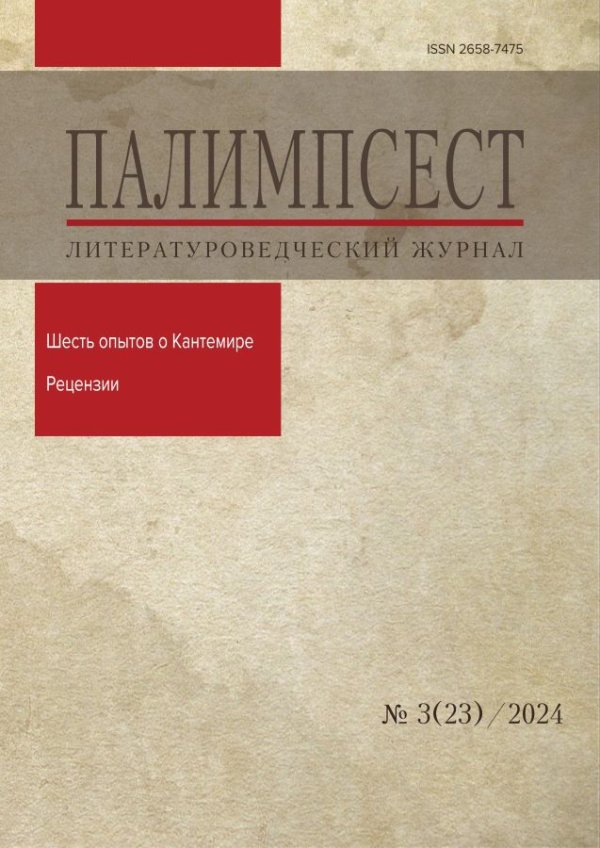

SIX EXPERIMENTS ON KANTEMIR
Microcosm of Kantemir's Satires in the Mirror of Emblematic Interpretation by Alexander Makhov
摘要
The article continues the author's long-term research devoted to testing various ways of reading Kantemir's satires. The organic connection of satires with European emblematics as a convenient prism for their interpretation has already become the subject of the author's attention. The reason to return to the topic was the new monograph by A.E. Makhov "Emblematics: Microcosm" published in 2024, which presents a fundamentally new view of European emblematics. Makhov's approach to emblematics from the position of "how it is done" (analysis of three main ethos and metaphors for their expression, the use of various types of paradox as a rhetorical device, a view of the body as a source of signs that make up the language of emblematics; description of the use of the argumentation system and highlighting the key role of the four main combinatorial operations – addition, subtraction, rearrangement, replacement, etc.) successfully "works" in interpreting Kantemir's satires. Satires easily “respond” to such a method of reading, which allows us to significantly develop the theme of the emblematic component in satires and once again recall the role of Kantemir in the process of connecting Russian literature to the European emblematic tradition. But the main thing in the article is still its theoretical component: the principles of interpretation used by Makhov are universal (at the deepest level, this is a system of metaphorical codes, a system of argumentation, and four combinatorial operations) and can be applied to the analysis of any material, and not only of a verbal nature. The use of general methods of interpretation for such seemingly distant genres as emblem and satire allows us to draw conclusions of a comparative nature: to note their common features. The parallel points of convergence between satires and the texts of later Russian authors (for example, A.S. Pushkin) can be considered a kind of “intertextual bonuses” that provide additional material for both research into the topics of Russian literature and for a comparative analysis of paired literary connections.
 7-34
7-34


Apophatic Metaphorization in the Creative System of A.D. Kantemir
摘要
The article examines the artistic specificity of the author's metaphorization of teleological aporias in the works of Antiokh Dmitrievich Kantemir, including apophatic attitudes in the construction of the author's artistic and philosophical world models. The article identifies and analyzes anthropological and ontological dimensions of the ambivalent world system “God's being is manifested in the created world / the created world is God's being”, as well as a number of the author's metatropes that center the artistic models of the “created world” and “God's being”. The author traces the possibility of correlating the cataphatic and apophatic interpretations of the metaphorics of Kantemir's circle that manifested in his “Letters on Nature and Man” and other texts. The article reveals the lexical-semantic and semiotic polyphony of the lexeme “creature”, which organizes the metaphorical semantic field of the ambivalent concept of the “created world”. The article examines the metaphorical components of the concept of “image”, which can be considered as a semiotic sign of “multiplicity”. The aim of the article is to study the possibilities of using the apophatic method in integral literary studies of Russian classics. The presented method can serve as a basis for the artistic practice of constructing the semantics of possible worlds.
35-46
Shishkov and Zhukovsky on Kantemir
摘要
The article discusses various aspects of the perception of A.D. Kantemir's literary heritage by V.A. Zhukovsky and A.S. Shishkov in 1803–1813. Despite the fact that Zhukovsky and Shishkov assessed the possibilities and prospects for the development of the literary situation in Russia differently, Cantemir turned out to be a kind of unifying figure for them: they both perceived him as the founder of a new Russian literature and a deep connoisseur of the European literary tradition and an exceptionally gifted poet, whose writings at the beginning of the XIX century lost neither their relevance nor artistic expressiveness. We assume that Iu.V. Stennik’s hypothesis on the hidden polemic with Zhukovsky in Shishkov's article "Kantemir" (1813) was insufficiently justified and at the same time too straightforwardly oriented towards the traditional, but not fully adequate to reality, ideas that the uniqueness of the Russian literary situation at the beginning of the XIX century could be explained by the confrontation of "archaists" and "Karamzinists". In fact, this confrontation was only a part of complex reality, and the disagreements of the literary parties in some cases turned out to be less significant than the intraparty ones. It is important that one of the most crucial elements of the literary background of Shishkov's article was his book "Reasoning about the old new syllable of the Russian language" (1803), in which he defended the opinion about the enduring meaning of Kantemir, arguing with Ia.A. Galinkovski, who already distanced himself from "Karamzinism" at that time, and later participated in the same "Conversation of lovers of the Russian word" as Shishkov himself.
48-62
The First Anacreons’ Ode in the 18th Century’s Translations and Interpretations: From A.D. Kantemir to G.R. Derzhavin and N.M. Karamzin
摘要
The article examines the evolution of translations of the first Anacreon’s ode by Russian poets of the 18th century. Appeals to Anacreontics by A.D. Kantemir, M.V. Lomonosov, N.A. Lvov, M.N. Muravyov, G.R. Derzhavin, N.M. Karamzin characterize each of these authors’ creative searches in this area in different ways, which is why the examination of one text can provide an opportunity to trace the features of “light poetry” at different stages of the Russian literary process of the 18th century, as well as within the framework of various individual creative strategies. The article notes the Russification in translations of Anacreon (replacement of the lyre with the “gusli” by A.D. Kantemir and M.V. Lomonosov), its inclusion in the polemics about the goals and objectives of poetry (M.V. Lomonosov, M.N. Muravyov), and a response to the contemporary political events (G.R. Derzhavin). The difference in approaches to the interpretation of the main theme of the ode within the framework of the classicist (M.V. Lomonosov) and sentimentalist and pre-romantic (M.N. Muravyov, N.M. Karamzin) systems is noted. Attention is drawn to the difference in genre definitions: if the term "ode" appears in the translations of A.D. Kantemir and M.V. Lomonosov, then for G.R. Derzhavin it is more typical to designate the translations as "idyls". Finally, it is noted that in the work of N.M. Karamzin, who consistently did not turn to Anacreontic poetry, one can nevertheless identify the influence of the motifs of Anacreon's first ode, creatively transformed within the framework of such a genre as a friendly message, or, in turn, put to work in the context of a discussion about the goals and tasks of poetry (including panegyric poetry).
63-72
“Satira – Kantemira”: About One Constant Rhyme Pair in Russian Poetry
摘要
The constant rhyme pair satira – Kantemira is repeatedly mentioned in the scientific literature, in the article by A.A. Ilyushin (1982) in particular. In our work, we consider rhymes that include the name or surname of Antiokh Kantemir, and rhymes that include the word satira. The Poetic Corpus of The Russian National Corpus was primarily used for the work: despite the fact that it doesn’t yet include all Russian-language poetic works, it can be considered representative, in part due to its wide popularity inscientific community; we also added other examples from poetry collections. Analysis demonstrates that is it possible to confirm or refute the assertion that the words satira and Kantemir often appear next to each other in a rhyme position. It also shows the semantics of the rhyme pairs encountered, and allows to see in principle the frequency of usage of Kantemir's name and surname in a rhyme position. The analysis reveals that the word satira is used many times in Russian poetry in the rhyme position, its popularity is incomparable with the use of the name or surname of Antioch Kantemir in the rhyme position. It cannot be said that these words invariably coexist with each other: for example, Russian poets used rhyme pair mir – Kantemir three times, mir also in different senses of this word constantly accompanies satira, and the most common rhyme is lira – satira (as part of a poetic understanding of the world or, on the contrary, as something that is opposed to crude satire). However, when Kantemir's surname is in the rhyme position, in a third of the cases it rhymes with the word satira, in addition, among the surnames of poets, only the surname Kantemir is repeatedly used in a pair of rhymes together with satira. This confirms the validity of the idea of the combination satira – Kantemira rhyme as a stable pair of rhymes.
73-89
Copies of "Symphony, or Concord to the Inspired Book of Psalms of the King and Prophet David" by Antiokh Kantemir in the Collection of the Research Department of Rare Books (Museum of Books) of the Russian State Library
摘要
The article examines the first published book by Antiokh Kantemir, "Symphony, or Concord to the inspired book of psalms of the king and prophet David". The work reveals the history of the creation and preparation for publication of this work, analyzes the dedication to Empress Catherine I and the preface to the reader. We are examining 32 copies of the bookfrom the collection of the Research Department of Rare Books (Book Museum) of the Russian State Library. Particular attention is paid to the origin of the copies that come from the Moscow Public and Rumyantsev Museums, the Moscow Theological Academy, the Moscow Theological Seminary, the Moscow Diocesan Library, the Bethany Theological Seminary, the Old Believer Rogozhskoye Cemetery, the Nilov Monastery, the Imperial Society of History and Russian Antiquities, the Historical, Artistic and Household museum of the 18th century, from the private collections of K.I. Nevostruev, M.N. Myasnikov, Archbishop of Moscow and Kolomna Augustine, I.Ya. Lukashevich, P.P. Shibanov, V.A. Desnitsky, A.I. Markushevich. When analyzing specimens, all bookplates, notes and notes are reproduced. The author concludes that studying the existence of copies of "Symphony" by A.D. Kantemir is important for understanding the demand for reference work in the culture of the 18th–19th centuries in educational practices, theological thought, literature.
90-107
RECENCES
Makhov’s Microcosm (Emblematics: Microcosm)
摘要
The article presents review of the second part of Alexander Makhov's emblematic dilogy «Emblematics: Microcosm», on which the scientist worked during the last years of his life. The book remained unfinished and saw the light after his death. Both parts of the dilogy (the first one was published in 2014) are considered in inseparable unity. The review is based on the principle of a tour through the text of the book. It analyses the structure of the book, which consists of two parts in accordance with the metaphor of soul and body, an extensive bibliography, numerous books of emblems used for interpretation by Makhov. The review considers in detail the main provisions of each part: ethos and their metaphors, argumentative techniques in the first one; the metaphor of the human body as a source of signs for creating the language of emblematics; gives vivid examples from the book. In the end the author makes a logical conclusion about the high scientific value of the reviewed book.
108-117